• TalkBass has been independent since 1998. Add your voice.
    Create a free account to reply to discussions, view embedded media, and browse with fewer display ads.
    Join freeLog in
    Want zero display ads or expanded classifieds tools? Compare plans.

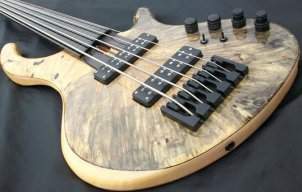
Prototype F4 short scale

you are, in essence, correct, but what do you think this will do to the sound? I don't understand what you are suggesting.

Back to this subject, I think what pilotjones is suggesting is that you're going to have 2 strings for which the pickups are in phase, and 2 for which it is out of phase.

I suppose you could probably just flip the 2 right hand poles on the stack as well. That should fix the phase, but I bet it will change the balance between EG, and AD strings. A standard P setup would do this as well, but probably doesn't as much, since they're spaced differently.

I'm just thinking out loud here. I could be way off base.

Incidentally, I have a P+J that's always sounded lousy any time I blend the pickups. I guess I should check the polarities.

-Nick
 
the polarity of the magnet is not what makes a string be sensed one way or another, the magnetic field itself it's what's important and a magnet wire coil around or close to it so that the magnetic field can be disturbed and a voltage induced into the coil (what gets amplified and we end up hearing).

You have to remember that each coil works, essentially, individually and the only thing that makes it work in humbucking mode is the way it's wired or the direction it's wound. Because the stacked and the P will be wired as separate pickups, and then wired up serially, it would be no different than the quad coil J that schaller sells (it's basically 4 split pickups on a single MM-like - 2 split Js - in a single cover). My expectation is that whatever problem you see in the magnetic direction and closeness of the magnets is just theoretical and won't translate to any practical difference in sound as if the coils were further apart (other than the different position of the string on which they sense, of course).

your suggestion about magnetizing the two bottom string magnet sets of the stacked to match the other coil of the split is good. I think I might just do that.
 
Well, aside from the debate over stacked humbuckers in general-

I'd expect the fields to set up the way I indicated in those illustrations. So, two strings would get a pair of narrow apertures, and the other two strings would get one wide aperture. This is not an issue in a conventional PJ setup, since the distance between the pups precludes their interfering with, or colluding with, each other.
 
Well, aside from the debate over stacked humbuckers in general-

I'd expect the fields to set up the way I indicated in those illustrations. So, two strings would get a pair of narrow apertures, and the other two strings would get one wide aperture. This is not an issue in a conventional PJ setup, since the distance between the pups precludes their interfering with, or colluding with, each other.

I get what you say, but what are your conclusions regarding the sound?
 
the polarity of the magnet is not what makes a string be sensed one way or another, the magnetic field itself it's what's important and a magnet wire coil around or close to it so that the magnetic field can be disturbed and a voltage induced into the coil (what gets amplified and we end up hearing).

You have to remember that each coil works, essentially, individually and the only thing that makes it work in humbucking mode is the way it's wired or the direction it's wound. Because the stacked and the P will be wired as separate pickups, and then wired up serially, it would be no different than the quad coil J that schaller sells (it's basically 4 split pickups on a single MM-like - 2 split Js - in a single cover). My expectation is that whatever problem you see in the magnetic direction and closeness of the magnets is just theoretical and won't translate to any practical difference in sound as if the coils were further apart (other than the different position of the string on which they sense, of course).

your suggestion about magnetizing the two bottom string magnet sets of the stacked to match the other coil of the split is good. I think I might just do that.

My uneducated hunch is that it'll sound fine as long as you invert the two poles on the J. You might get some variation, probably mostly in output level between the pairs of strings, but I think it won't be significant.

If you mixed a P with half inverted, and a straight J, you'd probably get either a thin somewhat tinny sound on the high strings if they're mismatched on the treble, or a weak bassless tone on the low strings, if they're the ones reversed.

A P with both facing same direction, and a single coil J in the opposite direction would probably give a more consistent sound, but you would likely get a lot more hum due to mismatch in the coils.

I've just started playing with pickups though, so I'm just basing this on logic, not so much on experience. I can't wait to see how it works out.

for my next bass I'm actually planning on winding a very low impedance active, putting it right near the bridge and equalizing the crap out of it. Just deciding how to deal with the hum right now. I'll probably be doing a shielded stacked humbucker, or a single with a dummy coil.

Not sure yet though.

-Nick
 
My uneducated hunch is that it'll sound fine as long as you invert the two poles on the J. You might get some variation, probably mostly in output level between the pairs of strings, but I think it won't be significant.

I disagree...I don't think that inverting the poles of the J is necessary, at all

If you mixed a P with half inverted, and a straight J, you'd probably get either a thin somewhat tinny sound on the high strings if they're mismatched on the treble, or a weak bassless tone on the low strings, if they're the ones reversed.

IMO...the WAY to wire this is to build a straight-up stacked J, and a straight up split P...these can then be combined (or not)...like I said, 4-wires and a 3-way switch for P/parallel/J is the way to go...

A P with both facing same direction, and a single coil J in the opposite direction would probably give a more consistent sound, but you would likely get a lot more hum due to mismatch in the coils.

A P with both facing the same direction is just fundimentally wrong. You're correct, you will get hum.

Humcancelling comes from reverse wind. But when you reverse wind, it is then necessary to apply the polarity correctly, else you'll get phase cancellation. Phase cancellation = puny sounding pickup
 
I get what you say, but what are your conclusions regarding the sound?
Well, based on other pickups, two coils sharing a field at close distance should sound similar to a humbucker (they'd probably even closer if you bridged the undersides with a steel plate), while if the two coils not sharing a field are .963 apart., they should sound similar to a MM. Closer, and you're in unknown territory, I think.
 
I don't know man, this all "looks" good in theory, but like I said, I don't think it really makes a significant difference in the sound. I mean, think about it, if magnets of the same polarity up interfere with each other, why do so many pickup design use 2 magnets (close together) per string, all with the same polarity up?
 
I think you guys should arm wrestle over it.


But seriously, Wilser. Extremely cool design you have there. The pickup configuration makes me think of what the Delano Hybrid would be if it was a PJ instead of a MMJ. Can't wait to see it finished.
 
I don't know man, this all "looks" good in theory, but like I said, I don't think it really makes a significant difference in the sound. I mean, think about it, if magnets of the same polarity up interfere with each other, why do so many pickup design use 2 magnets (close together) per string, all with the same polarity up?
Those are two magnets in the same coil. They act like one magnet with a bit missing in the middle. Different situation. Two magnets in two different coils that are going to be wired together reversed in phase should be very different.


Maybe I could bring in a ringer--my company had an arm wrestling champonship (I wasn't involved!), and the winner is pretty formidable. ;)
 
PilotJones, Wilser - this has got to be one of the most heady discussions about pickups (or just about any other topic) I've ever read! You guys are freakin' me out! LOL

I've been following this thread for a while, but last night when I started digging into this discussion I realized just how far over my head all of this is - but it's fascinating and I want to learn more!

I am going to read it over a few dozen times and see if I can't learn a little something about magnetic fields, pickups, polarity and how it all factors into the sound generated.
 
hey, this is not a fight, is a friendly inquiry on both our parts, right?

Maybe I should just do a split J in the middle and kill any possible problems. I'll wire it as it is when the moment comes and if it doesn't work right I'll just make another split J bobbin.

Thanks for your insight, Peter.

My bet is it will work just fine the way you have it.
 
hey, this is not a fight, is a friendly inquiry on both our parts, right?

Of course. I don't understand why everyone on the internet assumes that a discussion must be an argument. I

I disagree...I don't think that inverting the poles of the J is necessary, at all

IMO...the WAY to wire this is to build a straight-up stacked J, and a straight up split P...these can then be combined (or not)...like I said, 4-wires and a 3-way switch for P/parallel/J is the way to go...

A P with both facing the same direction is just fundimentally wrong. You're correct, you will get hum.

Humcancelling comes from reverse wind. But when you reverse wind, it is then necessary to apply the polarity correctly, else you'll get phase cancellation. Phase cancellation = puny sounding pickup

My point is that if you have a P with two seperate coils, the EA and DG pairs are out of phase with each other. Not a big deal.

But if you combine that with a standard J pickup, you're going to have EA in phase, and DG out of phase between the two pickups, or vice-versa.

The flipped magnets on the J is a total guess.. I don't know if, or how well it'll work.

I know my P+J sounds kind of crappy with both pickups on full, sort of weak in the bass. I think the bass strings are out of phase. The P has way more bass than the J, so it overpowers it, and doesn't sound completely out of phase wrong, but it definitely sounds much better with either pickup soloed than it does combined.

As far as the "You're correct, you will get hum." thing goes, You have to keep in mind that with a P with a north orientation, and a J with a south orientation, you would have a humbucking effect much as you would with a badly mismatched humbucker. The hum comes from the fact that the coils aren't identical.

Hum cancellation will definitely be better with a standard set up P, and a stacked-bucker J, but I don't think the phase thing should be ignored, unless you plan on soloing a pickup all the time.

winding a J sized pickup split like a P might be an interresting way to do it, or perhaps wiring a stacked humbucking P, with both sides the same polarity (assuming you still want the stagger) Otherwise, 2 J style, or standard humbuckers make more sense. Probably the reason why that's usually how it's done.

-Nick
 
hey, this is not a fight, is a friendly inquiry on both our parts, right?

Maybe I should just do a split J in the middle and kill any possible problems. I'll wire it as it is when the moment comes and if it doesn't work right I'll just make another split J bobbin.

Thanks for your insight, Peter.

A split J in the middle would be cool.
You could use a fender 5-way switch to get these combos below) .
(Or so I think. Wilser is aware of my GREAT WEALTH of PU wiring knowledg-i-ness;))
Active coils in RED;

-1-------2--------3--------4------5
EA--- --EA-- ----EA--- ---EA-----EA
EADG---EADG----EADG--- EADG---EADG
- -DG-----DG-- ----DG------DG------DG
 
A split J in the middle would be cool.
You could use a fender 5-way switch to get these combos below) .
(Or so I think. Wilser is aware of my GREAT WEALTH of PU wiring knowledg-i-ness;))
Active coils in RED;

-1-------2--------3--------4------5
EA--- --EA-- ----EA--- ---EA-----EA
EADG---EADG----EADG--- EADG---EADG
- -DG-----DG-- ----DG------DG------DG


NOOOOOOOOOOOOOOOOOOOOOOOO! *in a doppler effect kind of falling and fading voice*

The pickup will be wired as a single unit, no switching or mixing or anything. Just 2 wires coming out of it and into the preamp.

Maybe this is the perfect chance to build that "pickup test bass" I've been wanting to put together for such a long time.
 
A split J in the middle would be cool.
You could use a fender 5-way switch to get these combos below) .
(Or so I think. Wilser is aware of my GREAT WEALTH of PU wiring knowledg-i-ness;))
Active coils in RED;

-1-------2--------3--------4------5
EA--- --EA-- ----EA--- ---EA-----EA
EADG---EADG----EADG--- EADG---EADG
- -DG-----DG-- ----DG------DG------DG


cool..but

1 & 5 will sound extremely similar and they will both sound much like 2...

hence, we're back down to 2,3, & 4 :)