This gets two middle fingers from meIt's way easier than that. Like on guitar, I'll just continue to avoid anything associated with Gibson like it's the plague.

TalkBass has been independent since 1998. Add your voice.
Create a free account to reply to discussions, view embedded media, and browse with fewer display ads.
Join free Log in
Want zero display ads or expanded classifieds tools? Compare plans.
This gets two middle fingers from meIt's way easier than that. Like on guitar, I'll just continue to avoid anything associated with Gibson like it's the plague.

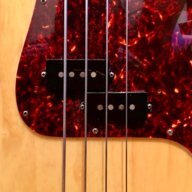
 Not the best bass to be judging string clarity, but there has been nothing which sounds odd. Perhaps it's just because all four strings have silk over the saddles, so there is no inconsistency?
I would say it's a poorly designed bridge.
The silk is usually wound around where the string core is twisted back on itself to hold the ball end captive. If this twisted portion is resting on the saddle, silk or no silk, it's not good for intonation, how the string vibrates, and the general playability of the instrument.
If it was my bass, I'd be getting rid of that bridge.
Also the horror stories about these being gradually pulled out of the body if the bridge isn't angled backwards... scary stuff.


All my Fender and Squier basses have silk over the saddles. I don't see or hear any problem.

Perhaps my wording wasn't clear enough; it's not the silk wrapping that is the problem, but what it is covering up. The problem lays where the string core is twisted back upon itself and then wound with the wire used for the outer winding that causes the issues I spoke of. This is the portion of the string that you do not want resting on the saddle, and should strictly be only in the string after-length well behind the respective saddle.I’ve got basses with that bridge. I’ve occasionally let silk wrap rest on the saddles and found it didn’t affect the intonation, note clarity or sustain, or the playability at all.
Perhaps my wording wasn't clear enough; it's not the silk wrapping that is the problem, but what it is covering up. The problem lays where the string core is twisted back upon itself and then wound with the wire used for the outer winding that causes the issues I spoke of. This is the portion of the string that you do not want resting on the saddle, and should strictly be only in the string after-length well behind the respective saddle.
Perhaps my wording wasn't clear enough; it's not the silk wrapping that is the problem, but what it is covering up. The problem lays where the string core is twisted back upon itself and then wound with the wire used for the outer winding that causes the issues I spoke of. This is the portion of the string that you do not want resting on the saddle, and should strictly be only in the string after-length well behind the respective saddle.


Yes that’s what I was saying. It’s an easy solution.Excellent suggestion @Engle, but just cut the ball ends off some old string set.
It's exactly what your picture shows on the E string.

It’s a known thing on basses with these bridges. There’s a spacer thing you can buy that’ll hold the ball ends farther away so the silks clear the saddles. I think it’s called a mod bar. You could use little bolts to accomplish the same thing. But as is it’s not really a problem.
Yes, unfortunately, this is the way Gibson-style bass bridges have been since the beginning. The best fix is an aftermarket bar that you run the strings through and tension holds it to the back of the bridge, extending the ball away from the bridge so only the speaking length, and not the silk, goes over the bridge saddle.Saw this today.