• TalkBass has been independent since 1998. Add your voice.
    Create a free account to reply to discussions, view embedded media, and browse with fewer display ads.
    Join freeLog in
    Want zero display ads or expanded classifieds tools? Compare plans.

Question about tube amps

Just have a backup. A backup head. Solid state. Then get tubes as needed for the SVT.

Or another SVT.
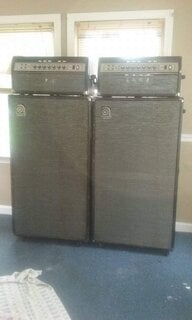
20200116_191334.jpg
 
Man, some of you guys have good luck. When I was touring, even with a custom fit foam lined hard case, I would often have at least one tube bite the dust annually or semi annually. And this is on a series of SVT's from different eras and a new-ish Orange.
A lot of it is temperature I suspect. Burning hot all night, goes into the case hot as hell, then out to the cold trailer for a bouncy drive for 2 to 14 hours.
 
  • Like
Reactions: Voyevoda
Man, some of you guys have good luck. When I was touring, even with a custom fit foam lined hard case, I would often have at least one tube bite the dust annually or semi annually. And this is on a series of SVT's from different eras and a new-ish Orange.
A lot of it is temperature I suspect. Burning hot all night, goes into the case hot as hell, then out to the cold trailer for a bouncy drive for 2 to 14 hours.

I like to let my tube amps cool off before I move them. I usually clean up my bass and pack everything I can before I move the amp. Then I try to gently set the head down on the floor, so the tubes can continue cooling while I load the rest of my gear.

For touring duty, I think it's real good idea to have some sort of back up. I have a bunch of tubes amps, but always toured with solid state or hybrids. I worked professionally for about 25 years and had two amps go down on the road. Finished up both tours on DI and monitors.

The last time I gigged with an all tube rig was probably 1985. It was an MTI era SVT biamped with a blackface Fender Twin loaded with JBL E120s covering 200hz up. That was one heavy rig.
 
  • Like
Reactions: BassikBrad
Burning hot all night, goes into the case hot as hell, then out to the cold trailer for a bouncy drive for 2 to 14 hours.

Hours wise, aren't tubes designed to last for 10k hours, or longer under recommended voltage and current? And I think I read some manufacturers designed for 100k hrs, so even the premature failures were getting thousands of hours of life before failure? But, If the circuit is malfunctioning, you might be reducing tube life. If the circuit is designed or adjusted to run tubes harder/hotter, you might be reducing life. If the tubes are experiencing a lot of vibration, hot, cold, even unpowered, you may be reducing life, etc.

If you run your tubes hard, touring and hitting them 20 hrs a week, you might need tubes every year, or 1000 hrs of usage. I've heard back in the day, active professionals had their gear reconditioned with new tubes annually as a routine to avoid a breakdown during a performance or studio work. I think the 10/20 years suggested is pretty reliable for most the rest of us folks.

I've got 1960's pre-amp tubes in my main guitar amp, with modern [Mesa labelled] power tubes. Its quiet, biased pretty hot, no degradation over 5 years of usage. I've got other amps with assortments of older US tubes, and I have amps with brand new tube sets. I have a tech fully adjust every amp when I acquire it, and he's pretty picky about tubes, new or older. I let him decide if a tube, resistor, or other component needs to be replaced, and interestingly, he selects tubes based on measured values. He has saved me a lot of money, where I was wasting money on tube rolling.
 
There are some amps that seem unusually hard on power amp valves, though fortunately for us those are mostly in the guitar world. Certainly when I've had bandmates using Fender Blues Juniors, those might only go a couple of years even with light use. I guess it's the non-adjustable fixed bias that runs them hotter than necessary.
 
One problem with buying a bunch of tubes for spares is they typically have a pretty short warranty period. So you buy a spare matched sextet of 6550s for your SVT and don't use them for three years. Then when you do use the tubes, you experience a failure. By this time the warranty is long gone, and you're probably going to be upset because you feel like the vendor sold you a bad tube. Unfortunately you need to buy from them again if you want a matched set.

I have a fairly large collection of small signal tubes. I bought most of the popular current production tubes to explore tube rolling. I had good results and then wound up buying some of the more coveted vintage tubes. I am sure I will get burned on some of them...but it's single tubes, and most of them were not very expensive.

When you buy output tubes you typically buy a set. For example you need six 6550s for an SVT, so you are probably going to be spending around $300 for a matched set. I buy output tubes as they are needed, so I can take advantage of the warranty. In my experience output tubes are most likely to fail when they are new.
I went through this.. Bought a sextet for my SVT's and sure enough a couple of years passed,a 6550 failed. Went to replace and had a bad tube..Warranty was way over.. Lesson learned.. Just keep a spare handy for an emergency or have a backup amp to get through till you can fix the issue..
 
  • Like
Reactions: Wasnex
Does the amp eventually start to sound bad?

Does yours sound bad, does it lack something it had when it was new?
Take it to a tech. The tech isn't going to know your reference point, but they'll take a listen.
A Tech would do is service it by making sure everything tight like ground lucks and jacks, ...
Then the Tech would check the tubes. If a bad one is found they'll replace it so they can test the rest of the circuit.

Yeah - great anecdotal stories of how long tubes last, but warranty on them, and the FAQs that manufacturers put out say different. The manufacturers want you to enjoy that head at it's best performance. Follow their guidance. If it's an Ampeg read their manual. Or look at other manufacturer's FAQs

Invalid Link Removed

Tube Life Span

The lifespan of a tube can be a bit tough to predict but the following may provide a bit of a guideline. If you play at moderate levels, 10-15 hours a week...

  • Preamp Tubes are generally at their best 2 - 3 years.
  • Power Tubes are generally at their best 1 - 1.5 years.
  • Rectifier Tubes are generally at their best 3 - 5+ years.
 
One problem with buying a bunch of tubes for spares is they typically have a pretty short warranty period. So you buy a spare matched sextet of 6550s for your SVT and don't use them for three years. Then when you do use the tubes, you experience a failure. By this time the warranty is long gone, and you're probably going to be upset because you feel like the vendor sold you a bad tube. Unfortunately you need to buy from them again if you want a matched set.

I haven't had to buy any tubes in a long time, but the chances of having a good quality tube fail that way are extremely remote. The warranty would be the least of my worries. IME tubes tend to advertise their problems before they go out, so you'd have warning.

But if I were gigging a lot, I'd rather pick up a used lightweight Class D amp for backup and tuck it in the car instead of buying a bunch of backup tubes I'll probably never use.

And unless you carry the tubes to every gig, why do you need them "right now"? I'd rather carry a backup (which I should anyway) and deal with a tube replacement when it is needed. But as noted in some posts above, if you play for 10-20 hours every week and play 40-50 weeks a year, you might want to work out a tube replacement schedule and keep a set of the old tubes as backups. Changing them annually still sounds unnecessary if you have backups.
 
Last edited:
I haven't had to buy any tubes in a long time, but the chances of having a good quality tube fail that way are extremely remote. The warranty would be the least of my worries. IME tubes tend to advertise their problems before they go out, so you'd have warning.

But if I were gigging a lot, I'd rather pick up a used lightweight Class D amp for backup and tuck it in the car instead of buying a bunch of backup tubes I'll probably never use.

And unless you carry the tubes to every gig, why do you need them "right now"? I'd rather carry a backup (which I should anyway) and deal with a tube replacement when it is needed. But as noted in some posts above, if you play for 10-20 hours every week and play 40-50 weeks a year, you might want to work out a tube replacement schedule and keep a set of the old tubes as backups. Changing them annually still sounds unnecessary if you have backups.

I think carrying a micro class D amp is a great idea. I never toured with a backup as we always had a full PA. When my amp went down I relied on the DI and monitors to get through. For local gigs, my amp often carries the room. Luckily I have never had a failure as I don't carry a spare.

I believe tubes are most likely to fail when they are new, so IMHO it doesn't make sense to buy a matched set of power tubes that will not be used until after the warranty expires. Output tubes can fail without warning. They may simply stop conducting or they may arc over and pull a fuse. Sometimes the put on a light show when they fail, and cause the amp to make a loud noise like a cannon shot.

I initially bought a small collection of small signal tubes for tube rolling experiments. I decided to buy in some quantity as I have several amps, and some of them run a bunch of tubes. For example my Trace Elliot V8 runs seven 12AX7s. After a few experiments I bought larger quantities of my favorite tubes. In bass amps I found I really liked the combination of a current production Mullard ECC83 in V1 and JJ ECC803S pretty much every where else. So I have a few Mullards and quite a few JJs in a box. I bought many of the other tubes in pairs, and some of them may never get used.

My V8 wound up with 1 Mullard ECC83, 1 Genalex ECC83 (Sino), 4 JJ ECC803S, 1 Tung Sol 12AX7, The Genalex is in the OD circuit and I used the Tung Sol because I didn't want to use my last JJ. I used it in a compressor circuit and I could barely tell the difference between the Tung Sol and JJ in that position.

Later I decided to build up a collection of vintage tubes. My perception is almost all of the true NOS supplies have been exhausted, so prices are going up and quality is going down. So basically I accepted some risk and bought a bunch of tubes. I haven't done any tube rolling with the vintage tubes yet, but I am sure some of them will turn out to be junk.
 
  • Like
Reactions: BassikBrad
I believe tubes are most likely to fail when they are new, so IMHO it doesn't make sense to buy a matched set of power tubes that will not be used until after the warranty expires. Output tubes can fail without warning. They may simply stop conducting or they may arc over and pull a fuse. Sometimes the put on a light show when they fail, and cause the amp to make a loud noise like a cannon shot.

I had one catch fire on stage, but that was a failure in the output transformer, I think. One of the transformers, anyway.
 
  • Like
Reactions: Wasnex
Somewhere along the line I formed an impression that tubes are less likely to fail during a gig if the amp is left on vs. cycled on/off during breaks, etc. So, if it fires up at start of gig you're likely in good shape ... perhaps others with more technical knowlege can confirm/deny.

And in this day and age with Class Ds like TE Elf, et. al. it seems a backup amp could be less girth and weight than a couple tubes :roflmao:
 
Somewhere along the line I formed an impression that tubes are less likely to fail during a gig if the amp is left on vs. cycled on/off during breaks, etc. So, if it fires up at start of gig you're likely in good shape ... perhaps others with more technical knowlege can confirm/deny.

And in this day and age with Class Ds like TE Elf, et. al. it seems a backup amp could be less girth and weight than a couple tubes :roflmao:
Yes, short term power cycling of a tube amp can shorten component life. So can accumulated hours. IME, generally the crossover point between the two modes is between 1/2 and 1 hour.

Carrying a backup amp is the way to go imo, nothing worse than changing tubes in an emergency and then discovering that there's something else wrong pretty much sucks.
 
  • Like
Reactions: BassikBrad
How often do you need to replace all the tubes? Does the amp eventually start to sound bad? Should I get a backup set?


I have a 1978 Ampeg B-15S with the original power tubes in it and have a 67 Fender Bassman that had the original power tubes in it when I first got it, one of them was microphonic though so I had to put a couple of other 6L6's I had lying around.