• TalkBass has been independent since 1998. Add your voice.
    Create a free account to reply to discussions, view embedded media, and browse with fewer display ads.
    Join freeLog in
    Want zero display ads or expanded classifieds tools? Compare plans.

question(s) about 'rolling' one edge of a maple fingerboard: need advice!

JRA

my words = opinion
Gold Supporting Member
In Memoriam
Oct 28, 2013
30,704
80,602
76
Indianapolis and Cincinnati
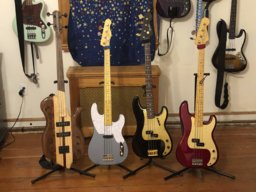
so i have this one maple board (my first maple!) and it's delightful in every way but one: the sharp edge of the fingerboard below the G string has bothered me since i put this (parts) thing together. it's not 'killer' distracting but because it's a slightly wider board than my two-octave axes it's always 'there' to be noticed while playing.

i've rolled the same edges on rosewood boards, and it was easy just to file/sand and oil = good to go!

but the maple has been coated, of course (poly?), and after filing and sanding, i'll want to re-coat that edge again, right?

what's the best, easy way (for dummies) to roll a sharp-edged maple board and then protect it after the work? i assume: file, sand, and then some wipe-on or brush-on poly. but i want to be sure!

front2.jpg

thanks for any advice/thoughts about rolling the edge of this maple fingerboard. :thumbsup:
 
Jon Clegg , thanks for responding. but: i've done the same/similar on the dark 'unfinished' boards and thought it was an easy job. this board is maple with a poly coating (i assume) and so i'll want that rolled edge to be protected against dirt/grime/oil from my playing hand...if possible. i was hoping that it's an easy thing to do, but i thought i'd check with the experts before i made a move! ;)
 
Not quite. You'll need to high grit sand a little to get that polished smooth feel.
yeah, i could have been more clear: i've rolled edges before. i've filed and/or sanded the rough shape and then sanded with higher grits to smooth. S.O.P. it was easy and quick. but i finished off the rosewood boards with nothing but oil and it worked fine for that darker wood.

maybe i really ought to know about the finishing aspect: i'm assuming it's a process of wipe-on poly --- a few coats and done.

right?
 
  • Like
Reactions: EatS1stBassist
maybe i really ought to know about the finishing aspect: i'm assuming it's a process of wipe-on poly --- a few coats and done.

right?

Probably right.

It's hard to give real specific advice without knowing more about your bass. Also, it will depend on how well you want the modified edge to blend in. Most poly will have a natural tint to it - it will be hard to get a totally invisible repair when just refinishing a narrow stripe like that. There's also the matter of matching the sheen (gloss is easier, usually. It's really hard to match a matte or satin finish). And you may still end up with witness lines where the two finishes meet even if all else goes well.

The most thorough thing to do would be to strip the whole fretboard and refinish it. Of course, you can always just touch up that area and see if you like it - and if not, refinish the whole thing...
 
  • Like
Reactions: JRA
I do know you want to be certain of the type of finish.

If it is lacquer the solvents in the new coat will dissolve and blend with the old coat.

Polyurethane won't stick to a smooth surface well. On furniture, I tend to sand the entire surface to rough it. I think you would have to sand the entire neck, I don't think you you can just spot repair it. Fortunately, it is fretless.
 
  • Like
Reactions: JRA
@JRA I'm another vote for poly - I'd recommend Minwax Wipe-on, in the Satin variety. It won't make a seamless join, but it will wipe down as you apply it, only sticking to the exposed wood edge. If you apply it a bit damp, and then wipe it right off, you should end up with the poly on the wood edge and minimal on other areas of the neck. Were it me, I'd probably do two coats and call it done. :thumbsup:
 
@JRA I'm another vote for poly - I'd recommend Minwax Wipe-on, in the Satin variety. It won't make a seamless join, but it will wipe down as you apply it, only sticking to the exposed wood edge. If you apply it a bit damp, and then wipe it right off, you should end up with the poly on the wood edge and minimal on other areas of the neck. Were it me, I'd probably do two coats and call it done. :thumbsup:
Beej --- that's what i was looking for (and hoping!). sounds good. thanks so much! :thumbsup:
 
  • Like
Reactions: Spidey2112 and Beej
Stew mac has a poly pen for touch ups. I have used it to blend tuner machine hole Ive filled after changing tuners.
That would probably work great for your purposes.
i'll check that out. you're right: it would be a very narrow, long strip: 1/8" to 3/16" wide from the nut to the end of the board at the neck pocket or thereabouts. thanks for the tip! :thumbsup:
 
One note about poly finishes: They dry relatively fast (you can pick them up and move them in a day or two easily), but....the cure time (to reach final hardness) is much longer (can be weeks). When you play on a poly coated fingerboard, depending on how hard you pull the strings down.....you probably want to wait until the poly is well cured to do that. On of the things you can use as a guide to whether poly is cured or not is smell - leave the thing in the open air, and come by and sniff it every once in a while*. When it doesn't smell, it's cured.

*When nobody is looking, of course.
 
One of the modern French polishes (essentially shellac, such as Behlen's Qualasole or one of the Mohawk products, and it's sad that Star Chemical is no longer) can work well for this application. It plays well with other finishes. Reclaimed diapers or flannel make good applicators. Many versions of technique are on the web. Feel free to PM me if you have any questions.
 
  • Like
Reactions: JRA
so i have this one maple board (my first maple!) and it's delightful in every way but one: the sharp edge of the fingerboard below the G string has bothered me since i put this (parts) thing together. it's not 'killer' distracting but because it's a slightly wider board than my two-octave axes it's always 'there' to be noticed while playing.

i've rolled the same edges on rosewood boards, and it was easy just to file/sand and oil = good to go!

but the maple has been coated, of course (poly?), and after filing and sanding, i'll want to re-coat that edge again, right?

what's the best, easy way (for dummies) to roll a sharp-edged maple board and then protect it after the work? i assume: file, sand, and then some wipe-on or brush-on poly. but i want to be sure!

View attachment 3738023

thanks for any advice/thoughts about rolling the edge of this maple fingerboard. :thumbsup:
Just a quick sand will take care of that edge for you.
 
  • Like
Reactions: JRA
thanks, all, for the tips on this. i've never been shy about 'working' the rosewoods or any of the darker woods. but since this maple board is my first, i though i'd better consult before i went at it!

a short opinion on how you like the Dimarzio Split P
i like it a lot. it's got plenty of 'punch'. i'm usee to my PJs with which i do a lot of blending. but for a single pickup with only a tone knob = i'm getting a lot to work with. i think the pickup makes it a fun ax to play.
 
  • Like
Reactions: bench
yeah, i could have been more clear: i've rolled edges before. i've filed and/or sanded the rough shape and then sanded with higher grits to smooth. S.O.P. it was easy and quick. but i finished off the rosewood boards with nothing but oil and it worked fine for that darker wood.

maybe i really ought to know about the finishing aspect: i'm assuming it's a process of wipe-on poly --- a few coats and done.

right?

yes but the problem will be blending the old Old finish With the new finish. I think you'll have to, at a minimum lightly sand the rest of the board and finish the whole board. Other wise you may get a visible line where the new Poly is
 
  • Like
Reactions: JRA