Hello Fellows,
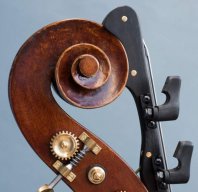
I'm about ready to reassemble this old Bohemian bass. Unfortunately the top and the back are both off. The form has been pretty well maintained.
What are the best practices for gluing up the top and back?
Which one first? I thought the top might first.
I also thought that clamping it up dry, getting it into proper postion, and then pinning it with small dowel might help.
My thought was that I would use straight edges to line of the neck, and also to make sure the angle of the neck is where it needs to be. The new finger board isn't on yet, but I can easily spot glue it temporarily. If I'm not mistaken, the measurement I'm after is around 150mm from the intersection of the top of the bridge along the plane of the fingerboard. Does this sound right?
This bass is like the other broken down Bohemian flat-back that come through here. $150.00 and a lot of sweat equity. So far it seems promising, but it certainly might sound lousy when it's done.
Thanks for any advice you can share.
I'm about ready to reassemble this old Bohemian bass. Unfortunately the top and the back are both off. The form has been pretty well maintained.
What are the best practices for gluing up the top and back?
Which one first? I thought the top might first.
I also thought that clamping it up dry, getting it into proper postion, and then pinning it with small dowel might help.
My thought was that I would use straight edges to line of the neck, and also to make sure the angle of the neck is where it needs to be. The new finger board isn't on yet, but I can easily spot glue it temporarily. If I'm not mistaken, the measurement I'm after is around 150mm from the intersection of the top of the bridge along the plane of the fingerboard. Does this sound right?
This bass is like the other broken down Bohemian flat-back that come through here. $150.00 and a lot of sweat equity. So far it seems promising, but it certainly might sound lousy when it's done.
Thanks for any advice you can share.