
+3Something SS most likely. GK would be a good choice. BTW I'm in Poland and absolutely love your country.

Enjoy the benefits of a premium membership!
Upgrade Account
-
TalkBass has been independent since 1998. Add your voice.
Create a free account to reply to discussions, view embedded media, and browse with fewer display ads.
Join free Log in
Want zero display ads or expanded classifieds tools? Compare plans.
You are using an out of date browser. It may not display this or other websites correctly.
You should upgrade or use an alternative browser.
You should upgrade or use an alternative browser.
Recomend me powerfull and fast amp
- Thread starter Bunyo
- Start date
More options
Who Replied?
It was odd to me, but recording engeener cut almost all bass when I recorded, and told me that too much bass will result in serious recording problems. He was settin my eq for almost two hours and can't find good eq set to him. Finally he set something which to me wasn't sounding like bass guitar and told that now it will sit in mix quite good.There isn't any bass or low mid in the recording


- May 9, 2008
- 4,081
- 1,236
- Disclosures
- Proprietor Springvale Studios
The trick with your style is dual band compression Trace elliot used to make a half decent dual band compressor pedal but in the studio I might use a Vintage gates varimu compressor on the bass end and a snappyIt was odd to me, but recording engeener cut almost all bass when I recorded, and told me that too much bass will result in serious recording problems. He was settin my eq for almost two hours and can't find good eq set to him. Finally he set something which to me wasn't sounding like bass guitar and told that now it will sit in mix quite good.
one on the hf like a smart c2, I would create a clone track and arrange the inserts with waves Q1 software hi and lo pass filters.
There is no kick drum in the mix or anything that carries solid low frequency either.
Re-mastering your mixes with a Manley Slam would do wonders for that tonality if you cant get a remix.

What's the diference between normal and dual band compressor? Doesn't tube amps have natural compression?

BurningSkies
CRAZY BALDHEAD
- Feb 20, 2005
- 27,956
- 20,348
- Disclosures
- Endorsing artist: Dingwall Guitars
Am I wrong in thinking that its not an engineer's job to completely re-work the sound of the band? That in doing so, he's in fact 're-written' your music and over-ridden any intent behind your sound?
Every time I've been in the studio, the engineer has done their best to present 'our sound' in a way that records well but retains fidelity to the original concept and sound the band wants. Yes, that may mean tweaks, adjustments, etc. but shouldn't mean changing EVERYTHING about what your instrument is producing.
I listened to the recording too, and while the bass certainly 'cuts', but it isn't sitting where I would think you'd want the bass sitting. It's competing with guitar range.
Every time I've been in the studio, the engineer has done their best to present 'our sound' in a way that records well but retains fidelity to the original concept and sound the band wants. Yes, that may mean tweaks, adjustments, etc. but shouldn't mean changing EVERYTHING about what your instrument is producing.
I listened to the recording too, and while the bass certainly 'cuts', but it isn't sitting where I would think you'd want the bass sitting. It's competing with guitar range.
- May 9, 2008
- 4,081
- 1,236
- Disclosures
- Proprietor Springvale Studios
Well the dual band compresses the bass in one channel and the upper mid and top in the other then you can mix them back together.What's the diference between normal and dual band compressor? Doesn't tube amps have natural compression?
A tube amp is good for about 6db of compression including the speakers
at cleanish high output.
But what volume was the amp set at?.
Power soaking a 400 watt tube monster head is easier with a sound dump room. So set the output to 4 ohms.
In my case an 8 ohm 8 x 10 Eden XLT in parallel with another specialized smaller cab in another sound proof room, in my case an old fender 4 X 10 with no tweeter and all drivers wired in series for 32 ohms then wire that in parallel with something like in my case a Sequis motherload but maybe try an Avalon U5 wired across a couple of the drivers in the 4 X 10 to get a direct signal out of your output transformer along with all the lovely back EMF, then use a little labs phase tool to put a Neumann U87 in front of the 4 X 10 in perfect phase with the direct line. Hope this makes some sense.
This studio does a bit of re-amp work so we have to have all the tools and systems to hand.

- Jun 25, 2007
- 4,531
- 135
- 63
- Disclosures
- Artist:TC Electronic RH450 bass system (original test-pilot)
TC Electronic RH450!
Built-in 3-band compressor. Fantastic EQ section.
tubetone circuit..
Don't let the size fool you ...This amp is loud!
Built-in 3-band compressor. Fantastic EQ section.
tubetone circuit..
Don't let the size fool you ...This amp is loud!
It was odd to me, but recording engeener cut almost all bass when I recorded, and told me that too much bass will result in serious recording problems. He was settin my eq for almost two hours and can't find good eq set to him. Finally he set something which to me wasn't sounding like bass guitar and told that now it will sit in mix quite good.
I noticed what Bassmec said also, I thought how come there isn't more bass standing out with a three piece combo.
Sit in the mix? More like buried in the mix. RE did you no favors for sure.
It's too bad you are not in the states, I'd let you try one of my AMPEG SVT-4PRO's and would even consider a trade between VBA400 and one. But you are just too far away.
BOB
Now I know. My question should be: "recommend me fast and powerfull bass guitar". I've recently changed my Fender Jazz Bass for MM Stingray 4 with Piezo and I'm very satisfied with my ound now. My amp is very powerful and fast with this guitar. Music Man in one word is amazing, rock soild bass with lots of lows and midlows and nothing muddy or something like that. I think that I will stay with my Marshall VBA400, Stingray is the answer. I think that this Stingray have some natural compresion, I wonder if this is the same with all active systems.
Thanks for everyone.
Thanks for everyone.
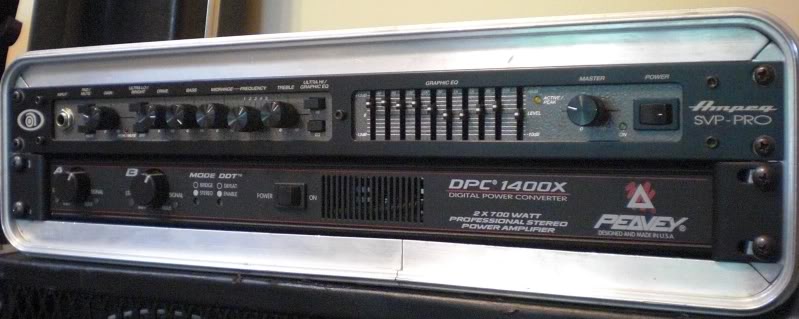
Loud, clean (dirty if you want) Loud, Light @ 34 Lbs, built in EQ and Did I say LOUD @ 1400 watts.
Now I know. My question should be: "recommend me fast and powerfull bass guitar". I've recently changed my Fender Jazz Bass for MM Stingray 4 with Piezo and I'm very satisfied with my ound now. My amp is very powerful and fast with this guitar. Music Man in one word is amazing, rock soild bass with lots of lows and midlows and nothing muddy or something like that. I think that I will stay with my Marshall VBA400, Stingray is the answer. I think that this Stingray have some natural compresion, I wonder if this is the same with all active systems.
Thanks for everyone.
There is usually no compression in the BASS itself, but you have the ability to hit the preamp harder with the bass getting a little overdrive or natural tube compression in the first preamp tube.
My Ameican Deluxe Jazz however seems to have the same output as a passive Jazz and I don't seem to get this same effect.
If you had used a AD Jazz previously with its graphic EQ instead of tone controls etc, you might have lost some of what you are determining as MUD.
I think bassists define MUD differently and it is subjective. Generally mud to me is what happens when you take soil and mix it with water...
BOB
- May 9, 2008
- 4,081
- 1,236
- Disclosures
- Proprietor Springvale Studios
A coil of wire round a magnet excited by a magnetic object passing in close proximity will exhibit coil saturation with enough turns in the coil.There is usually no compression in the BASS itself, but you have the ability to hit the preamp harder with the bass getting a little overdrive or natural tube compression in the first preamp tube.
My Ameican Deluxe Jazz however seems to have the same output as a passive Jazz and I don't seem to get this same effect.
If you had used a AD Jazz previously with its graphic EQ instead of tone controls etc, you might have lost some of what you are determining as MUD.
I think bassists define MUD differently and it is subjective. Generally mud to me is what happens when you take soil and mix it with water...
BOB
What's the betting that popular pickups have quite a few turns and have some saturation.


Define "fast". All amplifiers work at the speed of electricity. If you mean something that sounds "immediate" or something with a lot of clarity that will come from your speakers or your pickup as much as if not more than the amp.
you are right, in my opinion the fast or not so fast bass sound is more a thing of the speakers - normally 10s reacts faster (or more precise and direct) than 15s for example - so for funky styles i prefer 10s and for rock i like 12s with the same amp and of course good pickups are never wrong

Actually, amps can act "faster" than other amps. The measurement is called slew rate. Slew rate is usually expressed in units of V/µs and in general give you the "speed" the amp can react.
The faster the amp the more "transparent" they are in an audio circuit.
But never mind that now...
The faster the amp the more "transparent" they are in an audio circuit.
But never mind that now...

you are right, in my opinion the fast or not so fast bass sound is more a thing of the speakers - normally 10s reacts faster (or more precise and direct) than 15s for example - so for funky styles i prefer 10s and for rock i like 12s with the same amp and of course good pickups are never wrong
Reaction time doesn't depend on driver diameter.

- Feb 12, 2006
- 60,963
- 5
- 220,655
- Disclosures
- Development Engineer-Mesa Boogie, Development Engineer-Genzler (pedals), Product Support-Genz Benz
Slew rate on all modern amps are at least 10x faster than the fastest bass signals even at high power.
Say 20 volts/uSec (typical) means that the amp's "effective" bandwidth at 20 volts of output swing is on the order of 500kHz (note the overly simplified calculation), so at 40 volts output it's 250kHz and for 80 volts output it's 125kHz.
The top freqency of the highest practical harmonic on a bass is 10kHz on a good day.
Say 20 volts/uSec (typical) means that the amp's "effective" bandwidth at 20 volts of output swing is on the order of 500kHz (note the overly simplified calculation), so at 40 volts output it's 250kHz and for 80 volts output it's 125kHz.
The top freqency of the highest practical harmonic on a bass is 10kHz on a good day.
I think bassists define MUD differently and it is subjective. Generally mud to me is what happens when you take soil and mix it with water...
BOB
To me this metaphoriacal expression: "muddy sound" means lack of selectivity, lack of sharpness. With my playing it was usually experienced on low frequencies, when low notes was playing on low position.I play on Marshall VBC412 cabinet, and I think that pickups such as Antiquity II was not the best for my style of playing, because it was little muddy as I said, when I wanted to boos low frequencies. I know that jazz bass sound excellent on bright settings, like Marcus Miller slap style but I was looking for powerfull low but cutting or sharp sound. Original pickups on my 2005 Jazz Bass was'nt so powerfull and Antiquity II I think was too muddy, maybe its from their demagnetization. Don't get me wrong it wasn't bad sound but I knew that there must be something better for me. Firstly I was blaming my amp, because I heard that they can slow down or get muddy, but its no the case. Now I exchanged my jbass for Music Man Stingray with Piezo and this is the sound what I was looking for. It is very powerfull bass guitar with strong punch but with lots of clear and sharp low frequencies. My amp and cab greatly corresponds with this bass. Thats all.


