

Enjoy the benefits of a premium membership!
Upgrade Account
-
TalkBass has been independent since 1998. Add your voice.
Create a free account to reply to discussions, view embedded media, and browse with fewer display ads.
Join free Log in
Want zero display ads or expanded classifieds tools? Compare plans.
You are using an out of date browser. It may not display this or other websites correctly.
You should upgrade or use an alternative browser.
You should upgrade or use an alternative browser.
Recording with an SVT
- Thread starter DD Gunz
- Start date
More options
Who Replied?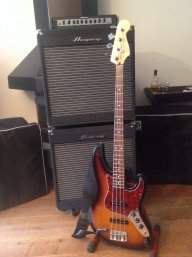
Allright, after all this, I am gassing for an EV RE20!
(and already saving - almost there - for a Ampeg V4B)
Where will it all end??
My poor, poor wallet...
(and already saving - almost there - for a Ampeg V4B)
Where will it all end??
My poor, poor wallet...


Allright, after all this, I am gassing for an EV RE20!
(and already saving - almost there - for a Ampeg V4B)
Where will it all end??
My poor, poor wallet...
Grab a Heil PR-40, basically a clone of the RE20 but about 75% of the new price.

Good idea, if I had one. Right now I am short on cabs so I went with the 810 as I think it sounds better (for me) than my other cabs.SVT for recording, I'd rather use a 2x10 than a fridge.
The rough mix came out huge though with two signals. This is a fairly aggressive rock project though.
Not available in Europe, as far as I know.
They list a bunch of Invalid Link Removedon their website, one of them may carry it.

Kinda yes, kinda noGrab a Heil PR-40, basically a clone of the RE20 but about 75% of the new price.
 The Heil has a crazy proximity effect that the RE20 doesn't, and if you mic it too closely it gets crazy woofy. But if you back off the grill a couple inches, then it sounds more like an RE20.
Well, they actually are available for 439 Euro (the RE20 being 459 Euro), but not a lot of euros between them.
I won't risk proximity effects like JimmyM mentioned and go for top notch straight away.
(my apologies for unintentionally hijacking the thread)
I won't risk proximity effects like JimmyM mentioned and go for top notch straight away.
(my apologies for unintentionally hijacking the thread)

How are you guys doing this? I put the cab (810) in the booth and ran a long speaker cable to the head which was placed well away from the cab (fan noise). My results were stellar, but I am interested to hear how others are doing it.
What are you using for a mic? Where is it placed? I have another two sessions available and want to get the absolute best results I can. Tell me about your expieriences
Used this similar method recently. (to a HLF410, however) Also ran a direct out. Had some phase/timing issues that were correct post production gave a nice blend between the two.

I always found a SVT kind of a overkill for recording. Yes, it sounds great.
But you have to crank it, to get that grind.
My fav. recording mic is an old Electro-voice 666. Found it in a friends studio. years ago.
Like it so much he sold me one. he had two. Works nice on upright too.
But you have to crank it, to get that grind.
My fav. recording mic is an old Electro-voice 666. Found it in a friends studio. years ago.
Like it so much he sold me one. he had two. Works nice on upright too.

the sound engineer record my bass through a markbass head and cab and shure sm57, not the best sound and mix as we record the whole band at once but hope it helps. I am using a fender japan p bass

Every engineer will have their favorite way of getting what they consider to be a "good" bass guitar sound. We can only hope that it is the same as ours. Many of the mics designed for kick drum have a really scooped response and don't do all that well at reproducing your sound. The best mic I've used for bass is a CAD e100. (older ones made in the USA) What you hear in the booth is what you will get on the track.
For any folks new to the DI/Mic blend setup, watch the phase, especially if you like any distance between speaker and mic to get a bit of depth in the sound...on most Daw's you can zoom way in and move things so they match up, or do any type of incremental phase flip trickery.
coz it will reflect the sound around and around in that small space, won't it?Ya, most engineers will take both.
Why not?
Maybe. If it does, move it. If not, play ball.coz it will reflect the sound around and around in that small space, won't it?
Just in the off chance there is a poor soul on here who is trying to achieve the sound I got I will post a clip when I get one. I am very pleased with the results, but I was going for a mid driven cranked SVT tone for this session. I got what I was after and then some.
coz it will reflect the sound around and around in that small space, won't it?
High frequency sounds "reflect" like light hitting a mirror, low frequency sounds pile in specific regions, creating nodes of increased or decreased sound. Which frequencies the room responds to depends mostly on the dimensions of the room itself. You can calculate which frequency by the simple calculation (speed of sound) / (dimension). E.g. 1130 feet per second / 8 feet = 142Hz. So you'll have issues at 142Hz and multiples of 142 Hz. Problems accrue when your room has many related dimensions - e.g. 8 feet, 12 feet, 16 feet. This is a horrible size for a room as you'll get large bass pile ups in the same frequency ranges on not just the pimary, but also the axial & oblique room modes.
Going the other way, you can calculate the length of a bass wave by the calculation (speed of sound) / (frequency). So 1130 feet per second / 40Hz = about 28 feet long - making the low E on your bass about the length of a city bus. Don't worry, though, small speakers are perfectly capable of reproducing these frequencies, a small speaker can move 40 times a second just as well as a large speaker (and will be more responsive to transients as there's less mass to put into motion & slow down).
High frequency sound is directional and suscepctible to phase issues, low frequency sound isn't very (about as directional as a bus sitting in your living room - does it matter which direction it's facing?). This is why you put the tweeters in your home stereo system pointed at you and equidistant from you, but the woofer you put in any old corner - putting it in the corner "reflects" the long bass waves back into the room and maximizes the standing wave effect in all 3 dimensions.
Here's a visual of a standing wave. Imagine you were afloat in this water (as your ears would be walking through a room with standing waves). Some areas would be subject to wild fluctations (increased sound) while others would get almost none (the areas between the standing waves, where you'd just sort of rock side to side gently).
BTW these calculations work with any unit of measurement, as long as you keep them consistent. E.g. 340 meters per second / 40 hz = 8.5 meters.
Notice how the "N" points hardly move at all.
Last edited:
Recording with big, loud amps can bring about logistical challenges. I always leave it up to the engineer(s) when it comes to micing and signal path. If they need my advice I know I'm in trouble...there's bound to be more things to worry about than tracking the bass.
Not in my lifeRecording with big, loud amps can bring about logistical challenges. I always leave it up to the engineer(s) when it comes to micing and signal path. If they need my advice I know I'm in trouble...there's bound to be more things to worry about than tracking the bass.
But OTOH, I know bass players who are quite happy to let the engineer do what he wants and never bring in any other gear but basses and they do just fine. Good results can happen regardless.
I really like the sound of a cab mic'd from about 4 or 5 feet away. Especially if you crank the amp. I recorded 3 bass tracks for every song on my last recording. One clean Reddi DI track, one dirty Neve direct track and one with my cab mic'd at 4 feet or so. I thought that mic'd track was gonna have way to much ambiance from the room but, we ended up using pretty much only that track on everything.
It's so funny how things sound SO different in the mix.
My only advice is to commit to something. I find that when you record 5 or so "safe" tracks to mess with during mix-down, you just end up making things confusing for the mixer. I'm sure you already know this though. I just often have to remind myself too.
It's so funny how things sound SO different in the mix.
My only advice is to commit to something. I find that when you record 5 or so "safe" tracks to mess with during mix-down, you just end up making things confusing for the mixer. I'm sure you already know this though. I just often have to remind myself too.


