As apposed to denied gratification? I think Freud would have something to say about that!
No as apposed to getting gratification through patience and waiting for a good thing.

TalkBass has been independent since 1998. Add your voice.
Create a free account to reply to discussions, view embedded media, and browse with fewer display ads.
Join free Log in
Want zero display ads or expanded classifieds tools? Compare plans.
As apposed to denied gratification? I think Freud would have something to say about that!


As apposed to denied gratification? I think Freud would have something to say about that!




No as apposed to getting gratification through patience and waiting for a good thing.



Travis -
There are a few things that stand out to me - but first let me say that it is very TOUGH to make a poly finish look convincing. It can be done, but it's such a PITA that most experienced guys avoid it.
Please take this as constructive criticism, as it is definitely meant as such...and hopefully will help you in the future.
Obviously you haven't worked on the hardware or the neck, so I won't address those things.
Overall the "feel" is fine. The things that stand out to me are :
1) The dings are all of similar depth, look like similar objects caused them, and are in some places where "deep dings" normally don't happen because the bridge and knobs keep the body elevated even if it is dropped on its' face. They take the brunt of the blow.
2) Also, even if the finish is somewhat dulled (and vintage guitars are usually at least "semi-shiny"), the dings will typically be shiny inside. That is because the paint in the dings is somewhat protected. When the dings are dull inside, that's a dead giveaway that the guitar is a relic.
3) The back/ buckle wear - pretty good job there...nice restraint, and overall looks like it should.
4) Pickguard - typically you won't have wear marks by the knobs, especially the tone knob. Wear indicates that it is a place that gets used/rubbed a lot, and bassists typically don't use their volume and tone knobs enough to wear down an anodized guard. The placement of the wear above the pickup is pretty good, though I personally use the corner of the pickup to anchor my thumb, as opposed to the screw mount...but that's a personal playing thing.
5) The area that you've "rubbed" along the bottom edge is a place that typically chips, not rubs. Dings happen there from setting the bass down, having it fall, etc... but you usually won't see rubs there that are similar to arm rubs.
So basically you have some good ideas, but since this is your first attempt, there are a few issues with the execution.
If it were mine and I didn't want to do a nitro refin, some things that I would do to make it more convincing are:
1) I would shine up the body. Use car wax and shine it to a nice semi-gloss.
2) Try to steam out/lift a few of the deeper dings. A wet/damp cloth over top and an iron can help raise them a bit so they aren't so deep.
3) I would add a few scrapes and dings (using different objects) along the bottom edge. Nothing big or drastic, but I would definitely (carefully and lightly)"chip up" the area that you've rubbed along the bottom edge.
4) Add a few shallow dings or grooves in the belt buckle wear area. Not much, but typically the paint doesn't wear smoothly there, and a belt buckle will usually cause a few deeper grooves.
5) Replace the anodized guard and only add a bit of wear in the place that my thumb actually "plants" when playing.
Tips for the future:
1) Take a look at how you play. Look at photos and see how and where your arm hangs, where your waistline is, where you hold your plucking hand, etc.
2) Formulate a "history" for the instrument. I do this before aging because it helps envision how the instrument will age. Who originally owned it and how was it played ? Was it stuck under a bed, or was it gigged ? If gigged, how often and by what type of musician ? Was it modded ? Etc, etc. Once you have a history/plan in place, you can begin aging.
3) When you think that you need to do "just a little more", that's the time to stop.
I hope this helps - this can be a really cool bass with a bit of planning, effort, and execution. In the end all that matters though is that YOU are happy with it !

2 things -
1) Chrome ages VERY differently than nickel - in "real life" and in "relic-world". It is incredibly UNCOMMON to see a beat up, rust set of pickup and bridge covers.
2) Typically people took the covers off their bass and kept them in the case, so scratching is light.
If you look at a bunch of "real" vintage guitars you'll see what I'm talking about. People are now so indoctrinated to the "rusty = vintage looking" theory that most relic builders follow, that they don't take the time to look at "real" guitars.
In looking at the pictures, I notice a few things.
First (and the most "telling" that the wear isn't natural), I wouldn't advise "scraping" the paint off. It just looks like "scraped off paint", not paint that has been "rubbed off over time. Better ways to get realistic wear include buffing wheels, steel wool, and lots of elbow grease.
Second, the key to making a poly finish look worn is to use moderation. Don't go too heavy on the wear, stick to very "light use" wear. No big arm wear marks, just a small rub. Dings, but no huge chunks out of it.
Third, look at the hardware on an old guitar. How is it worn ? Is it "even", or is there more wear in the places where body oils come in contact with the metal ?
What you want to do is formulate a plan, follow it, but go just a bit "lighter" on the wear than your plan calls for. Get a grease pencil or wax pencil, put your guitar on a strap and mark where your arm falls when you are playing it. mark the places on the back where your belt buckle would be, and any other "contact points". Stick the guitar on a stand, and mark the points that would be "hit" if the guitar fell. Just things like that. It's almost like fabricating a "history" of the guitar, and then through careful "artwork", you are making that "history" come true.
I hope this helps.



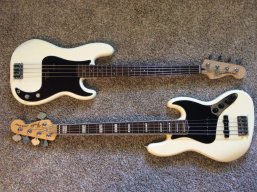
A few I've built in the past -
Link Removed
Link Removed


No as apposed to getting gratification through patience and waiting for a good thing.
I relic them without even trying.Take it to smoke-filled bars.Drop it, spill beer on it,leave it in the car overnite in the winter,bang it into the ceiling in the basement and play the hell out of it for 40 years.
Worked for me.
I relic them without even trying.