• TalkBass has been independent since 1998. Add your voice.
    Create a free account to reply to discussions, view embedded media, and browse with fewer display ads.
    Join freeLog in
    Want zero display ads or expanded classifieds tools? Compare plans.

Replace truss rod?

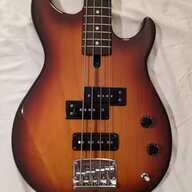
Just picked up an ibanez musician. The tone absolutely kills on this bass. Looks surprisingly good for a 37 year old bass. Feels great, although it's heavy it's quite balanced.

But the action is awful past the 12th fret. Brought it to a highly respected luthier and it needs a new truss rod and carbon fiber reinforcements. Not cheap.

But it would be such a damn shame to return and have this bass get junked. It's a special bass.

Assuming the seller will refund a good portion of the price paid, would you go through with the work? What would you all do?
 
Just picked up an ibanez musician. The tone absolutely kills on this bass. Looks surprisingly good for a 37 year old bass. Feels great, although it's heavy it's quite balanced.

But the action is awful past the 12th fret. Brought it to a highly respected luthier and it needs a new truss rod and carbon fiber reinforcements. Not cheap.

But it would be such a damn shame to return and have this bass get junked. It's a special bass.

Assuming the seller will refund a good portion of the price paid, would you go through with the work? What would you all do?

What's the luthier quoting to do the work? My gut is that the cost of the work might be more than the value of the bass. Certainly likely to be near or more than the cost of having a new neck built for it.

A new truss rod is a big enough job, but it can be done without removing the fingerboard. However, adding carbon fiber reinforcements (I've not heard of this done ever/often) requires taking off the fingerboard.

I think I'd return it and look for one with a good neck. The neck must be seriously messed up if he wants to add carbon fiber rods to it.
 
Yes, the neck is pretty messed up. And it will cost almost as much to fix as I paid for it. So I'm hoping the seller makes this right since the bass, as is, is essentially defective.

Don't really want to name drop luthiers names right now but he is well known and respected here in Austin. And he did state he'd have to remove the fingerboard to put in the reinforcements. You can't build a custom replacement neck for a neck through can you? My ignorance, just asking. Even if you could im not sure I want to lose any of the original mojo of the bass. If that's the only option is probably rather return it.
 
Yes, the neck is pretty messed up. And it will cost almost as much to fix as I paid for it. So I'm hoping the seller makes this right since the bass, as is, is essentially defective.

Don't really want to name drop luthiers names right now but he is well known and respected here in Austin. And he did state he'd have to remove the fingerboard to put in the reinforcements. You can't build a custom replacement neck for a neck through can you? My ignorance, just asking. Even if you could im not sure I want to lose any of the original mojo of the bass. If that's the only option is probably rather return it.

Oops, I didn't realize it was a neck-through. No neck swap for that thing.
Return that bass as fast as you can.
Good Luck!
 
Well, you can do just about anything, if you have the money and the time. But, short of turning it into a bolt-on neck bass (possible? interesting question...), replacing the neck will entail replacing the center of the body as well - leaving only the left and right body wings of the original body. Whether doing anything to it at all is "worth it", is another matter entirely; and up to you, I'm afraid...:)
 
Just picked up an ibanez musician. The tone absolutely kills on this bass. Looks surprisingly good for a 37 year old bass. Feels great, although it's heavy it's quite balanced.

But the action is awful past the 12th fret. Brought it to a highly respected luthier and it needs a new truss rod and carbon fiber reinforcements. Not cheap.

But it would be such a damn shame to return and have this bass get junked. It's a special bass.

Assuming the seller will refund a good portion of the price paid, would you go through with the work? What would you all do?

How did he come up with cf reinforcements?!? How much relief are we dealing with at the moment? Does the truss rod work at all? Is the TR nut removable? Is there "ski jump" involved? Did the tech give an explanation why this is needed above & beyond the realm of simpler avenues?

Riis
 
Truss rod was pretty much maxed. He removed the tr nut and checked it to see if perhaps the threads were worn and a "washer trick" could fix the issue, to no avail. By the way if I get some terminology wrong please don't jump one me. I can change the strings on my bass. After that I don't know much about guitar repair.

So, iF the truss rod doesn't work past the 12th fret what do you do when the action is so awful past the 12th fret and the truss rod does nothing to fix it? I didn't measure it but it's probably 1/2 to 3/4 inch high. Unplayable.
 
From your description, it sounds like it has developed a "ski jump" condition, which I usually refer to as a "12th fret kink". Basically, the wood on the back of the neck around where it transitions to the body has stretched, and the whole neck from the 12th to the headstock has angled upwards a small amount. The effect is that the neck can be nice and flat for most of its length, but then it has a ramp starting at around the 14th and rising up to the heel. That's why it's called a "ski jump". But the actual problem is that the neck is kinked at the 12th fret. As FranF said, the truss rod can be working fine otherwise, but it won't help with the kink.

Fixing it will require some surgery. If the kink isn't too bad, resurfacing the fingerboard may be enough. Pull the frets and trim down the ramp; then refret. If there's enough travel in the bridge (the saddles aren't bottoming out), that may be enough to get it playing well again. The neck would still be angled upwards, even though the fingerboard would be flat, and there's a chance that the neck may continue to kink further over time.

The true forever fix is a whole neck rebuild. Cut off the entire fingerboard and create a new flat surface. Add some reinforcements in the kink zone. Put on a new fingerboard and trim its thickness so it is slightly wedged; thicker at the heel to compensate for the wood removed by the flattening. Refret. The truss rod doesn't have to be replaced if it is working correctly otherwise.
 
Truss rod was pretty much maxed. He removed the tr nut and checked it to see if perhaps the threads were worn and a "washer trick" could fix the issue, to no avail. By the way if I get some terminology wrong please don't jump one me. I can change the strings on my bass. After that I don't know much about guitar repair.

So, iF the truss rod doesn't work past the 12th fret what do you do when the action is so awful past the 12th fret and the truss rod does nothing to fix it? I didn't measure it but it's probably 1/2 to 3/4 inch high. Unplayable.

Bruce Johnson nailed it. Could be the TR is working as it should. This really requires a segmental eval of the entire neck with a straight edge and a trained eye. Here's a quick trick to determine whether a ski jump is present and to what degree it affects playability: check your relief while depressing directly on top of the first and 17th frets. Now, repeat using the first and 24th (...or last) fret. Is there a huge discrepancy? The road to hell is paved with good intention: over-zealous tightening of the TR to correct a kink at the 12th fret or higher will oftentimes kick a neck in to the dreaded "S" curve where the fingerboard frets 1-7 begin to bow backwards further complicating issues.

Riis
 
Bruce johnsonson is right. I would also run away from a luthier who just suggested a new truss rod for a 12th fret and beyond problem. That is ski jump territory and not correctable without planing and refretting. You have to reshape/remove the fretboard material that is pushed up.