• TalkBass has been independent since 1998. Add your voice.
    Create a free account to reply to discussions, view embedded media, and browse with fewer display ads.
    Join freeLog in
    Want zero display ads or expanded classifieds tools? Compare plans.

Replacement power transistors for Acoustic 220

Dear everybody!

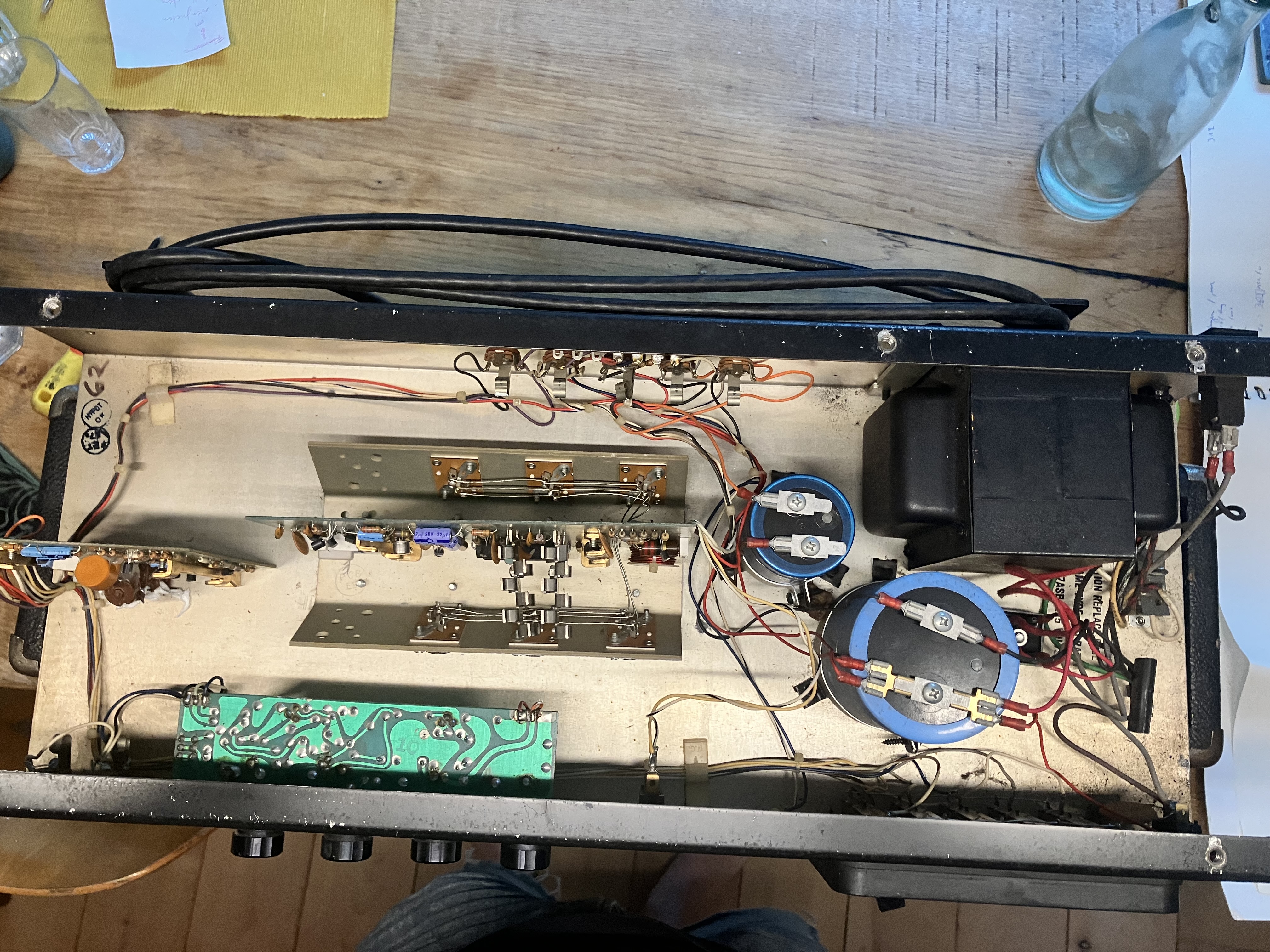
My beloved Acoustic 220 is very ill. My amp doctor discovered that the power or output transistors are getting bad. On 2 and 4 ohm there is some clipping and it will only get worse (on 8 ohm it is not that bod for the moment). He decided not to repair cause the transistors are not available and for searching an alternative it would be too much work for him.

Maybe there is a chance someone here knows where to find 6 transistors of these?
Or does someone know if there is an alternative that will work?

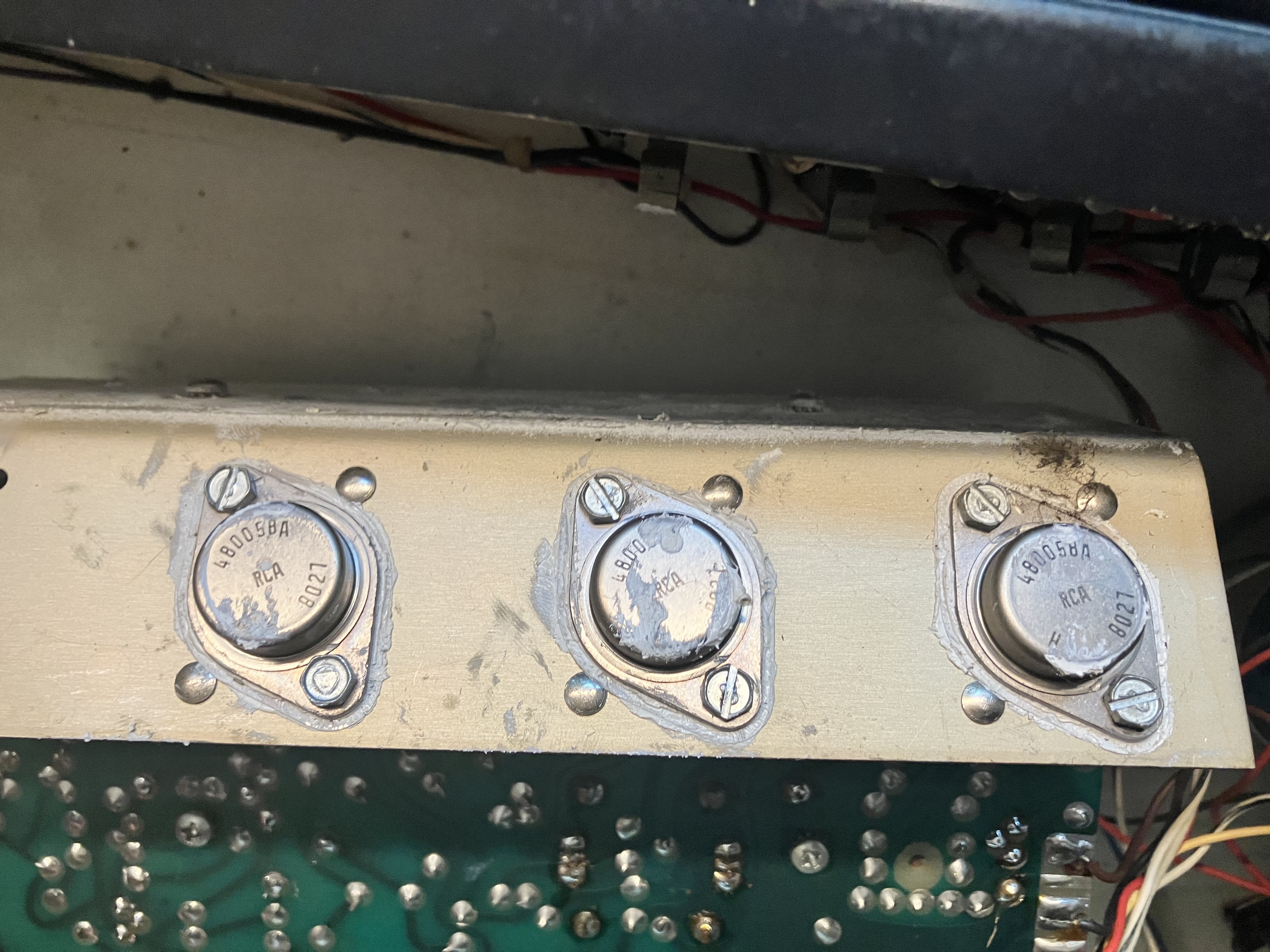
The transistors are marked like this:
480058A
RCA
H 8027

who can help me?

link to service manual

IMG_6341.jpeg

IMG_6342.jpeg


IMG_6333.jpeg
 
Last edited:
I recommend performing a more conclusive in-depth analysis of the amplifier and the suspect devices before condemning them as defective, or "getting bad".

The actual transistor type may be 2N3055. (Transistor crossover - RCA - Music Electronics Forum)

If that is the device, you may find a source here:


Warning: There is always the possibility that unscrupulous vendors will sell counterfeit mis-labeled semiconductors.

Buyer Beware!
 
Last edited:
I recommend performing a more conclusive in-depth analysis of the amplifier and the suspect devices before condemning them as defective, or "getting bad".
I concur, that's an odd diagnosis.

The 2N3055 transistors used in the 150 and 370 etc. were designated with the 480015 Acoustic house part number. The 220/230 amps used house number 480058A semiconductors and the 320/330 used house number 480060. The 480058A may quite possibly have been a 2N3442 and the 480060 an RCA 2N3773. The 220 and 320 used the exact same power amp assembly, with the 220 just leaving two of the power transistor sockets unpopulated and using a fixed bias resistor instead of a potentiometer. I would use the 2N3773 as a replacement in either amp. Russ Allee, the designer of the 220 among others recommended the 2N3773 as a replacement for the 2N3055 unless you used the hometaxial version of the 2N3055 (e.g. 2N3055H). Some 2N3773 NOS are available at Electronic Surplus in Ohio. YMMV
 
Last edited:
In general, power transistors work or don't, rarely just "start getting bad". Possible? sure. Likely? Not so much.
Agreed, it’s 99.9% certain that it’s NOT the output transistors.

A truly qualified tech will look at things like DC operating points and even testing the output transistors before making any such assumption.

The only exception to this is the rare germanium power transistor, but most techs will work a lifetime and never see one. These are not germanium parts.

I believe the NPN transistor is a 2N3773, beware that the surplus market is awash in counterfeit and re-marked parts that there’s no way to know what you are getting.
 
Agreed, it’s 99.9% certain that it’s NOT the output transistors.

A truly qualified tech will look at things like DC operating points and even testing the output transistors before making any such assumption.

The only exception to this is the rare germanium power transistor, but most techs will work a lifetime and never see one. These are not germanium parts.

I believe the NPN transistor is a 2N3773, beware that the surplus market is awash in counterfeit and re-marked parts that there’s no way to know what you are getting.
In my youth, I worked on some line amps that utilized germanium transistors! (chest swells with pride) :D
 
Agreed, it’s 99.9% certain that it’s NOT the output transistors.

I also agree. In the rare occasions I've had a power transistor go bad I never ever had a "start getting bad" early alert honeymoon period.

I believe the NPN transistor is a 2N3773, beware that the surplus market is awash in counterfeit and re-marked parts that there’s no way to know what you are getting.

Certainly also true. I've had good luck in the past with hometaxial RCA 2N3055H old stock from Electronics Surplus. They list these 2N3773s as RCA new old stock, so if it was me and I really did need to replace power transistors in a 220/320/370 then these are probably the only ones I'd take a chance with.
 
I also agree. In the rare occasions I've had a power transistor go bad I never ever had a "start getting bad" early alert honeymoon period.


Certainly also true. I've had good luck in the past with hometaxial RCA 2N3055H old stock from Electronics Surplus. They list these 2N3773s as RCA new old stock, so if it was me and I really did need to replace power transistors in a 220/320/370 then these are probably the only ones I'd take a chance with.
I would look at new current devices with similar hfe, that way you know that you are getting genuine parts.
 
I would look at new current devices with similar hfe, that way you know that you are getting genuine parts.

I've gone that route in the past, in fact if memory serves I replaced blown 480058A power transistors in an Acoustic 220 with a set of OnSemi MJ15015G devices and lived to tell.

However several years ago Duke Aguiar, designer of the 370, posted over on the unofficial Acoustic forum about the danger of using newer semiconductor devices, even the epitaxial-base 2N3055s, as drop-in replacements in those Acoustic amps due to their greater bandwidth product. He stressed that some circuit redesign would be required to prevent runaway and also some additional emitter resistance would be necessary. Considering all that is why, in the unlikely event I ever tear into another one, I might consider the NOS 2N3773 from ES instead.
 
Back in the days when dinosaurs still roamed the earth, I would test semiconductor devices like this on a machine known as a "curve tracer" to determine the operational characteristics of the device to confirm its performance and to confirm its acceptability for any particular application. That may be a good way to evaluate the condition of the output devices.
 
Last edited:
You're not really say what the symptoms are?

Those transistors can easily be removed and tested out of circuit. A good modern transistor tester is affordable.

There are many counterfeit transistors that you need to beware of, so you need to be able to test replacements out of circuit before you swap out the replacements. Replacing transistors can wipe out other good ones.

The schematic and service manual are available online for this amp at many places.

If two or more transistors are out of spec you might want to look at replacing the power amp with an ICEPower module. You may still retain all the preamp tone by replacing the power amp.
 
I've also never heard of output transistors "going bad". They are not like tubes. Every case I've seen, they either work or they don't. When they fail, they will likely blow a fuse, and many times take other components with them.

I would not trust that diagnosis.
 
  • Like
Reactions: byacey
Waw, thanks you all for this information! More complicated than I thougt… I will test the power amp with another pre amp. If its the power amp i will let the amp like this and look for a replacement amp.

Thanks for the advice and maybe saving me for spending money on something that would not be fixed!
 
  • Like
Reactions: agedhorse
Not the same as the power transistors for the Acoustic amp but germanium small signal transistors are still in demand for current and reissue pedals. They need to he sorted and matched when you buy a batch as performance can vary. Good to do with all transistors.
 
Waw, thanks you all for this information! More complicated than I thougt… I will test the power amp with another pre amp. If its the power amp i will let the amp like this and look for a replacement amp.

Thanks for the advice and maybe saving me for spending money on something that would not be fixed!

Although you gotta do what ya gotta do, it sure would be a shame to give up on the 220. It's probably one of the easiest amps in the world for any reasonably competent tech to repair with its simple fixed select resistors for bias and symmetry and single-ended power supply. It's not clear from your OP if the clipping is symmetrical and at what drive level. Could be bias or voltage starvation or something going on in the drive circuit, but a tech shouldn't have a problem diagnosing.
 
Not the same as the power transistors for the Acoustic amp but germanium small signal transistors are still in demand for current and reissue pedals. They need to he sorted and matched when you buy a batch as performance can vary. Good to do with all transistors.
Sorting and matching are totally unnecessary for modern small signal silicon transistors in a competent circuit design.

Sorting and matching are very much a DIY hobby avocation, no different than the mythology of recapping everything they see because they “know” the caps are bad. It’s an absurd reality imo.
 
  • Like
Reactions: Michael4bass