

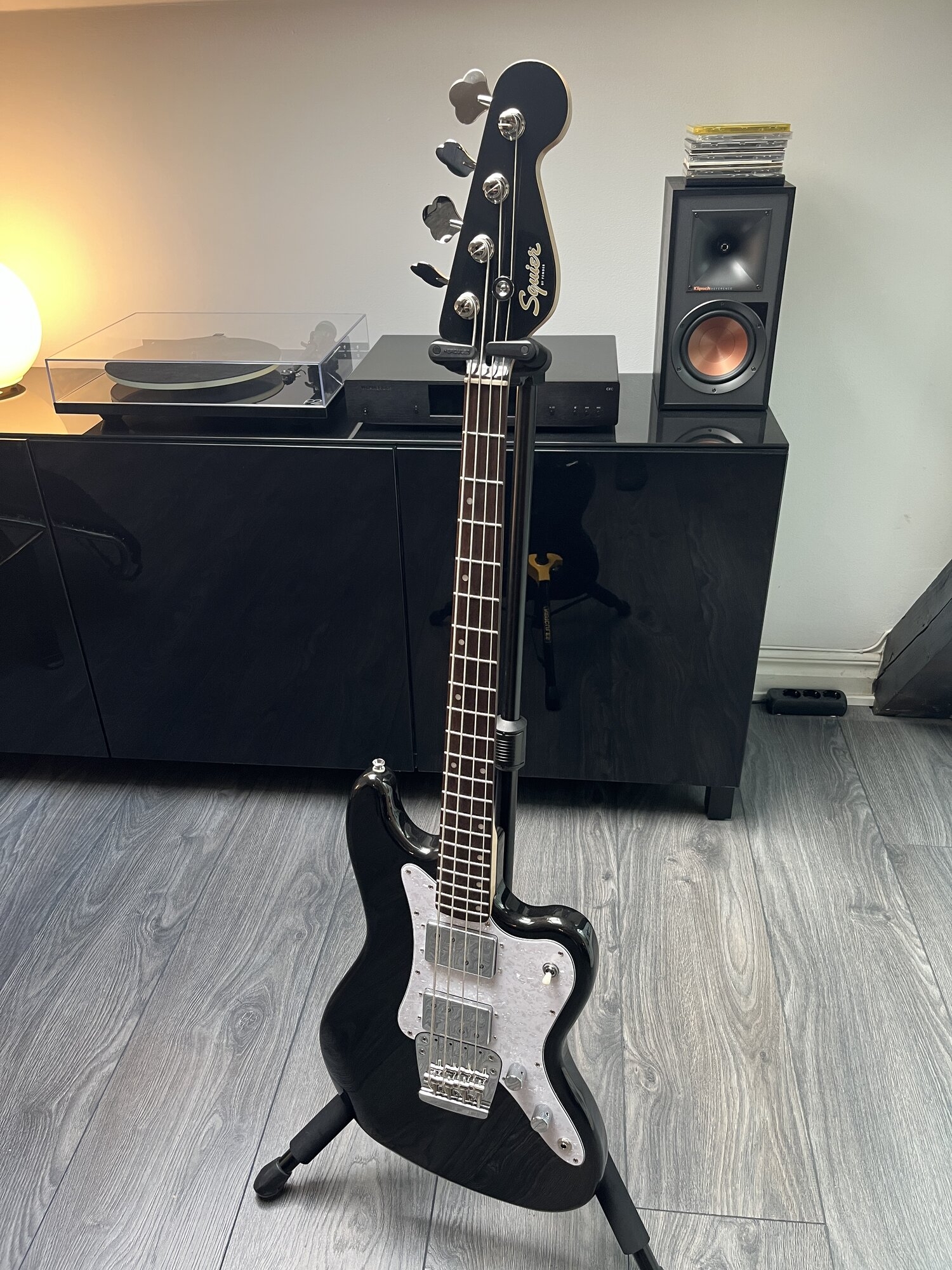
After having tested out this bass for a couple of weeks, I thought I’d give my impressions of it. This is my very first Squier, and I was a little unsure what to expect. it’s also my first short scale bass, and while it does have a scale length of 30", the total length of the instrument is equal to that of a long scale bass, which might be somewhat disconcerting. This is because the bridge is mounted quite high up on the body, much like that of a guitar. One good thing about the length is that the bass doesn’t need a special gig bag, it will fit very nicely in a standard one.
Fit and finish
These were very good. The black metallic finish was absoutely flawless, although the «metallic» part really isn’t that apparent. You can see a slight metallic sheen if you look closely, but that’s about it. That’s absolutely fine by me, I’m not that into metallic finishes anyway. The gloss neck is OK, although I would have preferred a satin finish. It’s not a deal-breaker by any means, but all things being equal, satin is better, IMHO.
The neck was straight, and the neck pocket was nice and tight, with no cracks in the finish. The fretwork was also very good, with no sharp edges or sprouting, and the nut was filed decently. The Coronado-style painted headstock is beautiful, and the Indian laurel fretboard looks and feels very similar to rosewood.
Hardware
The hardware is relatively basic, as you might expect for the price. The tuners are the same tuners you find on most budget basses - nothing special, but they’re servicable, turn smoothly and stay in tune, which is what you want. The chromed, Squier-embossed pickup covers are eye-catching, and make the bass look great.
A bridge too far
The string-through Mustang bridge looks very cool, but is also the achilles heel of this bass in some respects. On a Mustang this bridge is mounted much closer to the bottom edge of the body, and it works fine in this position. However, the bent base of the bridge plate, which accommodates the saddle screws, is quite narrow, about half the height of that of a standard Fender bent plate bridge. This makes the intonation screws sit at a a fairly acute angle, rather than more or less parallel to the bridge plate. The bridge also has a lip which hides the screw heads from view. This makes the intonation screws difficult to reach on the Rascal because the bridge is mounted so far from the edge of the body that it puts the screwdriver at an awkward angle (and indeed at the opposite angle to the intonation screw heads), and you can’t see what you’re doing because of the lip. This increases the danger of stripping the screw heads and/or damaging the finish when adjusting the intonation.
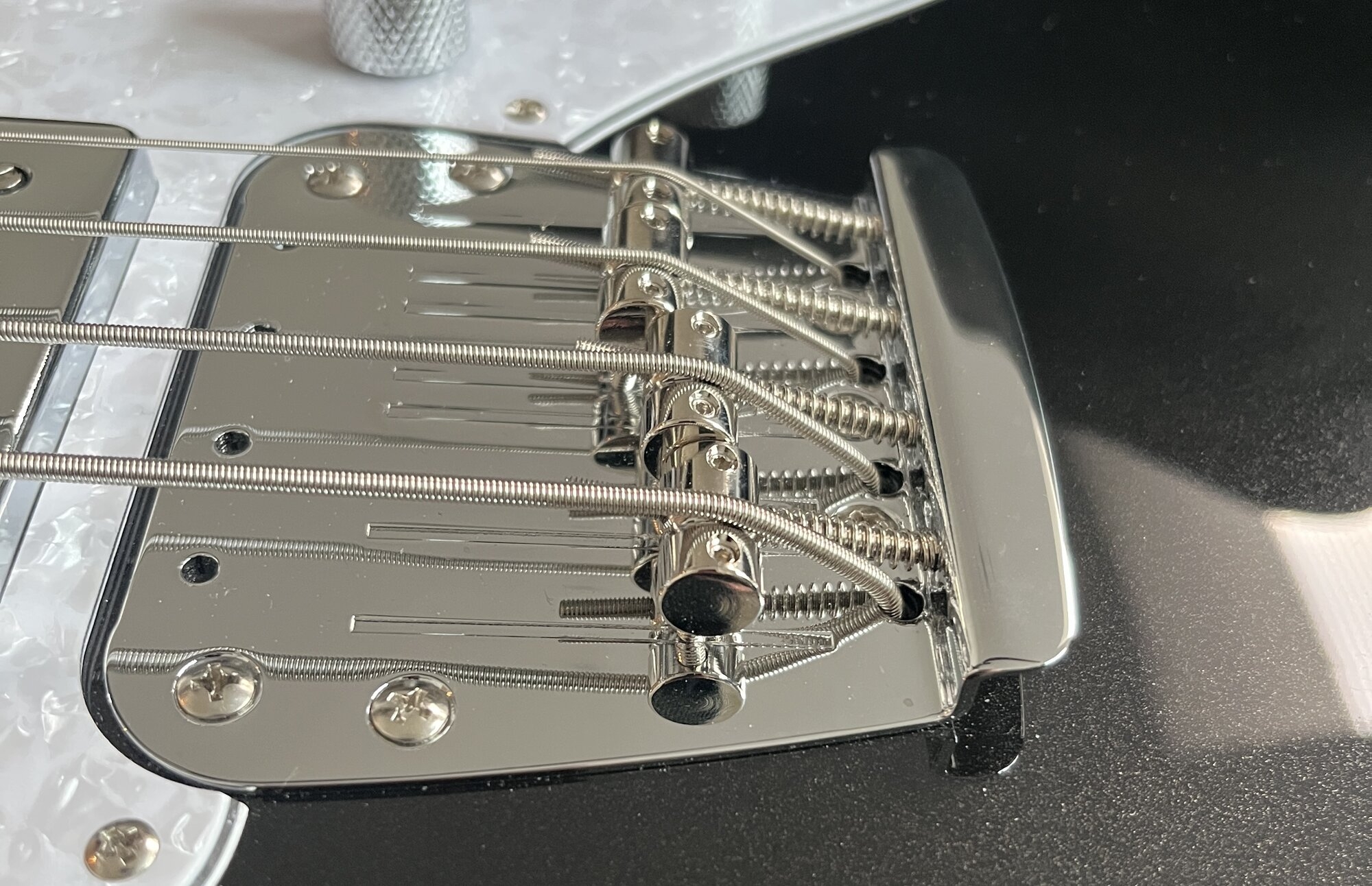
The Mustang bridge. Note the narrowness of the base, which makes the intonation screws angle upwards.
This illustrates the danger of simply transplanting hardware components from one design to another, especially if they differ significantly. Squier would have done better to make a modified version of the Mustang bridge which accommodated the difference in placement.
Electronics
The pickups are great - no two ways about it. The bridge pickup especially has a sound all its own, and lifts this bass from the commonplace. The neck pickup sounds similar to a Gibson mudbucker, but has better definition and clarity. They do run fairly hot, I had to adjust the input gain on my amp a good deal. A simple Les Paul-style switch lets you switch between the neck pickup, bridge pickup, or both.
The controls are one volume knob and one tone knob, the pots seem solid and the knobs turn smoothly.
Playability
Because of the length of the instrument and placement of the bridge, the hand naturally sits over the bridge pickup when playing, so many players will need to adjust their playing style a little. I found it very easy to get used to, so most will probably experience little difficulty. Because of the Bass VI-style body the access to the upper frets is very good. The bass balances well on a strap, but is a little on the heavy side, probably due to the poplar body.
All in all, I think this is a great bass, albeit with some minor flaws. You can get some great vintage-style sounds out of it, it looks really cool, and is great fun to play. The quality is close to that of a MIM Fender, so you get a lot for your money, and although I’m not making this my #1 bass, it’s certainly a worthwhile addition to the stable.
Fit and finish
These were very good. The black metallic finish was absoutely flawless, although the «metallic» part really isn’t that apparent. You can see a slight metallic sheen if you look closely, but that’s about it. That’s absolutely fine by me, I’m not that into metallic finishes anyway. The gloss neck is OK, although I would have preferred a satin finish. It’s not a deal-breaker by any means, but all things being equal, satin is better, IMHO.
The neck was straight, and the neck pocket was nice and tight, with no cracks in the finish. The fretwork was also very good, with no sharp edges or sprouting, and the nut was filed decently. The Coronado-style painted headstock is beautiful, and the Indian laurel fretboard looks and feels very similar to rosewood.
Hardware
The hardware is relatively basic, as you might expect for the price. The tuners are the same tuners you find on most budget basses - nothing special, but they’re servicable, turn smoothly and stay in tune, which is what you want. The chromed, Squier-embossed pickup covers are eye-catching, and make the bass look great.
A bridge too far
The string-through Mustang bridge looks very cool, but is also the achilles heel of this bass in some respects. On a Mustang this bridge is mounted much closer to the bottom edge of the body, and it works fine in this position. However, the bent base of the bridge plate, which accommodates the saddle screws, is quite narrow, about half the height of that of a standard Fender bent plate bridge. This makes the intonation screws sit at a a fairly acute angle, rather than more or less parallel to the bridge plate. The bridge also has a lip which hides the screw heads from view. This makes the intonation screws difficult to reach on the Rascal because the bridge is mounted so far from the edge of the body that it puts the screwdriver at an awkward angle (and indeed at the opposite angle to the intonation screw heads), and you can’t see what you’re doing because of the lip. This increases the danger of stripping the screw heads and/or damaging the finish when adjusting the intonation.
The Mustang bridge. Note the narrowness of the base, which makes the intonation screws angle upwards.
This illustrates the danger of simply transplanting hardware components from one design to another, especially if they differ significantly. Squier would have done better to make a modified version of the Mustang bridge which accommodated the difference in placement.
Electronics
The pickups are great - no two ways about it. The bridge pickup especially has a sound all its own, and lifts this bass from the commonplace. The neck pickup sounds similar to a Gibson mudbucker, but has better definition and clarity. They do run fairly hot, I had to adjust the input gain on my amp a good deal. A simple Les Paul-style switch lets you switch between the neck pickup, bridge pickup, or both.
The controls are one volume knob and one tone knob, the pots seem solid and the knobs turn smoothly.
Playability
Because of the length of the instrument and placement of the bridge, the hand naturally sits over the bridge pickup when playing, so many players will need to adjust their playing style a little. I found it very easy to get used to, so most will probably experience little difficulty. Because of the Bass VI-style body the access to the upper frets is very good. The bass balances well on a strap, but is a little on the heavy side, probably due to the poplar body.
All in all, I think this is a great bass, albeit with some minor flaws. You can get some great vintage-style sounds out of it, it looks really cool, and is great fun to play. The quality is close to that of a MIM Fender, so you get a lot for your money, and although I’m not making this my #1 bass, it’s certainly a worthwhile addition to the stable.


