• TalkBass has been independent since 1998. Add your voice.
    Create a free account to reply to discussions, view embedded media, and browse with fewer display ads.
    Join freeLog in
    Want zero display ads or expanded classifieds tools? Compare plans.

Rickenbacker 4003: The Struggle is Real

Why Rickenbacker? Why?

  • Stop complaining, once they're setup they're awesome.

    Votes: 96 50.0%
  • I used to own a Ric and will never own one again.

    Votes: 29 15.1%
  • Can't justify the price to buy one.

    Votes: 67 34.9%

  • Total voters
    192
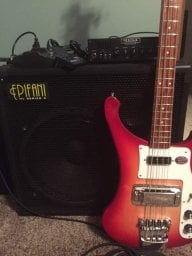
Just recently bought a used 2017 Ric 4003 because I've always loved the classic look and wanted to add a Ric sound to my collection. It's been quite the journey..

It's my first experience with double truss rods and the stock bridge adjustments are extremely limited.. I ended up replacing the bridge with a hipshot and got the neck sorted. Both seem unnecessarily difficult (including the ground wire soldered on the bridge).

Then, when I finally think I'm done, I find out the factory tapped Schaller strap lock buttons into the bass with massive bolt holes. Rather than fill the holes and install the standard strap locks I have on 90% of my other guitars and basses, I discovered the Fender strap locks on my American Ultra Strat fit the Schaller buttons and are half the price.

I currently own Gibson, Fender, PRS, Carvin, Lakland, Aria, Ibanez, ESP, Schecter and Yamaha basses and guitars. It's like Rickenbacker just wants to be difficult for the sake of being difficult.

That being said.. It's still a badass bass. lol

View attachment 5411514

In the 34 years I owned my 4001, it required no trust rod adjustments and zero need to to do anything with the bridge.
 
It's such a shame to hear stories such as yours. I find the exact opposite. Especially when playing live with my group. My Rick practically plays itself. The notes just come forth so effortlessly that any ergonomic issues disappear.
My previous post notwithstanding, I wil say that I can play some pieces of music far more easily on my Ric than on some of my other basses. Weird.
 
Most of the classic gripes have been addressed within the past 2 years of current production.

For instance.

New Single Truss rods which are buttery smooth and super simple to dial in.
Necks now again feel like the old 4001's.
new improved bridge which is a 2 piece design making tail lift impossible as there is now a solid steel block that holds the ball ends, That is screwed to the body and the rest of the bridge goes over that.
 
I recently put Dogal JH172 Flats on my Rick 4003. Dogal 172 are Stranded core. I would have thought it would be very difficult to get my Rick setup perfectly but it was easy. The relief stayed spot-on and action is fantastic. The intonation was very, very close and 3 strings were done in seconds. I had to flip one saddle around to get the necessary range of adjustment. That took all of 1 minute.

The OP's Saddle locations looks pretty wonky. It looks like a bad D string honestly. I would never expect an OEM Rick bridge to have enough range to get that D string in Spec.


Would love to hear a clip of those Dogals on a Rick!!
 
My previous post notwithstanding, I wil say that I can play some pieces of music far more easily on my Ric than on some of my other basses. Weird.
I agree that you may have to adapt more to a Rick. If the binding is uncomfortable, shift the bass a bit. I find angling the headstock upwards is effective in keeping the binding from digging into my forearm.
Then there's the tone. If you're lucky enough to find your perfect tone on a Rick, you'll never want to put it down.
I think some people expect to sound like Chris Squier(or other Rick player) immediately. Then when they don't, they just give up on Rickenbackers. I am running flats on my basses and the 4003 really comes to life with them. I literally wake up wanting to play each morning.
 
A few years ago (2020?) they changed the bridge to the "V2". Each string is much more adjustable. In the last year or two they switched from the dual truss to a single truss rod and a thinner neck profile. These changes make adjustments a lot easier. Stop by the https://www.talkbass.com/threads/the-rickenbacker-club-part-twelve.1070836/page-3158 thread for a lot of good information if you have more questions. Enjoy your new bass.

It's silly to buy a used one these days for way more money that's for sure, the prices on reverb are bonkers when the new ones are so good with the improvements.
 
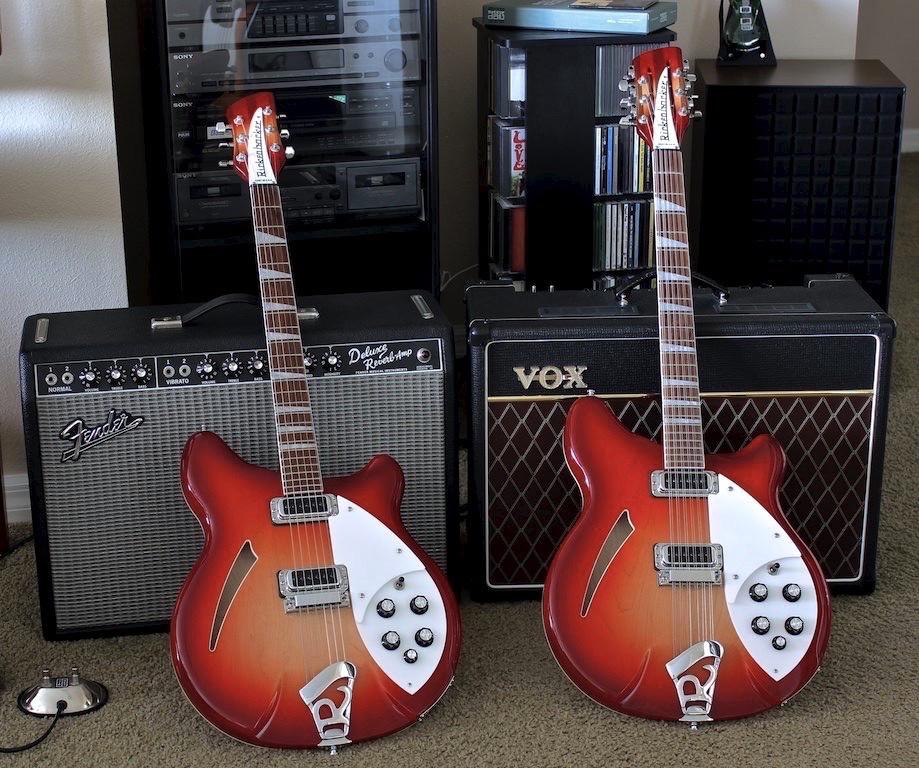
If you indulge me for a second, I'll opine here on my Rickenbacker guitars - But since this is a Rickenbacker bass thread, I'll make this as short as possible. It might make some sense though, regarding some of the other comments about Rickenbacker inconsistencies..

I've got a Ric 360/6 and a Ric 360/12 - both are 2014 models... Both have the Fireglo finish. They look virtually alike, made in the same year - other than one is a 6-string and the other is a 12-string.

So - - My tech told me this particular 360/12 of mine is absolutely the best Rickenbacker 12-string he has ever worked on or played.. Yet he told me this particular Rickenbacker 360/6 of mine is the absolute worst 360/6 he's ever worked on or played...

And I tend to agree..

True story.

Go figure... :eyebrow:

lpD37l0.jpg
 
Last edited:
  • Like
Reactions: GregC and woodyng2
Just recently bought a used 2017 Ric 4003 because I've always loved the classic look and wanted to add a Ric sound to my collection. It's been quite the journey..

It's my first experience with double truss rods and the stock bridge adjustments are extremely limited.. I ended up replacing the bridge with a hipshot and got the neck sorted. Both seem unnecessarily difficult (including the ground wire soldered on the bridge).

Then, when I finally think I'm done, I find out the factory tapped Schaller strap lock buttons into the bass with massive bolt holes. Rather than fill the holes and install the standard strap locks I have on 90% of my other guitars and basses, I discovered the Fender strap locks on my American Ultra Strat fit the Schaller buttons and are half the price.

I currently own Gibson, Fender, PRS, Carvin, Lakland, Aria, Ibanez, ESP, Schecter and Yamaha basses and guitars. It's like Rickenbacker just wants to be difficult for the sake of being difficult.

That being said.. It's still a badass bass. lol
Well, you've gone about things in a bit of a strange way, but each to their own.
  • The stock bridge/tailpiece assembly is fine as-is and I don't particularly regard the Hipshot as an upgrade and a couple of mine have made their way onto copies. (Amusing complaining about the Gnd wire being soldered, though. :-) )
  • Schallers are the standard Straplocks, aren't they? I think the Ric ones are made by Schaller (as are the tuners).The bolts came about because the original strap buttons used are the very same part as the original tailpiece mute height adjusters. Interestingly, after RIC swapped to Straplock ones, Schaller converted their general ones to single-piece ones too. I have Schaller ones on my other guitars & basses, except for a couple of Warwicks which have inset straplocks.
  • I too remove the Treble pickup cover - I don't see the point of it (other than on one I have with a horseshoe magnet pickup). Though I have them on a couple of Rics I can take or leave the bezels; I don't particularly notice them and I thought about buying one I saw on eBay but when I checked the bass it already had one!
Oh, and I once had a Leo Quan bridge on a Ric - that was truly Badass!
 
I went with the first option, but I wouldn't tell you to stop complaining. I have 2 S models and the setup quirks on these basses never scared me.

That said, one of them does have the old bridge and I still like the idea of replacement, but the Babicz bridge looks less difficult.

Rock that bass in good health. Nothing sounds like one and my next bass may be a model with ROS on it.
I don't quite get the Babicz bridge - it is only the bridge part, so doesn't solve tail-life and the saddles are higher so you can't palm-mute.

I have a 1999 v63. No bridge lift, dual truss rods are a bit off-putting, but perfectly logical. No neck issues and great sound. The horsehoe is a pain to
play around but for the sound, I'll suffer.

I've had 4 previous Rics, two 4003s and two 4003. I bought them all used, with local shop guarantees and after in person playing them. Based on what I have HEARD, but not experienced, I am skittish of Rics and I would not buy a Ric without playing it first, but mine have been workable, reliable instruments. Not as solid FEELING as a p bass, but not fragile in any way.
I have a '64, no tail-lift.
I tend to buy used and would tend to play before buying; I wouldn't pay the asking price for a new one.

I agree that Rics have kind of walked their own path for a long time, but have recently tried to modernize and join the mainstream. They have gone to a normal, single standard style truss rod and updated their bridge design. I think that started in 2022. With the move to a single truss rod, they have also returned to the classic 4001 style neck profile in 2023.

While the older ones are a pain, they definitely are worth it when you finally get it set!
That "standard" word - there was no standard when the 4001 appeared; the Rics got a bit of bad press because folks wanted to adjust them like Fenders but they aren't Fenders.
The best advice to folks who complain that Rics aren't like Fenders is to go and buy a Fender then!

Love that hipshot replacement bridge. Glad to hear you put one on. The OG bridges everyone bags on are really as bad as made out to be.
I don't rate the the Hipshot bridge:
  • They're a pain to fit and on occasion I've spent time looking for the spring that pinged out across the roon whilst I was trying to put the E saddle back on as I had to removed it to screw in the fixing screws.
  • The E saddle tends to sit on one of the fixing screws, which hampers its intonation.
  • There isn't much travel in the saddles because the intonation screw holes don't go right through like on a Fender bridge (see, I did the "Fender" thing!); however, you can cut them to size.
  • I think they ruin the aesthetic of the Ric; they are a bit bland sat there.
  • Height-wise, the stock Ric bridge is curved to match the fretboard, so setting their relative string height with a file should be a once-only thing.
  • The brass Hipshot bridge is quite heavy.
(That said, I do have a V2 unit waiting to go on a 2010 4003 I have; I just fancy giving it a try.)
 
Snapped Truss Rods are from being abused. Imagine the amount of unnecessary force that had to have been applied to actually have a "noticeable amount of material ground away from adjustments." It takes only a very slight amount of turning force to adjust Truss Rods when done right.

I play my Rick every day and it's always 100% playable. Relief stays spot on and it barely needs tuning once strings have settled in.
The great thing about Ric truss-rods is they are field replaceable.
However, for folks who are worries about snapping them, here's a link to someone who knows describing how to (and not to!) adjust a truss rod; he's demonstrating it on a Fender, so it's not peculiar to Rics.
The "not to" is don't use the truss rod(s) to adjust the neck, but rather use gentle force against the neck to bend it to position and use the rods to lock it in place. Older Ric manuals suggest doing this over your knee.
However, there is one thing in the video you should not do on a Ric and that is put pressure on the headstock: if you look at the truss-rod adjusters bay there, that's taken out a lot of wood, so any pressure should be against the fingerboard.
 
I agree that Rics have kind of walked their own path for a long time, but have recently tried to modernize and join the mainstream. They have gone to a normal, single standard style truss rod and updated their bridge design. I think that started in 2022. With the move to a single truss rod, they have also returned to the classic 4001 style neck profile in 2023.

While the older ones are a pain, they definitely are worth it when you finally get it set!
They have mainly because John Hall retired and his son Ben took over as CEO in 2022. That's also why they finally updated their website for the first time in about 25 years, reissued the 4005, and retired the 4003/S5.
 
Last edited:
They have mainly because John Hall retired and his son Ben took over as CEO in 2022. That's also why they finally updated their website for the first time in about 25 years, reissued the 4005, and retired the 4003/S5.
The 4003/S5 is the only Ric I've sold; it didn't feel like a Ric and I found I was reaching for my Warwick 5-er when I wanted the extra string.
 
When someone asks, or talks about any brand of guitar besides Rickenbacker: Why is it always prefaced with some form of apology, or dislike for them? Then something positive is said.
It seems like when talking about someone "Take him or leave him" then throw in a compliment.
 
  • Like
Reactions: Gilmourisgod