• TalkBass has been independent since 1998. Add your voice.
    Create a free account to reply to discussions, view embedded media, and browse with fewer display ads.
    Join freeLog in
    Want zero display ads or expanded classifieds tools? Compare plans.

Rickenbacker bridge pickup

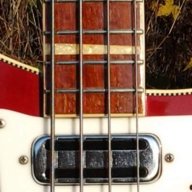
Hey hi hello, I have a Ric 4003 and my bridge pickup seems to loose some of the bottom end. I love the tone the zing and time but it isn't as full as the neck pickup. However, the neck pickup hasn't got the same ripper grind to it. Is there a way to wire them together like a humbucker? Or are the already humbuckers? My buddy said it's single coils. I don't have any idea, so I thought I would ask here
Thank you for your time and attention!
 
Well...
Having played more than a couple of Rick basses since the late 1960s - when the pickups were very different; and currently being the owner of a '73 4001 and an '01 4003, here's what I know about them (or think I do...).
1. Because of where it's located (pretty far back & close to the bridge saddles). the bridge pickup ("treble pickup" in Rick-speak), has a hard time generating output signals compared to the neck ("Bass") pickup, because there's not all that much string movement back there. Which is why that pickup has always been wound a little hotter that the other one. Which helps - some; but it's also very dependent on correct pickup height. Too low, and the already comparatively weak output will be weaker still. You might want to check that...
2. Can you wire them together like a humbucker? No, not exactly. What you can do, is wire the pickups so that the polarity is North- South on one, and South-North on the other. Which, for the purpose of eliminating single coil hum, is mimicking a humbucker. Its a fairly common trick - or used to be - among Rick owners that are plagued by a lot of hum (I'm not one of them, by the way). Not sure it would increase the output, though...
3. In case it isn't obvious by now? YES, Rick 4003 pickups are single coils. Far as I know, the only Rick basses that came factory equipped with humbuckers were the 4004s and (I think) the modern 5 string 4003s5. All the others? Single coils, every one...:cool:
 
  • Like
Reactions: Mikechromeserp
Those are single coils and the difference in sound and tone is due to where they are. Close to the bridge, shorter vibration, bite. Close to the neck, wider vibration, bassy.

Part of the beauty of that design is exactly what you describe.

Put the selector in the middle position, and dial in the relative mix of neck and bridge you want.

That's another beauty of the design. With the pickup selector, you can go full bridge for bite, full neck for bassy, and middle - both - for your desired combination of bite and bass.

You don't need to change anything, just use the pickup selector and knobs.

I mean right?
 
Hey hi hello, I have a Ric 4003 and my bridge pickup seems to loose some of the bottom end. I love the tone the zing and time but it isn't as full as the neck pickup.
What year is it? Older 4003s had a capacitor in series with the treble pickup that gave it a brighter sound by blocking the lowest frequencies. At some point (late 80s? I'm too lazy to go look it up) this was removed. Some people like it the old way, some people like it the new way, so eventually this was added with a bypass switch so it could be either way.

If you have an old 4003, you could try bypassing this. If you have a new one with the switch, the switch might not be working correctly.
 
Yeah what year is it? The rear pickup controls went thru a couple changes. My 93 doesn't have the extra capacitor that cuts lows, and my bottom end is tremendous.

So to recap: earlier years had the extra cap, and is common thing people remove.
90s ones dont have the cap from the factory, I dont know which year they stopped and started that.
From about mid 2000 and up, Ric put a push/pull rear tone pot along with the extra cap so you can have either the early or later style bottom end sound.
 
About the capacitor in the treble (bridge) pickup circuit? Yeah, that was a "feature" of the 4001's - and the early 4003's. Lots of people did, indeed, remove that cap, when the "trend" was for a brighter sound. Some people, though, wired a small 2-way switch into the circuit, so they could cut the cap in or out, as the occasion demanded... I'm not sure exactly when RIC bowed to the pressure and eliminated the cap in the treble circuit, but my '01 COY 4003 definitely didn't have one. Which annoyed the Hell out of me... Fortunately, by the time I bought the thing, RIC had bowed to the pressure of owners that did want the cap in the treble circuit (proving that customers really are never satisfied), by putting it back, and also installing a push/pull tone knob, so they could select it - or not. Personally? I think that's a great idea. My 4003 had the knob and the capacitor installed by the local Rick dealer's certified tech. I also had the push/pull knob installed in my '73 4001. Which was kind of a waste of $$, since I've never used it with the cap cut out, since I had it done. But, it's there - just in case I ever get a wild hair... :whistle:
 
About the capacitor in the treble (bridge) pickup circuit? Yeah, that was a "feature" of the 4001's - and the early 4003's. Lots of people did, indeed, remove that cap, when the "trend" was for a brighter sound. :whistle:
Removiing that capacitor does not make a Ric brighter. That capacitor high passes the bridge's contribution to the sound, which fives you a bit less comb filtering in the low mids when both pickups are operating. when you remove it, you have to short where it was, or the bridge pickup won't ever be heard.

It doesn't affect the treble content of the bass one bit. Yes, capacitors can be used to tame the high end of a n instrument, but they only do that if placed in the right spot. The capacitor in question is in a different part of the circuit.
 
Yeah what year is it? The rear pickup controls went thru a couple changes. My 93 doesn't have the extra capacitor that cuts lows, and my bottom end is tremendous.
Another misconception about that capacitor. It removes the low frequency content of the bridge pickup WHEN both pickups are operating. That actually gives you a bit more low end, as the neck pickup is not loaded by the bridge pickup. So, as tremendous as your low end is, it'd actually have even more with the capacitor in the circuit.
 
Removiing that capacitor does not make a Ric brighter. That capacitor high passes the bridge's contribution to the sound, which fives you a bit less comb filtering in the low mids when both pickups are operating. when you remove it, you have to short where it was, or the bridge pickup won't ever be heard.

It doesn't affect the treble content of the bass one bit. Yes, capacitors can be used to tame the high end of a n instrument, but they only do that if placed in the right spot. The capacitor in question is in a different part of the circuit.
Well, then I guess all those people who BYPASSED (which is, essentially, "removing" it from the circuit) were wrong. Still, call it you want; a 4001 or an older 4003 with that cap bypassed sure sounds different than it does when its still actively in the circuit. Nitpicking semantics doesn't change the sound...
 
Well, then I guess all those people who BYPASSED (which is, essentially, "removing" it from the circuit) were wrong. Still, call it you want; a 4001 or an older 4003 with that cap bypassed sure sounds different than it does when its still actively in the circuit. Nitpicking semantics doesn't change the sound...
It does sound different. And yes, I was one of the folks who bypassed that capacitor, but I did with a pot, so I could have in between sounds.

Explaining what actually happens when you bypass the capacitor is clarification of a technical point - it's not "nitpicking semantics".
 
For decades people have been removing the low cutting cap and getting.... more low end! So much so Ric stopped putting it in for big period.
As I said, Ric now has a push pull pot to engage or disengage the cap and the bottom certainly doesn't get bigger in 'vintage' position.

But hey, you do what you want with your Ric.