• TalkBass has been independent since 1998. Add your voice.
    Create a free account to reply to discussions, view embedded media, and browse with fewer display ads.
    Join freeLog in
    Want zero display ads or expanded classifieds tools? Compare plans.

Rickenbacker - Why do you love/hate it?

Why do you love/hate Rickenbackers?
LOVE: Tone; Neck & Playability
Dislike (not hate): The body style
Strongly Dislike: Weak Pickups, so spend more $$$ on a powerful amp. If you change out the pickups, you just screwed the pooch, so no. You paid good money for that tone so leave the stock pickups alone.
HATE: Cheap Pot Metal Bridge. Impossible to adjust properly. It's the worst hunk of junk that is especially egregious due to the high price. Oh yeah, the needlessly high price.
 
Last edited:
Hello, I hope all is well. I have a question for you all and I apologize if this thread has already been made in the past. Just trying to gather some input from everyone on Rickenbackers. There seems to be no medium and people fall on one end of the spectrum only.

Why do you love/hate Rickenbackers?


My only issue is I abhor a lacquered fretboard.

They probably make them without via a special order, just a matter of time before I bag one.
 
  • Like
Reactions: Michael Schreiber
I've had two Rickenbackers. One was a 4003 in the special edition Montezuma Brown (just like a hazelnut-looking "burst" pattern), and the current one is a 4003S (no binding, no fretboard inlays, no stereo jack, bridge pickup cap switch) in mapleglo.

Love: the sound (pickups played together or separately), the slightly shorter scale (1/2" shorter, I believe), the shallow neck, the relative lack of taper from headstock to body, the sound, the weird styling that seems like a perfect balance between hopelessly retro and positively timeless, the extreme variations you get between different kinds of strings, that there are lots of extremely minor/low footprint modifications you can do very easily (e.g. bridge pickup thumbrest insert) and that you can easily bring the bass back to stock, and oh did I mention the sound? People criticize the basses as one-trick ponies, but I cannot think of a style that you couldn't play effectively on this bass. At the most, you'd need to swap between flats and rounds, but it's a surprisingly versatile bass given all the witty one-liners you hear about the "clank".

Hate: that only my current one has a shallow neck while my first one was more P-bass-shaped (I guess that's quality control? The neck depth famously varies wildly from year to year and model to model), that the finish shows wear extremely easily, the stock bridge (it's pretty but not very functional; replace it with a Hipshot with the same footprint), that the bridge pickup cover isn't more easily detachable and basically just exists for cosmetic reasons, and that the pickup cavities aren't shielded for noise.

Considering all the other really lovely basses out there that I love (Zon, Steinberger, Pedulla, Wal, etc.), Rickenbackers are relatively reasonably priced. It's always been my dream bass ever since I saw one, especially since I heard one (the Beatles, Rush, Yes), and every time I encounter a flaw that I think will make me like the basses less, I just... don't. They're certainly not perfect, and they're certainly not for everyone, but unlike any other kind of bass, I will never not have a Rickenbacker.
 
Beautiful basses. What model is the black one? And did you have a replacement bridge put on?
I intend on removing the neck pick-up from the 4003S I just got and turning it into a 4000. I ordered the guard from PickGuardian. I much prefer the sound of just the bridge p/u. And while I could just not use the neck p/u, I don't like having features on the bass that I'm not going to use. I find myself gravitating to the simplicity of single p/u, passive instruments.
Firstly,Thanks fo the compliment! And the simplicity of the layout is one reason i've hung on to my 4000! I can also attest that the aluminum hipshot bridge installed on the 4000 is a great addition/improvement.
The black bass is a highly modded 4004 Laredo. It still has the Schaller bridge that came on it from the factory. (Installed slightly askew from there,i might add.) Dane Wilder swapped out the hb pickups for a Rick toaster and a Classic Amplification bridge pickup in a Ric surround,cut the back painted gold pickguard,and set it up with a 1vol,1tone,full size selector switch harness.
It is a killer sounding bass.
 
I was 14 years old in 1972 and already completely in love with Rickenbacker basses and guitars because I loved the Beatles. Then I discovered Yes because my older sister brought home The Yes Album and Trilogy after a date and I heard how Squire used his Ricky with effects, a pick and lots of imagination and skill. The Yes album made no impression on my sister but did change me.
I've owned at least 1 Ricky since 1974 or so, had three for a while since they presented themselves to me cheaply at the time, but my original Ricky now sports EMG pickups and a replacement bridge because by the late 80s or so I thought I needed some improvements on both of those fronts and by that time the consensus was that Rickenbacker was being left behind since they would not offer new designs. I used a former Rickenbacker tech, Mark Arnquist, a bunch for a while and he said he made lots of prototypes for the company that were all rejected and chopped up with a band saw. Maybe they just were not any good but there just were not any new designs until recently. Arnquist also says they've had lots of troubles with unstable finishes and bindings but I don't think that was an issue until the 90s.
If you want the sound of a Rickenbacker 12 string you should probably buy a Ricky 12 string but I don't know why a guitarist would buy a Ricky 6 string other than for looks. Just a strange prejudice of mine I guess.
What I love:
Stereo independent outputs with lots of tone control.
I thought they looked beautiful and lusted after them for years before getting one.
I learned to love the lacquered fretboard and can bend the strings bigly and precisely but have never had to deal with refretting or other fretboard issues.

What I don't love:
The bridge with the damn mute screws that got in the way of my right hand. Never encountered the bridge coming loose and pivoting on the mounting screws though.
The pickup cover because it also got in the way of my right hand.
I found the original pickups to be weak and noisy once I started playing other basses but I still kind of think of my original 74 JG as my main bass.
DSCF0914.JPG
 
I LOVE the look, sound, feel, just about everything....except the price. I used to own a fire engine red one with black hardware, (I can't remember what the Rick "-glo" name for the color was.) and I owned a white tuxedo 4001. I don't think I paid more than $500 for either of them. Of course, that was back in the 90s. I would love to own another one, but not for well over $1000 on the used market.

That would have been "Red" (RED) which came standard with black binding, plastic, and blackened hardware.

Although many call any white Rick with black binding a "tuxedo," the true "Tuxedo" was an all-white (even the fingerboard) 4003SPC from 1987.
 
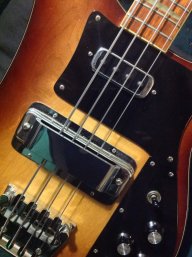
If you leave the bridge pickup cover on, it minimizes the hum, they are actually copper plated under the chrome plating
Are you sure? You can't electroplate plastic (it's an electrical process that only works on metal stuff), so I'm not sure how they'd have gotten a layer of copper or chrome onto that part.

My Ric is fairly hum-free as well, with the pickup cover removed.
 
Are you sure? You can't electroplate plastic (it's an electrical process that only works on metal stuff), so I'm not sure how they'd have gotten a layer of copper or chrome onto that part.

My Ric is fairly hum-free as well, with the pickup cover removed.
Yup. Got it straight from Ric, and while I am not by any stretch knowledgeable on plating, plastics or metals, I have seen this done before.
 
Yup. Got it straight from Ric, and while I am not by any stretch knowledgeable on plating, plastics or metals, I have seen this done before.
What do you know! I poked around the Ric forums and it sounds like the official description is

"In this case, the copper has to be added to the plastic with a vacuum deposition process, rather than plated, as a base for the chrome to be plated upon."
Rickenbacker International Corporation - Forum • View topic - Why is the 4003 pickup cover plastic?

I'll keep that in mind if I ever need to cut down on hum...
 
Yup. Got it straight from Ric, and while I am not by any stretch knowledgeable on plating, plastics or metals, I have seen this done before.

I can confirm that. Thanks to resting my right hand on the cover, I already rubbed down some of the chrome layer - and made way for some copperish shine :D
 
I was 14 years old in 1972 and already completely in love with Rickenbacker basses and guitars because I loved the Beatles. Then I discovered Yes because my older sister brought home The Yes Album and Trilogy after a date and I heard how Squire used his Ricky with effects, a pick and lots of imagination and skill. The Yes album made no impression on my sister but did change me.
I've owned at least 1 Ricky since 1974 or so, had three for a while since they presented themselves to me cheaply at the time, but my original Ricky now sports EMG pickups and a replacement bridge because by the late 80s or so I thought I needed some improvements on both of those fronts and by that time the consensus was that Rickenbacker was being left behind since they would not offer new designs. I used a former Rickenbacker tech, Mark Arnquist, a bunch for a while and he said he made lots of prototypes for the company that were all rejected and chopped up with a band saw. Maybe they just were not any good but there just were not any new designs until recently. Arnquist also says they've had lots of troubles with unstable finishes and bindings but I don't think that was an issue until the 90s.
If you want the sound of a Rickenbacker 12 string you should probably buy a Ricky 12 string but I don't know why a guitarist would buy a Ricky 6 string other than for looks. Just a strange prejudice of mine I guess.
What I love:
Stereo independent outputs with lots of tone control.
I thought they looked beautiful and lusted after them for years before getting one.
I learned to love the lacquered fretboard and can bend the strings bigly and precisely but have never had to deal with refretting or other fretboard issues.

What I don't love:
The bridge with the damn mute screws that got in the way of my right hand. Never encountered the bridge coming loose and pivoting on the mounting screws though.
The pickup cover because it also got in the way of my right hand.
I found the original pickups to be weak and noisy once I started playing other basses but I still kind of think of my original 74 JG as my main bass.
View attachment 1159601
Wow that's a nice collection right there.
 
  • Like
Reactions: Michael Schreiber
I wish I could get the sound of a 4003 in a modern bass. I thought about buying all the electronics direct from Rick and installing them in a custom bass that didn't look anything like a Rick and was built the way I liked it.

Still thinking about it, though it may be a bit of a pipe dream.
 
I wish I could get the sound of a 4003 in a modern bass. I thought about buying all the electronics direct from Rick and installing them in a custom bass that didn't look anything like a Rick and was built the way I liked it.

Still thinking about it, though it may be a bit of a pipe dream.
I'm not sure, but I would wager that if you just put a couple of single-coils in the right places you'd be real close. If I'm not mistaken, it's been done by someone here. Ric5 maybe?