• TalkBass has been independent since 1998. Add your voice.
    Create a free account to reply to discussions, view embedded media, and browse with fewer display ads.
    Join freeLog in
    Want zero display ads or expanded classifieds tools? Compare plans.

Rickenbacker

I've got a 135 on my 4003S/5 and have seen no issues yet.

I am thinking of taking it down a notch or two (to about 120-125) only because it's really FAT sounding, moreso than I thought I ever wanted.

Sounds like THUNDER when you're already thundering away on your E.

For that alone, I might keep it the way it is.
 
For what it's worth, I've used nothing but mediums (mostly nickel, though often stainless) strings on my Ricks since I took off the factory Maxima flats when I got my first ('76 4000) in 1986.
Mine have the usual amount of tail lift, less than 1/8", and often this is because the body is not perfectly flat front to back, they are hand finished after all.
I've never had a neck issue, ever, of any kind, and I tried using the heaviest, highest tension strings I could find (Rotos) before I knew that they weren't designed (until the 4003) for roundwound strings.
Now I use medium nickels exclusively, stainless go dead too quickly for me.

The RIC string set is 45-55-75-105 and that's what ships on new basses.
The A and D strings are not as high tension as the E and G, so they feel a little weird at first, but if they ship 'em with those strings, then they can certainly handle the tension.

I've seen numerous posts from folks who have used B E A D tuning on Ricks with the lower 4 of a 5 string set, up to a 135 with no ill effects, just rod adjustments needed, naturally.

How's this for neck strength: Jeff R (Ric5) puts a 5th string on a standard 4003 (and adds the 2 extra tail screws for insurance). That's a LOT more tension added than just using heavier strings, and the neck works very well, he even says the bass resonates better that way, and he's been doing this mod for years.
Check out his site for more detailed info.

There have been a few instances where the black tailpieces have bent under string tension to the point of near failure, but that's apparently due to the heat treatment required to give them the black finish.
The standard tail rarely causes serious.
Granted, it's an old (1950s) design and could use a substantial update (reported by the CEO to be in the works), and the functionality is a compromise compared to modern units, but if you don't expect it to be what it can't be and can live with the quirks and compromise, it's fine, IMHO. Once it's set up, how often are you really likely to frig with it? :)

If you are a constant tweaker and experimenter, then a Rick probably isn't the best fit.
They are what they are.
Some love 'em, others hate 'em, many find them great only for specific things. They are more versatile than they're given credit for being, and are plenty rugged, and very well built, and extremely stable.
I haven't played all of 'em naturally, but mine are totally reliable.

The best bass ever made? Probably not, but for a regular production bass (or guitar) they are easily equal to anything in their price range and even above.
 
As to heavier gauge strings, my 4004Cii wears a set 65-85-105-125, tuned BEAD, with no ill effect whatsoever. In fact, the B on that bass feels and sounds better than many 5 string basses I've played. Pure awesomeness. My 4003 wears factory strings, but previous 4003's and 4001's I've owned played well with lots of different sets, though usually no bigger than 105. I think I could do the same BEAD thing with my 4003 if I wanted to, the necks are all quite sturdy and strong. I certainly wouldn't worry about a 115 or 120, if you wanted to tune down some, (on a 4003). The 4001V63, or C64 has a much slimmer neck, not quite as sure about those.
 
I have a 4003 Fireglo made 09/1998 (mistakenly entered as Jetglo on the Rick register) which I have been refurbing after a 12 year, 4 nights a week gigging regime.
Replaced the mono/stereo output jack harness (rusted out), bridge (saddles eaten away around the strings), tailpiece and treble pickup surround (chrome crazed and peeling), treble pup cover (sweat stripped plating). Setup the intonation from scratch and can report that I am officially in love again. What a magnificent instrument.
 
Has anyone found that their 4003 loses punch when using the stereo output? I have checked and each pup signal is going to different amps but regardless of EQ, it doesn't sound as punchy as the mono output. Could it be a phase issue?
 
ancient thread right here.

"the finest production 4 string ever built."

now that's a pretty gonzo assessment. i love how the OP just stated it as a fact. ricks are good, solid basses. the woodworking is good, and the sound and feel of the instrument are unique in a way that facilitates a certain way of playing. but the idea that they are these immaculate, refined masterworks is a misnomer. aside from the price, they're much closer in spirit to your average workhorse fender than anything really high end.
 
I have read through these knowledgeable posts and admire your sage opinions.
How do you feel about using string gauges other than 105, 75, 55, 45 on the 4003?
I feel that this combination of strings give the Rick its distinctive sound as well as unique playability and responsiveness. Additionally, as there relationship between string size (and tension) to intonation, I believe the use of standard sets of strings (105, 85, 65, 45 or similar) could also compromise the accuracy of the intonation, regardless of adjustment, as the scaling of the instrument is not designed to overcome changes of this magnitude. I would never be able to bring myself to file the nut to make the bigger strings fit, in any case.
I had to learn to play again after I got my rick - I found that if I hit the strings too hard the sound just choked. My Rick changed my life forever...
 
Hi I just bought a very early 1973 checkerboard binding bass with the brighter "poured" inlay made for only a few months. The bridge pickup died and was replaced with a modern high gain and it's a cool Jetglo relic. It's got a toaster and I love Chris Squire and Mark Walkers tone on youtube out of his checkerboard Ric. My question I want to get an original vintage horseshoe if possible (searching everywhere) or a Lollar Horseshoe (Heard he makes the best repro) to replace the modern high gain bridge pickup. Now I read a big part of the horseshoe pickup sound is having the correct value pots. Would my 1973 if stock have all the right value pots ? Secondly I love the modern/vintage capacitor switch idea. Having that option. But don't really want to swap new pots for stock vintage if I can help it. I've heard C3 mentioned and I half a rough idea of what it is. But does it add on to my existing vintage pots or do I have to replace a stock vintage volume or tone pot for it? I heard an earlier post say there are three different C's C1 C2 C3 for different volumes and tones pots? I want the option of either a modern/vintage switch on a newer rick or the c3 giving me full output and using my volume knob turning down if I want the bridge pickup cut like the vintage caps did. Basically building my dream chris Squire sounding bass. Wanted a real vintage checkerboard with the best horseshoe pickup I can get and vintage pots caps as close to the real deal as possible. But I also would like the most tonal options for a fuller sound of needed. I'm a full time touring working bassist who's putting it together for work in bands as well as loving to play it. Want as vintage correct as possible keeping the most vintage parts while having the most tonal options to get the most tone out of the bass. My whole life wanted that vintage Rickenacker Squire tone. Mark Walkers tone on youtube is what made me take on this pricey dream project. His tone is insane. Being going crazy saving a while to get as close to his and Squires as possible. I'm very Excited but there's so much to sort out to get it truely right now I bought the right bass. Please can someone or the community help me figure out the details ? The whole c3 caps situation, the correct pot values for vintage horseshoe/toaster pups, the best horseshoe pickup repro until I can locate the real deal. (If anyone is selling one I will pay well for one) Also will a horseshoe pickup fit into my existing stock 73 high gain bridge surround ? I love the look of the 60s surrounds but don't want to mod the bass anymore than neccesarry. Putting in a new 60s vintage correct surround would probably damage or mod the bass permanently right ?... Then again it's a HEAVY relic already especially by the surround from ALOT of hard picking over almost 50 years of the basses life. I love the fact it's such a relic from heavy playing and picking. Means someone truely loved that bass. So the paints all worn and messed up by the surround Anyway and not a little either. Anyway I'm going on and on any help would truely be a miracle to get on this. I'm new here glad I found this place.
OHHH... One last question and it's a BIG one... Mark Walker on youtube has these three switches on his Checkerboard/Horseshoe Jetglo Rick any idea what they are for ? For capacitors like C3 ? Or for parrell or series switch's for the two pickups ? Out of phase in phase maybe ? Like Brian Mays switches maybe ? Like I said it's going to be my main bass and I'm a working bassist. The more tonal options the better while also making sure I nail the classic vintage tone first and foremost/ keep as many vintage parts as possible. But if it meant alot more tone options I would replace a pot or capacitor if it really helped added more tone flexibility. Thanks ahead of time sorry for writing a novel. Hopefully you know how it is when you obsess over a particular bass and save like crazy for months and devote alot of time saving up, researching and building it lol..

Mark Walkers Rick with three extra switches I spoke of. Any idea what they do ?
 
Last edited:
  • Like
Reactions: StereoPlayer
Can't help with the three switches question, but here is Mark playing a '08 4003 I owned for a few years.

Mark-Walker_1200_6415.jpg


If you can find a '60s horseshoe pickup, they do sound great. :thumbsup: I bought a rebuilt one years ago and installed it, over time, in three Ricks I had, the one pictured above (before I got the HS PU), my '98 4001V63 (I have a recording of that), and one of the two '73 4001s I had, which is now with a friend of mine.
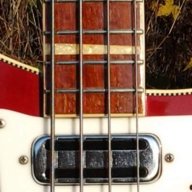


4003JPSVP_1200_7124a.jpg


4001V63-1200_9082.jpg


4001-1200_0735.jpg
 
Hi I just bought a very early 1973 checkerboard binding bass....
Congratulations! I have a '72, that was an excellent era for the 4001. Those original toaster pickups are magic, and the skunk-strip necks (hidden by your JetGlo) are really stable. Make sure any truss rod adjustments are done correctly, they don't work like a F****r.

@Aceonbass can answer all your questions about wiring harnesses, and he can make a replacement harness that will bring out the best from your bass, with a push-pull switch to control whether the "vintage" capacitor is in the circuit.

I've never understood the fanaticism about keeping original pots in instruments unless they were pristine collector's items and preserving total originality has a big effect on the monetary value. It sounds like you want your bass as a player, not a museum artifact or a financial investment. It's already been modded, it's yours now, so don't be afraid to do the things that will make it the instrument you want! If I remember right, the horseshoe was still available as a factory option in the early 70s, but used the 70s surround, not the old 60s style. If you want a period-correct look, put a horseshoe pickup in the existing surround, and rock the hell out of it!
 
  • Like
Reactions: Rezdog
The CTS pots RIC was using in the 70's should be 500k for tone and 250k for volume. This is what I use also. C1, C2 and C3 refers to the three lugs on a potentiometer, and has nothing to do with tone caps. The push pull pots I use require 1" of cavity depth. Whenever possible, an original vintage instrument should retain all of its original parts if it is to retain its greatest value. Original date coded pot casings can be used with modern internals to restore a wiring harness. I liken it to having all of the correct date codes and casting numbers on parts in a vintage auto.
 
  • Like
Reactions: Rezdog
Greetings from the North,

As mentioned before the original parts help to retain/establish value. What I've done in recent years with any of my Rics or other basses for that matter is setting aside or zip lock bagging & labelling any original parts that I've replaced. That way you can restore the bass to the original configuration or pass the parts on to the next owner.

Rezdog
 
  • Like
Reactions: Aceonbass
Thanks so much definitely hit up aceofbass. Found out the electronics are newer Rickenbacker stock not original as well as a few other little things which makes me feel better about my project. I got the right bass to do this on I won't devalue it. Basically I love the 60s 4001s that are deluxe with the triangle inlay and checkerboard binding. In my opinion the best bass Rickenbacker made was the 60s 4001s. So with the checkerboard binding , horseshoe, correct Pickguard and thumb rest other than the missing walnut wings (which you can't see under Jetglo), and the poured not crushed inlay ( which you have too see up close to tell the difference, plus some earlier 4001s I saw had a non crushed inlay that at first glance look similar to my poured inlays) ... My 73 once converted should look at first glance to a non Rickenbacker expert to be a mid 60s 4001 and it being made mostly pre transition is basically made the same during the same era as a 60s 4001... So I hope with correct parts I can get 90-95 percent there tone wise. This particular bass was played a ton and loved. It has that special resonance when played acoustic. I would imagine it vibrates more and has more resonance than the average new Rickenbacker. Got a good feeling about the tone I'll get out of this bass wood wise. I'm mostly a metal and rock bassist and that Squire 4001 trebley mid growl is a monster tone not many in Rock are using anymore these days. I can only imagine what my 4001 played agressively to aggressive music will sound like in a high end studio. I'm hoping close to Paul D'Amour from Tool when he used a chris Squire Signiture 4001 in the mid 90s. That way the bands I work with will be thrilled and me being a prog and Yes/Squire fanatic will be even happier. Personally I'm not a metal fanatic but I'm grateful for the breaks and bands I've gotten. Anyone ever gotten a Lollar Horseshoe ? I've seen some people actually say it's even better than a vintage horseshoe pickup. They have adjustable pole pieces and Jason said probably around 10 years before it needs to be reguassed. That's a big promise but if it even comes close to that long I've be very happy. The old horseshoes I've heard are fuzzy and can be hard to maintain for optional tone. Needing reguassing and having obvious common issues from aging. Part of me is thinking just maybe the lollar Horseshoe could be awesome and on par with a 60s. A few people said they are better in there opinion. Probably be months or years before I can grab the real deal 60s horseshoe for sale. Wanted to ask was thinking about getting the polarity switched on the horseshoe to cancel the noise between the toaster and horseshoe. How much noise and how bad is the feedback on a horseshoe/toaster 4001 ? Will getting the Horseshoe built in reverse polarity ruin the Squire tone I'm after ? Also curious if the neck construction on mine might even sound better and be sturdier than the walnut wing headstocks ? Thanks to you all. Beyond grateful for all your help and input


Congratulations! I have a '72, that was an excellent era for the 4001. Those original toaster pickups are magic, and the skunk-strip necks (hidden by your JetGlo) are really stable. Make sure any truss rod adjustments are done correctly, they don't work like a F****r.

@Aceonbass can answer all your questions about wiring harnesses, and he can make a replacement harness that will bring out the best from your bass, with a push-pull switch to control whether the "vintage" capacitor is in the circuit.

I've never understood the fanaticism about keeping original pots in instruments unless they were pristine collector's items and preserving total originality has a big effect on the monetary value. It sounds like you want your bass as a player, not a museum artifact or a financial investment. It's already been modded, it's yours now, so don't be afraid to do the things that will make it the instrument you want! If I remember right, the horseshoe was still available as a factory option in the early 70s, but used the 70s surround, not the old 60s style. If you want a period-correct look, put a horseshoe pickup in the existing surround, and rock the hell out of it!
 
Last edited: