• TalkBass has been independent since 1998. Add your voice.
    Create a free account to reply to discussions, view embedded media, and browse with fewer display ads.
    Join freeLog in
    Want zero display ads or expanded classifieds tools? Compare plans.

Roasted Necks on basses

Is anyone growing weary of the “roasted neck” craze?

  • Yes, I’m growing sick of seeing them!

    Votes: 9 4.6%
  • I’d like to see less of them.

    Votes: 10 5.1%
  • There ought to be choices: Well done, Medium Well, Medium, Medium Rare, Rare.

    Votes: 39 19.8%
  • I like them in moderation.

    Votes: 47 23.9%
  • Pile’em on!

    Votes: 55 27.9%
  • Great for kindling!

    Votes: 4 2.0%
  • Roasted carrots are better.

    Votes: 33 16.8%

  • Total voters
    197
  • Poll closed .
Feels odd to have a discussion about overused cosmetic trends
Just so you know, Torrefaction (aka roasting) is not a trend. Or if it is, it's a damn long one. And it's not really about cosmetics, but if you like the look better, OK.

The Vikings (not the football team, actual vikings) used torrefaction for the wood on their longships because they knew (1400+ years ago) that the wood held up better in the environment. For those wondering if torrefaction makes the wood "weak", the technique was used on warships.
 
I apologize it was K-Line guitars that stopped using it. He is at the top of his class so i don't question his knowledge on the subject but of course everyone will have a different opinion. This is a quote from him about discontinuing use.

"Very brittle. Also had three go backbow on me in the last year. I did not do too many to begin with but the rate of failure is not great. Also tends to develop small hairline cracks even with oversize tapped holes and wax on the screws. Not worth the hassle."
Maybe he should blame his supplier of roasted neck blanks and not the process as a whole.
 
I'm still wondering is there a window where too little or too much roasting affects the integrity of the neck? Kinda like how you need to get your rice or pasta off the pot during that "sweetspot" window or it'll be undercooked crunchy or overcooked mush, both of which are not good.
On a sidenote: you can overcook top quality pasta by several minutes and it won't get mush at all. May be the same with maple, but I don't know.
The questions you are raising are really valid IMO.
 
I'm all in favor of them if this maxim actually works over time.
I have had extremely good luck with roasted necks in terms of stability when the whole neck is roasted (including the fretboard). With a rosewood fretboard, the fretboard changes differentially than the roasted part of the neck, and you do a tweak a couple times a year (where I live we have huge humidity swings), but after 3 or 4 years, as the rosewood stabilizes, the tweaks seem to be getting much smaller. The all roasted maple necks I don't have to adjust, unless I change string gauges.
As a counter point to the stability I know of a few techs who won't do any significant work on roasted maple necks. Even just drilling in for new tuner screws can chip the wood. Suhr has stop using it on guitar builds completely. He said it wasn't worth the headaches
I've built a couple dozen basses with roasted necks at this point. Half 4 strings, half 5 strings, that's on the order of 108 tuner holes I have drilled - mostly with a hand drill. So far, not a single chip, crack, or any other wood strength related issues. In my case, all my necks are Warmoths - with some of the other necks (where they roast much more/darker), not sure what the result would be.
 
Last edited:
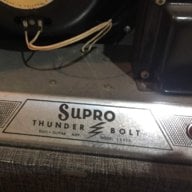
Thunder Front.jpg


Most of my basses have roasted necks and bodies at this point. On this one, the body has no top and the fretboard is roasted maple; there isn't any non-roasted wood on the thing. I did it originally for weight reasons, but I'm convinced it helps the acoustics as well. The thing really rings when you tap on the back of the neck.
 
If you keep your bass long enough it will become a roasted neck over time anyway. My 25 year old Lakland 55-94 has that patina. It just kinda happens over timeView attachment 7300662
Maple will darken - whether it's the wood or the finish, the changes occur on the surface. If you cut into an old piece of wood, it's still pale in the middle - it hasn't really aged in there. If you cut a piece of torrified wood, it is dark al the way through from day one. The processes are different - from what I see, it'd take more than a few decades for a regular maple neck to catch up with a roasted one.

Some woods will change throughout. If you drive screws in certain old studs, they literally scream at you - the wood has aged thoughout. Softwoods are more porous, maple is pretty well closed cell, its surface seals off the interior more than a lot of woods do.
 
I had never played or owned a roasted neck before my Harley Benton doohickey.

Don't know if it adds anything to the sound of the bass because there is so much new happening for me. Multi-scale, 5-piece neck, single cut, stainless steel frets. But it does feel good under the hand, I like that. 😊
 
  • Like
Reactions: Larryfales
I'm all in favor of them if this maxim actually works over time.
This is LITERALLY the reason why manufacturers do the, comparatively expensive, process of roasting necks rather than just staining them.
I'm honestly a bit shocked that people think it's just about "oooh what a pretty colour".

 
  • Like
Reactions: DJ Bebop
I’ve had three basses with roasted maple necks, and loved the feel and look.
- Stingray Special with Ebony board
- Sterling Ray35 with roasted maple board
- Charvel Pro Mod San Dimas V with “caramelized” (roasted) maple board

The SS with ebony looked incredibly rich, and the oil finish was so smooth to play.

Amongst several Fenders with various shades of vintage yellow tint, I also have a 2017 Pro Jazz with zero tint and holy heck does it look white next to all the rest. I sorta want to take the neck off and leave it in the sun for a while to darken it up some.

I don’t believe it’s going away, and look forward to when it’s standard on Fenders.
 
Last edited:
  • Like
Reactions: DJ Bebop
I have two, nice medium color.
They don't move in any seasonal swings.
I have several customs from the same builder: my all my first ones with regular maple all took a while to settle in for my climate and stop moving, and still move as expected from very dry winter to very humid summer.
But my two with roasted never moved since they landed, rock solid, never had to acclimate.
 
Roasted necks are no longer unique. Since it’s a very inexpensive process we’re seeing more of them in cheap basses. I prefer ebony and standard maple fretboards.
You’re talking about two different things. You can have a roasted maple with an ebony or maple fretboard. I don’t consider them a fad, but an improvement.

The key to roasted maple is not how it looks. They are more stable than non roasted necks since the roasting process removes most of the moisture. Personally that is a big plus in my book.
 

Latest posts