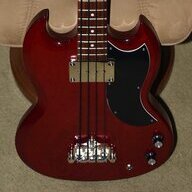
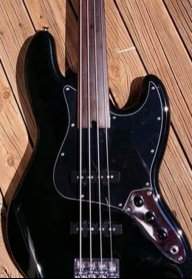
Unless you also demonstrate that the electronics (pickups etc) are identical, then all you have shown is that two different basses sound different. And they do indeed sound different. In fact, the difference is so great, that I seriously doubt it is due to the fretboard wood.
-
This.
To put this debate to rest, here are just a
few of the things that would have to take place, in no particular order.
1. You would have to use the same body, strings, nut, tuners, string trees, and truss rods. Only the neck could change. And, you would have to torque the neck screws to the precise nM every change. And the necks would have to be spot-on; weight, dimensions, etc.
2. You would have to use a minimum of 100 maple and 100 rosewood necks (1,000 is better; lowers the error sampling rate). These two sets of 100 necks would have to all weigh, within miniscule amounts of tolerance, all the same. This is probably the best way to gather density data. All the rosewood slabs would also have to be cut from the same source, and the glue used would have to be from the same batch.
3. All these necks would have to be made from the same source woods; IE all necks cut from the same timber.
4. They all would have to be PLEK'd.
5. To eliminate player deviance (pressing too hard, etc.), the guitars would then have to be played via some type of mechanical means.
6. The audio result data from all this would then need to be peer-reviewed by audio engineers.
7. These experiments would then have to be (preferably) double-blind tested with bassists of similar skill levels.
8. The amps used must remain constant output and energy input with constantly measured voltages to avoid spikes and background noise.
9. All these test would have to be conducted in a chamber with the same air temperature, density, pressure and humidity.
Remember, elimination of variables is key. These are just some off the top of my head. If anyone has the time or money to make this a reality, I'd like to see it.







 .
.


 .
.