• TalkBass has been independent since 1998. Add your voice.
    Create a free account to reply to discussions, view embedded media, and browse with fewer display ads.
    Join freeLog in
    Want zero display ads or expanded classifieds tools? Compare plans.

Rule of thumb for clipping new strings

it depends on the type of tuning posts the instrument has.

The G and D strings I do not cut if going on a in line headstock.

It also depends on the string and how thin they taper off to at the tuning post.

Generally people say two posts away, but I like to do a little more than that..
 
Generally people say two posts away, but I like to do a little more than that..

Me, too. I like to have two (B, E, and A) or three (D and G) turns around the post, when I'm done.

I measure off about half again (i.e., 1-1/2 times) the width of my hand across the knuckles, make the 90 degree bend there, and cut the string to leave about a half-inch tail to go into the hole in the post.

Works pretty well for me: enough wraps to keep the standing part of the string pushed down in the nut slot.
 
Depends on the diameter of the post. Three turns is enough, to my opinion. Too many turns make the settling time longer. Under tension the strings will find the shortest route around the posts, making extra tuning required. On my Ibby the strings start in the centre of the post, almost one inch down. Then there's a sharp bend onto the surface of the post. The strings are anchored quite well this way, so there's no need for many turns.
 
Don't forget about the unfortunate TB member who just got pricey TI Flats, clipped them too short on his 2x2 headstock, and there were not enough windings on some of the posts to force the string down to the headstock to create that sharp break angle that TI Flats need to prevent buzzing.

I also started crimping the bend the slips into the post before I make the cut on all strings types now.
 
I always bend the string to a 90° angle before I cut, and I cut about 5/8" to 3/4" from the end. This gives you something to stick into the hole in the middle of the peg.
 
I'll rephrase that. "What is the politically correct way to clip your non denominational strings?"

:P

First, acknowledge that all strings have equal right to be on your bass. Then you must choose a set based purely on performance; not from some arbitrary discriminating factor like color, gauge, silk style, or brand.

There's no need for stringism.
 
Im a hand-ruler user also. I put the bottom of my hand (wrist) on the post then measure the string up to my 1st knuckle. Cut there. I get a nice uniform 3 winds around the post.
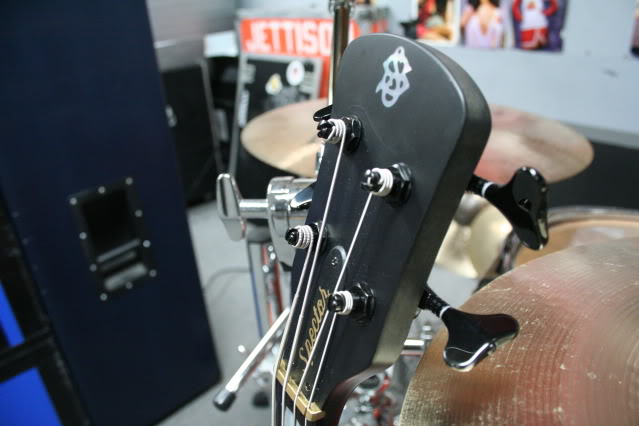
IMG_3149.jpg
 
I use hand widths, too. Thought I was the only one. :)

Two hand widths, maybe a little more, for the vintage, fat tuning pegs, one hand width plus a little more for smaller pegs.

I never think to use the old string as a perfect model.
 
Alas, if only I had read this thread first...

One good trick I learned is to pre-cut the string based on the original string length...
That's what I TRIED doing, it's what I've always done, but the TIs are so low tension that it gave me massive buzzing instead.
Don't forget about the unfortunate TB member who just got pricey TI Flats, clipped them too short on his 2x2 headstock, and there were not enough windings on some of the posts to force the string down to the headstock to create that sharp break angle that TI Flats need to prevent buzzing.

I also started crimping the bend the slips into the post before I make the cut on all strings types now.

Howdy. That was me. Yeah, not fun. Learned my lesson.
Although I did fix the problem by winding the part I clipped off into the winds around the post, pushing it down far enough. I'll have to take a picture to show what I mean.
 
That's what I TRIED doing, it's what I've always done, but the TIs are so low tension that it gave me massive buzzing instead.

I'm a bit confused by this statement. If the buzzing was coming from the saddles, it would be an issue with a lack of downward pressure caused by cutting it too short. If the buzzing was coming from the frets, that would be caused by the tension.
 
I'm a bit confused by this statement. If the buzzing was coming from the saddles, it would be an issue with a lack of downward pressure caused by cutting it too short. If the buzzing was coming from the frets, that would be caused by the tension.

The first. It's a fretless bass, I should have said that. I'm guessing it was caused by the tension drop, because they are literally cut the EXACT SAME length as the set that was on before. I never had buzzing issues with the old set, though.

Regardless, it's been fixed.