
Enjoy the benefits of a premium membership!
Upgrade Account
-
TalkBass has been independent since 1998. Add your voice.
Create a free account to reply to discussions, view embedded media, and browse with fewer display ads.
Join free Log in
Want zero display ads or expanded classifieds tools? Compare plans.
You are using an out of date browser. It may not display this or other websites correctly.
You should upgrade or use an alternative browser.
You should upgrade or use an alternative browser.
Rumble 210+210 impedence setting
- Thread starter gabe878
- Start date
More options
Who Replied?

Hello, I'm new here, and I'm sure this has been talked about a million times, but I can't find a direct answer. I own a Fender Rumble stage 800. Just bought a Rumble 210 extension cab. Do I set the ohms to 400watt 8ohms, or 500watt 4ohms? Thanks!
The manual says...
N. EXTERNAL SPEAKER OUTPUT AND IMPEDANCE SWITCH (RUMBLE STAGE ONLY): Connect an exter-
nal speaker cabinet here (8Ω or 4Ω minimum impedance); combination jack works with Speakon® or 1/4"
speaker cable.
>>> Set switch to match impedance rating of external cabinet; <<<
continuous power rating of external cabinet must meet or exceed power rating listed for the chosen switch setting.
Set switch to 8Ω when no external cabinet is connected.
I will admit that this isn't the best written instruction I've ever seen.
Looks like it says to use the 8 Ohm setting with no external cab, or with an external 8 Ohm cab, such as your Rumble 2x10. The 4 Ohm switch setting is used if you connect a 4 Ohm external cab. This sets the amp to operate at lower impedances than 4 Ohms.
Most SS amps do reduced power at 8 Ohms and full power, at 4 Ohm without needing a switch. This amp can drive a lower impedance (Ohms) load if you switch to the 4 Ohm position.
Clear as mud, eh?
Also look at the POWER OUTPUT part of the specifications at the end of the manual.
Last edited:

Haha, yes! It just confuses me more. I will look at the manual with my lawyer dictionary out this time. I have it set on 8ohms, and it seems to be working fine. Thanks for your help.The manual says...
N. EXTERNAL SPEAKER OUTPUT AND IMPEDANCE SWITCH (RUMBLE STAGE ONLY): Connect an exter-
nal speaker cabinet here (8Ω or 4Ω minimum impedance); combination jack works with Speakon® or 1/4"
speaker cable.
>>> Set switch to match impedance rating of external cabinet; <<<
continuous power rating of external cabinet must meet or exceed power rating listed for the chosen switch setting.
Set switch to 8Ω when no external cabinet is connected.
I will admit that this isn't the best written instruction I've ever seen.
Looks like it says to use the 8 Ohm setting with no external cab, or with an external 8 Ohm cab, such as your Rumble 2x10. The 4 Ohm switch setting is used if you connect a 4 Ohm external cab. This sets the amp to operate at lower impedances than 4 Ohms.
Most SS amps do reduced power at 8 Ohms and full power, at 4 Ohm without needing a switch. This amp can drive a lower impedance (Ohms) load if you switch to the 4 Ohm position.
Clear as mud, eh?
Also look at the POWER OUTPUT part of the specifications at the end of the manual.
Problem I'm seeing is the continuous power of external cabinet is only 350 watts. It's so confusing to me.The manual says...
N. EXTERNAL SPEAKER OUTPUT AND IMPEDANCE SWITCH (RUMBLE STAGE ONLY): Connect an exter-
nal speaker cabinet here (8Ω or 4Ω minimum impedance); combination jack works with Speakon® or 1/4"
speaker cable.
>>> Set switch to match impedance rating of external cabinet; <<<
continuous power rating of external cabinet must meet or exceed power rating listed for the chosen switch setting.
Set switch to 8Ω when no external cabinet is connected.
I will admit that this isn't the best written instruction I've ever seen.
Looks like it says to use the 8 Ohm setting with no external cab, or with an external 8 Ohm cab, such as your Rumble 2x10. The 4 Ohm switch setting is used if you connect a 4 Ohm external cab. This sets the amp to operate at lower impedances than 4 Ohms.
Most SS amps do reduced power at 8 Ohms and full power, at 4 Ohm without needing a switch. This amp can drive a lower impedance (Ohms) load if you switch to the 4 Ohm position.
Clear as mud, eh?
Also look at the POWER OUTPUT part of the specifications at the end of the manual.
Problem I'm seeing is the continuous power of external cabinet is only 350 watts. It's so confusing to me.

8 ohm cabinet set to 8 ohms.
4 ohm cabinet set to 4 ohms.
Very simple
4 ohm cabinet set to 4 ohms.
Very simple

Hopefully this helps clarify.
Specs:
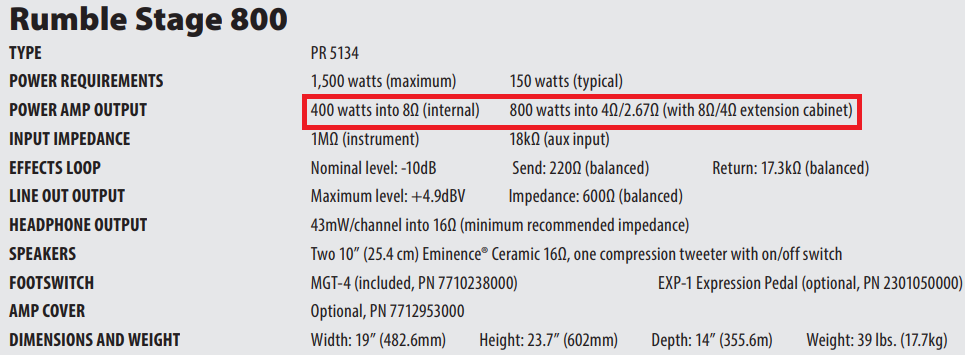
Note the area in red. The internal speaker is 8 ohms. The minimum impedance is 2.67 ohms. You can run either an 8 ohm or a 4 ohm extension cab. FYI, Using an 8 ohm extension results in a 4 ohm load, and using a 4 ohm extension results in a 2.67 ohm load.
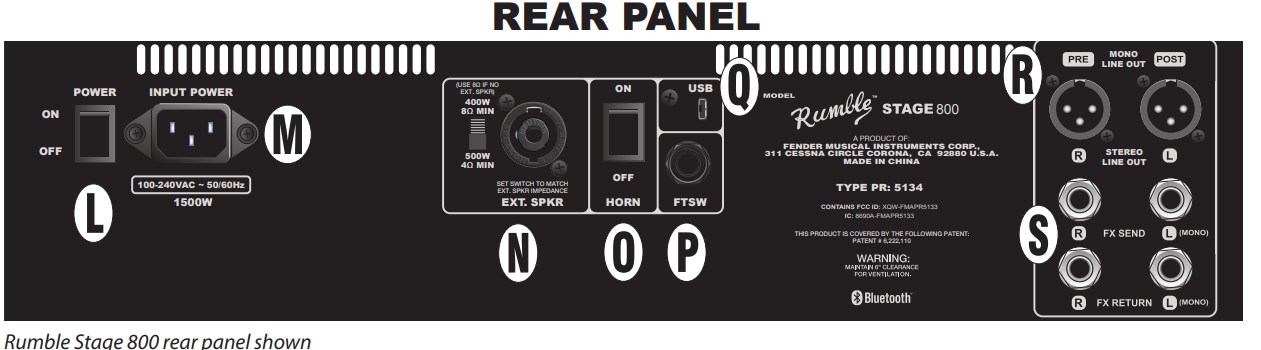

Notice the area in red. The switch is specific to the impedance of the extension cab, rather than the total impedance. Per the specs, the amp makes 800W at either 4 ohms or 2.67 ohms. If you use an 8 ohm extension, set switch to 8 ohms. Total power is 800W and each cab will get 1/2 of the power (400W).
If you use a 4 ohm extension, set the switch to 4 ohms. Total power is still 800W but it will not be shared equally. [266.67 + 533.33= 800] The internal 8 ohm cab will get 266.67W and the 4 ohm extension cab will get 533.33W--a little more than the back panels says.
Specs:
Note the area in red. The internal speaker is 8 ohms. The minimum impedance is 2.67 ohms. You can run either an 8 ohm or a 4 ohm extension cab. FYI, Using an 8 ohm extension results in a 4 ohm load, and using a 4 ohm extension results in a 2.67 ohm load.
Notice the area in red. The switch is specific to the impedance of the extension cab, rather than the total impedance. Per the specs, the amp makes 800W at either 4 ohms or 2.67 ohms. If you use an 8 ohm extension, set switch to 8 ohms. Total power is 800W and each cab will get 1/2 of the power (400W).
If you use a 4 ohm extension, set the switch to 4 ohms. Total power is still 800W but it will not be shared equally. [266.67 + 533.33= 800] The internal 8 ohm cab will get 266.67W and the 4 ohm extension cab will get 533.33W--a little more than the back panels says.
Is the amp in this rig the 500 combo or the Stage 800?
Hello, I'm new here, and I'm sure this has been talked about a million times, but I can't find a direct answer. I own a Fender Rumble stage 800. Just bought a Rumble 210 extension cab. Do I set the ohms to 400watt 8ohms, or 500watt 4ohms? Thanks!
I think you have the answer a couple times, and definitely in the first response, so welcome to Talk Bass.
>>> Set switch to match impedance rating of external cabinet; <<<
Yeah. I saw that two, then looked at the manual for the 2x10 cab.Problem I'm seeing is the continuous power of external cabinet is only 350 watts. It's so confusing to me.
Quote: "A companion for the 500 Combo."
Rumble stage 800 extension cab
Also ran across this thread from nearly four years ago.
Rumble stage 800 extension cab
There is a Rumble Club on TB, maybe you can get some experienced responses there?
But yeah, I'm feeling your pain, and supposedly I am somewhat versed in the ways of Ohm's law. While that covers resistance and power and other mostly static situations it's not a lot of help here. Your's is a dynamic system involving much more than covered by Ohm and his rules of electricity.
Though I still hold that this setup will be so stupidly loud that you'll never crank it up all the way in normal use. At this point it pays to be conservative, and listen to the speakers for the sounds of being stressed.

Im pretty clueless on the subject, but Surely the technology must exist for the amp to simply sense the load of any speaker combination applied and supply power accordingly? Why is that NOT standard on many (most?) Amps? Not being snarky, just curious. That would seem to aptly fit the term "plug and play".

The Stage 800 is a combo and puts out 400 watts at 8 ohms using the internal speakers. The extension cab is identical to the ordinary Rumble 210 cab, save for the grille cloth and corner protectors, and is therefore 8 ohms as well. When you connect it to the combo, the total load will be 4 ohms, with a total output of 800 watts. Don’t worry about the power rating of 350 watts - Rumbles are very conservatively rated, so you’ll be fine.

...I'm feeling your pain, and supposedly I am somewhat versed in the ways of Ohm's law. While that covers resistance and power and other mostly static situations it's not a lot of help here. Your's is a dynamic system involving much more than covered by Ohm and his rules of electricity.
Though I still hold that this setup will be so stupidly loud that you'll never crank it up all the way in normal use. At this point it pays to be conservative, and listen to the speakers for the sounds of being stressed.
I second that last advice, it's the easiest way to get close to solving.
Basically there is also Watt's law, like Ohm's but relates to power, and it's when both work together that it gets slightly odd. W=V2/R, where R is the speaker impedance, V is voltage, and W is the power, watts. Without getting to details like frequency-depenance of impedance, it's important to see that SMALL changes of voltage can make big changes in power, it goes up as a 'square law'. The numbers don't matter, but that square law thing DOES because it trumps all other scales of intensity in the calculation.
In practise what that means is it's only the strong transients in the output that will drive anywhere near the full power, if you're careful to avoid blasting all controls to 11 and trying to break your guitar. The usual signs of hard transients is a farty sound on the attack of the note. So long as you back off when that happens (assuming you're not making a preamp do it deliberately), it will be safe unless something else is wrong somewhere.
Just turning up volume goes with a non-linear curve so anything but full throttle on a 400W amp into a 400W cab will actually drive a lot less than 400W. In other words, get the impedance matched, that's important, but matching power is far less so if you're careful to listen for signs of stress.
Im pretty clueless on the subject, but Surely the technology must exist for the amp to simply sense the load of any speaker combination applied and supply power accordingly? Why is that NOT standard on many (most?) Amps? Not being snarky, just curious. That would seem to aptly fit the term "plug and play".
Would be nice, but there are too many physical variables.
That said, those of us who like a hard snarly tone in a bass have to work out the sound in advance, with low level signals, then feed that via a clean power stage to the cab. Well, we do if we want an easy life and don't want to go through speakers like chowing our way through a sack of spuds.Stage 800Is the amp in this rig the 500 combo or the Stage 800?
Thank you! This knowledge sets my mind at ease.I second that last advice, it's the easiest way to get close to solving.
Basically there is also Watt's law, like Ohm's but relates to power, and it's when both work together that it gets slightly odd. W=V2/R, where R is the speaker impedance, V is voltage, and W is the power, watts. Without getting to details like frequency-depenance of impedance, it's important to see that SMALL changes of voltage can make big changes in power, it goes up as a 'square law'. The numbers don't matter, but that square law thing DOES because it trumps all other scales of intensity in the calculation.
In practise what that means is it's only the strong transients in the output that will drive anywhere near the full power, if you're careful to avoid blasting all controls to 11 and trying to break your guitar. The usual signs of hard transients is a farty sound on the attack of the note. So long as you back off when that happens (assuming you're not making a preamp do it deliberately), it will be safe unless something else is wrong somewhere.
Just turning up volume goes with a non-linear curve so anything but full throttle on a 400W amp into a 400W cab will actually drive a lot less than 400W. In other words, get the impedance matched, that's important, but matching power is far less so if you're careful to listen for signs of stress.
Thank you! This knowledge sets my mind at ease.
Thanks. Mind you, seeing a good second or third opinion will set mine at rest too.
Good thing about TB, there are so many people, you'll probably get a good one.
Im pretty clueless on the subject, but Surely the technology must exist for the amp to simply sense the load of any speaker combination applied and supply power accordingly? Why is that NOT standard on many (most?) Amps? Not being snarky, just curious. That would seem to aptly fit the term "plug and play".
It is even simpler (in most cases) than any type of sensing. An amp generally will just provide all the power it can based on the impedance of the cabs connected to it. Impedance (like resistance) is a measure of how much the signal will be restricted from full flow. Tube amps require having some means to account for the impedance of the speakers connected to it. That's a whole other discussion. A Solid State Amp can just "sense" the impedance, but sometimes there will be a switch for lower than 4 Ohm operation. This may have more to do with better efficiency of the power amp than the actual impedance the amp sees.
In electronics we often learn about this stuff by using the analogy of water flowing through a pipe. The water pressure available at the faucet is like voltage, the diameter of the hose is like resistance or impedance, the rate that the water flows from the hose is the current.
If you open the faucet up all the way, (turn your amp to ten) all of the water pressure (voltage) available can be used. If you hook up a smaller hose (higher cab impedance) not all of the available water will flow, (less current is drawn from the amp). If you connect a larger hose, (4 Ohm cab or two 8 Ohm cabs) this will allow more water (current) to flow. It is the combination of voltage x current that we measure as power. I guess you can say the rate of flow (as restricted by the hose size) x the water pressure will create a force of flow (power) out of the hose.
If you don't open the faucet all the way (don't dime your amp) there will be less pressure available and things won't get as loud.
These water analogies don't work as well when we talk about a cab's impedance. While both impedance and resistance restrict current flow. Resistance refers to what happens at D.C. Once we add the frequencies of the audio involved, it gets more complicated. But in simple terms, impedance is a measure of the restriction to current flow in an A.C. circuit. It's ability to restrict that flow depends on the frequencies involved. With audio, that can be around 20 Hz (Hertz or cycles per second) up to around 20,000 Hz.
That impedance rating on your speaker does not apply at all frequencies used. It is not a constant value across the audio spectrum. Therefore, they sometimes use the term Nominal Impedance. This means in name only. The actual instantaneous impedance of a speaker changes with the frequencies of the signal applied to it. You don't normally need to concern yourself with this, just the what the nominal (nameplate) impedance is.
What Speaker Impedance Means and Why It Matters
Small hint on verifying impedance if you have an ohm meter: if it's meant to be a nominal binary multiple, i.e. 4, 8, 16, then the DC ohm meter reading will usually be between the nominal value and half of that value, likely a bit more than 6 if supposed to be 8. Readings like this can be a good way to start checking for loss of a driver in an array. It's the fastest test, so often wise to do first, but don't rely on it alone. Better yet, do it on a known good cab, note it in writing, then if in doubt later, see if it remained unchanged.


