• TalkBass has been independent since 1998. Add your voice.
    Create a free account to reply to discussions, view embedded media, and browse with fewer display ads.
    Join freeLog in
    Want zero display ads or expanded classifieds tools? Compare plans.

SBO 23 - All Spruced Up

Dec 11, 2019
893
3,208
UK
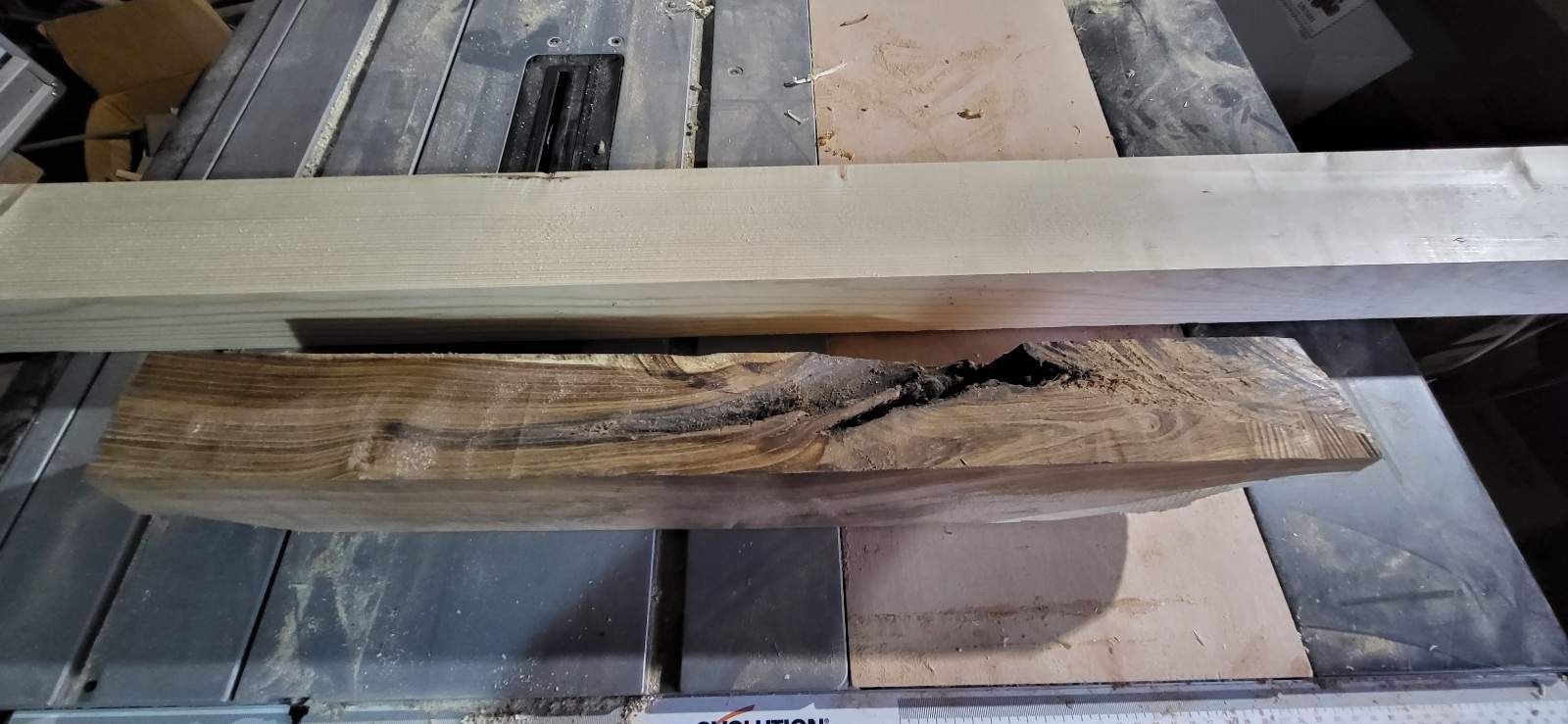
My entry to summer build off 23 is based on an idea most of us have had. Can you build an instrument from construction lumber. My guess is yes.
20230620_093332.jpg


Here is a piece of spruce from a DIY supermarket, and the last of a laburnum log that I think has another fretboard in it. Let's see what the summer brings.
 
I've recently taken apart two of my earlier basses that I wasn't fond of and I'm going to reuse the parts. The spruce is left over from my Acoustic Double Bass build and the Laburnum I've used for several things. There's a very strong new beginnings from old theme going on.

I'm going to make a bolt on, headless spruce neck and a 3 piece spruce body. Short scale, 4 strings, and for a change I'll try painting the body. It is a whole crossroads of new directions for me.

On the spruce neck, Spruce has a modulus of 9.7 GPa compared to the 12.6 GPa of Hard Maple. But stiffness is thickness cubed times modulus. A 23mm spruce neck will be as stiff as a 21mm maple neck.
 
Last edited:
The laburnum looks tasty. I've got a lead on a rather large laburnum log (well large for laburnum anyway) which has been well seasoned in a barn for several years.
It does *NOT* like to be planed against the grain, but it is a nice piece of wood when sanded. So I've read, it is the closest to rosewood a British native timber gets. I've done a few fretboards and a top from it and I've always been pleased with the results.
 
There are wood hardener products out there, though I've never tried using them. If you're building with pine lumber, it's gonna be soft. I guess you could have tried a coat of epoxy before priming, but I don't know how much of an effect it would have.
 
As a recovering engineer that sees the benefits of headless design, I only just saw that the lower bout really reminds me of a Strandberg design. I like!
It's an evolving design. I like asking What is the function of a bass body? rather than just copy what has been done before. Some just copy the twin bout shape of an acoustic guitar. The bottom side of a body needs a hook to sit on the player's leg, and enough room to house the electronics. With no need to counterbalance a headstock, I've taken everything else away.
 
I've found a little time today to fit the electronics. Disappointingly, I'd mismeasured the cavity so had to take a Dremel to it to make it all fit. The nut I took off one of the donor bases is too narrow, so I'll have to make a new one. I was hoping only to reuse old parts fir this build. As expected it is pretty light. 2479g or 5.5lbs with just the tuners and strings to fit.

20230704_130400.jpg
 
Today is brought to you by the words careless, and measure twice. The neck pocket should have been further in to the body. Normally it wouldn't matter. Just screw the bridge down and you're all good. But with a headless, you need it to be right at the end. The G string saddle is hanging over the end to make it intone. I'll make a thicker tail piece and move the tuners up. I'll fit them more central to the neck while I'm at it.

The action is too low even with the saddles wound up. A deeper pocket would be the best fix, but a negative break angle on the neck will work as well.

All up it is 2654g or 5lbs 13.6oz which is pretty light given no effort was made to save weight.

20230706_215434.jpg
 
An observation on the spruce neck. It has been tuned to pitch overnight and has not moved. With no adjustment on the truss rod from its neutral position there is about the right amount of relief just from the string tension. Thinking about it, that's what I get when I make a neck out of maple. I calculated the neck thickness based on the difference in stiffness between spruce and maple, so it's no surprise I got the same result. It seems like a spruce neck doesn't need to be thicker if you're prepared to take up any slack with the truss rod. Or perhaps just 1mm thicker instead of 2mm.
 

Latest posts