• TalkBass has been independent since 1998. Add your voice.
    Create a free account to reply to discussions, view embedded media, and browse with fewer display ads.
    Join freeLog in
    Want zero display ads or expanded classifieds tools? Compare plans.

SBO22 - Mandola

Routing tearout prone wood along the grain like that is a pain. It can rip even with reeeeallly light passes and the tearout is almost always really bad since it's taking off long slivers instead of small chunks. In those situations I try to only route downhill, i.e. from the heel to the nut. And on really wild wood I will flip the piece so I'm climb cutting AND routing downhill on both sides.

Were you using a bottom bearing bit? It looks like the cutter overshot the bearing a little. Is the neck blank tapered at all? It also looks like the bearing was pressing hard enough against the neck that it caused the little intentation maybe a quarter inch below the fretboard?

 
The rout was from the heel to the nut. Since the neck isn't tapered, that's neither up- nor downhill.

Yes, I used a bottom bearing bit, and now I'm wondering if the little wheel is just too small for the cutters. Haven't noticed this before.

As for the little indentation you mention: I just ran upstairs to my workshop and felt up the neck. The indentation isn't there. Must be some trick of the light.
 
16618625286901975931468.jpg

Some strings arrived, so I can experiment. :hyper:
 
Yes, I used a bottom bearing bit, and now I'm wondering if the little wheel is just too small for the cutters. Haven't noticed this before.
A flush-trim bit should not create a step like that. In the picture it looks like either the bearing is too small or it's routed at a tilt angle. Definitely check your bit with calipers. Note that there are also bottom bearing bits with a built-in offset, for example for binding channels. Maybe it's one of those?
 
I measured the bit with a caliper. The bearing is 9.5mm and the cutters are 9.7mm. Well well.

Thing is, I had some trouble sourcing a bottom bearing router bit. The choice was between this one, which was €12 or another one that cost €54. I'm not going to pay that.

So I'll stick to the twelve euro bit and I'll make it work somehow. Maybe put a sticker around the bearing?
 
I measured the bit with a caliper. The bearing is 9.5mm and the cutters are 9.7mm. Well well.

Thing is, I had some trouble sourcing a bottom bearing router bit. The choice was between this one, which was €12 or another one that cost €54. I'm not going to pay that.

So I'll stick to the twelve euro bit and I'll make it work somehow. Maybe put a sticker around the bearing?
Or get a bearing? That's the correct size.
I can see the tape idea ending badly.
 
I measured the bit with a caliper. The bearing is 9.5mm and the cutters are 9.7mm. Well well.

Thing is, I had some trouble sourcing a bottom bearing router bit. The choice was between this one, which was €12 or another one that cost €54. I'm not going to pay that.

So I'll stick to the twelve euro bit and I'll make it work somehow. Maybe put a sticker around the bearing?
Check out the router bits at Dieter Schmid Fine tools in Germany. They have quality bottom bearing bits in the 20€ range. Trimming Cutters | FINE TOOLS

That current bit is going to cause more trouble along the way. Working with a good flush-trim bit is very rewarding and you save a ton of time in sanding afterwards.
 
  • Like
Reactions: instrumentalist
When I put electric guitar strings on a uke I leave the ball and cut the free end. Wound guitar strings don't mind being cut back. Just kink the string right before you cut it.

I have put a couple wraps of plain old masking tape around router bit bearings when I needed to make very small adjustments to bearing diameter. It works fine. The bearing really doesn't need pressure against the workpiece or template, if you're pushing it too hard you'll have problems no matter what. Tape is more than durable enough to work as a shim.
 
  • Like
Reactions: instrumentalist
I measured the bit with a caliper. The bearing is 9.5mm and the cutters are 9.7mm. Well well.

Thing is, I had some trouble sourcing a bottom bearing router bit. The choice was between this one, which was €12 or another one that cost €54. I'm not going to pay that.

So I'll stick to the twelve euro bit and I'll make it work somehow. Maybe put a sticker around the bearing?
I have put masking tape around a router bit bearing to adjust the size and not had any issues. You do need to be careful that the tape doesn’t protrude past the edge of the bearing and get caught by the cutting edge. But the outer race of the bearing doesn’t rotate at high speed, so there isn’t really any risk there.

Alternatively, you can just run the tape along the edge of the template and accomplish the same thing.
 
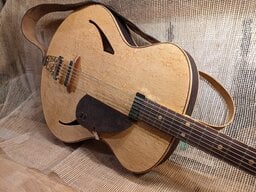
One thing I've really struggled with is the neck angle. I have calculated and measured in many ways, and arrived at slightly different results every time. It's glued in now, so I hope I finally got it right.
View attachment 4799920
I’m glad I’m not the only one. I have drawn and calculated, thought about string tension and downforce and break angle, and still do t really have a plan.
 
I'd say you're pretty close to dead on for neck position...
Thanks. The neck position hasn't been much of a problem. What I was referring to is the vertical angle of the neck. In other words, whether the strings, forming a straight line from the nut to the bridge saddle, will end up in a playable height above the fingerboard.

Since both the nut and the bridge are still unfinished, I'm hopeful that I can cheat my way to playability. :D