
Enjoy the benefits of a premium membership!
Upgrade Account
-
TalkBass has been independent since 1998. Add your voice.
Create a free account to reply to discussions, view embedded media, and browse with fewer display ads.
Join free Log in
Want zero display ads or expanded classifieds tools? Compare plans.
You are using an out of date browser. It may not display this or other websites correctly.
You should upgrade or use an alternative browser.
You should upgrade or use an alternative browser.
Separate active and passive electronics?
- Thread starter Harper Oliver
- Start date
More options
Who Replied?

If I’m following the premise that’s doable, but may be more trouble than is worth. What do you think you’d achieve with this?
I feel this would be especially useful if you play without a guitarist. On one output you could all sorts of affects, and change the eq. With the other output do a completely different sound. Almost like having 2 different players.
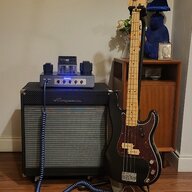
Get a bass with a stereo output or a rickenbacker and a ric-o-sound box (or just an insert cable). Or get a splitter box that you run one input into and two outputs each to a different amp one with heavy effects in the chain and a preamp. Lots of bassists do that .
I have a bass I'm heavily modifying and have sort of the same idea, but rather than running borh at once i would have a footswitch type button on the bass that clicks between the circuits. But both use the same output. It's like two basses in one!
Im planning a Dimarzio DP120 into a passive circuit with a stacked volume and tone knob and then a bartolini MM/J combo into an actuve circuit with a prewired preamp. And the mounted footswitch to click between. I'm pretty sure its possible.
I have a bass I'm heavily modifying and have sort of the same idea, but rather than running borh at once i would have a footswitch type button on the bass that clicks between the circuits. But both use the same output. It's like two basses in one!
Im planning a Dimarzio DP120 into a passive circuit with a stacked volume and tone knob and then a bartolini MM/J combo into an actuve circuit with a prewired preamp. And the mounted footswitch to click between. I'm pretty sure its possible.
Last edited:

This will let you select 2 different outputs or both and provides lots of other switching options.
https://www.boss.info/us/products/ls-2/
https://www.boss.info/us/products/ls-2/

Rickenbacker does that with their Ric-O-Sound system, without one of the pickups being active AFAIK. You might want to check that out on YouTube & read up here to see how users get along with it.
My first concern would be how the two signals blend onstage. (If they're way out of phase, mostly canceling each other out, you might need to flip one of them 180º.)
My first concern would be how the two signals blend onstage. (If they're way out of phase, mostly canceling each other out, you might need to flip one of them 180º.)

Freekmagnet
Commercial User
This will let you select 2 different outputs or both and provides lots of other switching options.
BOSS - LS-2 | Line Selector
This is the best solution. +1.

Running two circuits where one is active and the other is passive works perfectly fine, apart from the obvious potential for volume differences. It's when you want to run passive and active in a single interacting circuit you get impedance issues and such.

Passive / active selector would be better. 2 separate pickups is 2 different pickup positions so that would be a different sound regardless of electronics.

There are a couple of groups that use an outboard option to achieve what you are looking to do. Check out Clatter and Royal Blood. Both are two piece bands with bassist/vocalist and drummer. Both use a splitter outside the bass to send one signal into a bass signal chain, and another to send to a guitar signal chain. I know that Amy from Clatter even has a video on YouTube explaining her setup in detail. Mike Kerr of Royal Blood on the other hand, is well known for guarding his pedal board setup and not sharing how he achieves his sound. There is a video where some guys in the UK tried to get his sound for under a certain monetary marker.
Amy's Video:
The one from the UK guys:
Hope this helps out some.
Amy's Video:
The one from the UK guys:
Hope this helps out some.

You could wire up a passive setup and an active setup on one axe with two output jacks; the rub would be matching output and where each one would be located along the string length.
Actually many basses are wired close to this already. Look for 'active' basses with an active/passive switch. This is a dead giveaway that it's using passive pickups connected to a battery powered active set of cut/boost tone controls. On the better setups, in passive mode, one of the cut/boost knobs becomes a passive tone control.
No separate outs, but easy enough to plug into an A/B splitter with a separate cable to each of the two amps.
Actually many basses are wired close to this already. Look for 'active' basses with an active/passive switch. This is a dead giveaway that it's using passive pickups connected to a battery powered active set of cut/boost tone controls. On the better setups, in passive mode, one of the cut/boost knobs becomes a passive tone control.
No separate outs, but easy enough to plug into an A/B splitter with a separate cable to each of the two amps.

I feel this would be especially useful if you play without a guitarist. On one output you could all sorts of affects, and change the eq. With the other output do a completely different sound. Almost like having 2 different players.
yeah, that works, to some extent. I played around with dual/stereo outputs (tho all passive), and with an LS-2 someone suggested above. I found the latter less complicated and just as useful if not more. Well, I found none of it useful for my band, but it was lots of fun

I’m not sure if/where the value or combining active and passive comes in, but yeah, they’d sound different. Perhaps a nice hi-fi active clean tone + dirty passive tone.

Dual output basses are great fun. Your idea for a combination of active and passive pups in one bass presents no problems at all. Do it! And, report back.
While on the subject, how do you make the bass signal stereo? I know some basses have mono and stereo, how could I make a pickup stereo?
While on the subject, how do you make the bass signal stereo? I know some basses have mono and stereo, how could I make a pickup stereo?
Most of what’s called “stereo” historically has been a 2 pickup instrument with one pickup going to the tip terminal of a TRS jack and the other to the ring terminal. Then you’d use a stereo cable and plug into a box (Ric-O-Sound) that splits the signals to 2 TS jacks or use a Y splitter cable.

Depends on what you think "stereo" means. Usually, it means that there is different information being presented to the left and the right ear. Stereo cannot be realized with a single source.
If you mean that one pickup is dedicated to the left side and another pickup to the right there will be some pitch difference between the two but it's still the same note that is being sensed.
If you mean that only certain strings (say, E and A) go to one pickup and ear, while the other strings (D and G) go to the other ear, the sound will bounce around as you maneuver across the neck.
I'm not a big believer of stereo bass, as I view it as a single source instrument. It's not like a piano where the bass strings are in closer proximity to your left ear than the higher register.
If you mean that one pickup is dedicated to the left side and another pickup to the right there will be some pitch difference between the two but it's still the same note that is being sensed.
If you mean that only certain strings (say, E and A) go to one pickup and ear, while the other strings (D and G) go to the other ear, the sound will bounce around as you maneuver across the neck.
I'm not a big believer of stereo bass, as I view it as a single source instrument. It's not like a piano where the bass strings are in closer proximity to your left ear than the higher register.
I prefer dual mono over using a TRS stereo 1/4" jack for stereo. And with the idea of one active and one passive pup, a single stereo output is either, not possible, or at least much more complicated than dual mono. Think of each pickup being a separate system, but on the same bass.While on the subject, how do you make the bass signal stereo? I know some basses have mono and stereo, how could I make a pickup stereo?

I once modified my '83 Ibanez bass with an EMG-P (active) in the bridge position by also installing a Gibson EB0 (passive) "mudbucker" in the neck position. I had them wired to two completely separate output Jack's.
I used this for occasional recording for several years because I wanted to be able to record a track with a 2nd option available where the bass tone is like the classic Cream/Jack Bruce sound, along with the studio standard P bass sound. Simply run each output to its own track on the recorder and there's the two options.
Although there are some possibilities of using a two output setup on a live stage, Personally, I'm not interested in mucking about with trying to blend 2 bass signal channels into one good bass sound on stage. It could be done (and has been done) but I really don't see the point. It just seems like a lot of effort for very little benefit.
I used this for occasional recording for several years because I wanted to be able to record a track with a 2nd option available where the bass tone is like the classic Cream/Jack Bruce sound, along with the studio standard P bass sound. Simply run each output to its own track on the recorder and there's the two options.
Although there are some possibilities of using a two output setup on a live stage, Personally, I'm not interested in mucking about with trying to blend 2 bass signal channels into one good bass sound on stage. It could be done (and has been done) but I really don't see the point. It just seems like a lot of effort for very little benefit.

Passinwind
I know nothing.
- Dec 3, 2003
- 23,045
- 45,909
- Disclosures
- Designer/Toaster Tech @ Passinwind Electronics
While on the subject, how do you make the bass signal stereo? I know some basses have mono and stereo, how could I make a pickup stereo?
Look at the Roland GK pickups for one approach, the venerable VG-8 and some of the other similar Roland boxes allow assigning individual strings to the left or right outputs.


