• TalkBass has been independent since 1998. Add your voice.
    Create a free account to reply to discussions, view embedded media, and browse with fewer display ads.
    Join freeLog in
    Want zero display ads or expanded classifieds tools? Compare plans.

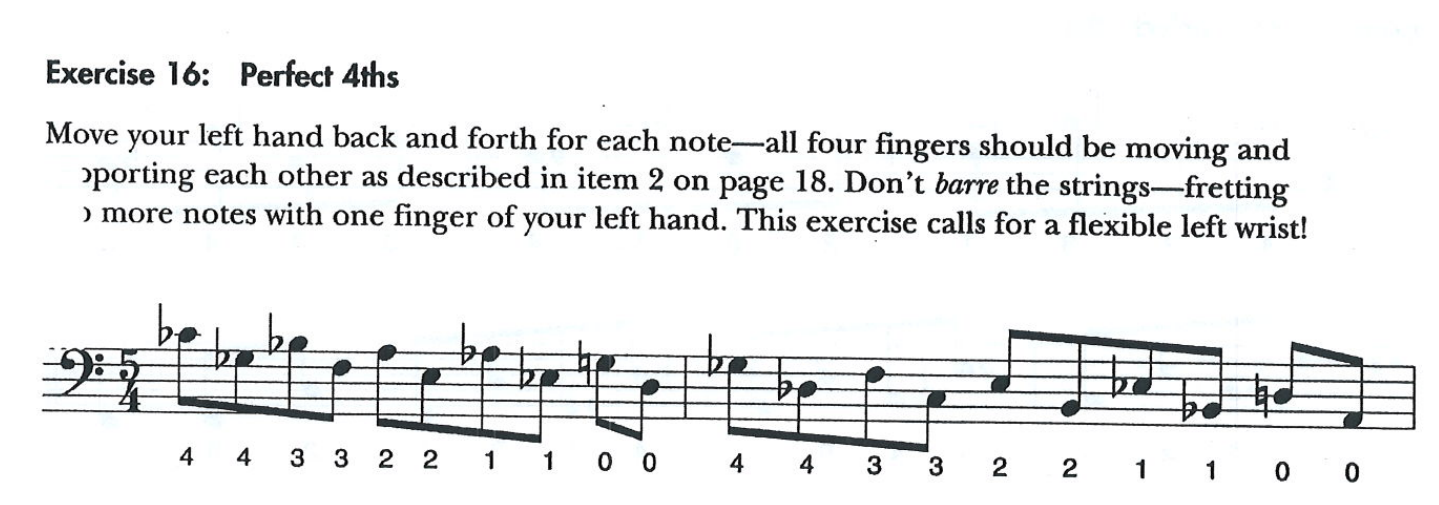
Serious Electric Bass - Ex. 16 - Fourths

Hey, I'm playing this exercise from "Serious Electric Bass". My question is, the author says not to barre the strings, and I assume I need to be in the same position. Does it mean I should jump between the strings? How would you play this?
1749669057822.png
 
Yes jump between the strings. Start very slowly & build it up gradually over months/ years.

This isn’t a ‘song’ you learn in a day….. it’s a short ‘drill’ or ‘technical exercise’ to add to your daily technique practice sessions to strengthen your weaknesses.

Work on this over a long time and you’ll really hone your skills in ways you won’t realise until you do.
 
Last edited:
  • Like
Reactions: docent_lol
Hey, I'm playing this exercise from "Serious Electric Bass". My question is, the author says not to barre the strings, and I assume I need to be in the same position. Does it mean I should jump between the strings? How would you play this?

View attachment 7249260
It would be useful to first see what is recommended in Item 2 on Page 18 before making further comment. I will guess it shows a left hand being forced open with the fingertips on/over each of frets 1-4 of the same string.
 
  • Like
Reactions: docent_lol
It would be useful to first see what is recommended in Item 2 on Page 18 before making further comment. I will guess it shows a left hand being forced open with the fingertips on/over each of frets 1-4 of the same string.
1750875360444.png


It's actually a bit confusing to me, as it means when playing, say, G# to C# on the E and A strings, all 4 fingers would need to jump at the same time? While pressing the neck in both positions?
 
View attachment 7260057

It's actually a bit confusing to me, as it means when playing, say, G# to C# on the E and A strings, all 4 fingers would need to jump at the same time? While pressing the neck in both positions?
I thought so. Is this the 1997 Joel di Bartolo book? IMHO this approach is a 'hangover' from older electric methods derived from elementary double-bass technique. Modern basses with modern flexible strings and more 'sporty' setups no longer demand this approach. These days, 'spare' left hand fingers are often more gainfully deployed on muting duties than 'backing up' fingers that don't really need it.
 
I thought so. Is this the 1997 Joel di Bartolo book? IMHO this approach is a 'hangover' from older electric methods derived from elementary double-bass technique. Modern basses with modern flexible strings and more 'sporty' setups no longer demand this approach. These days, 'spare' left hand fingers are often more gainfully deployed on muting duties than 'backing up' fingers that don't really need it.
Yeah, that's the one. So then the question is - for simple, say G then A on the E string (3 to 5 fret) would you still depress all 4 fingers when playing A?
 
Yeah, that's the one. So then the question is - for simple, say G then A on the E string (3 to 5 fret) would you still depress all 4 fingers when playing A?
No I would not. The fingers remain in a 'ready' posture, close to or touching the strings but there will be no pressure on any finger other than the one stopping the string.

With that said, IME it depends on where you are on your learning journey. For beginners, the idea of keeping fingers down is important for development of good posture/hand-shape, positional 'familiarity'. It is worth noting that the muscles used to stop the strings are not in your hand or thumb, but in the forearm. The thumb is only there to stabilise the hand and provide reliable position references, not to apply grip.
 
  • Like
Reactions: ProbablyTooLoud