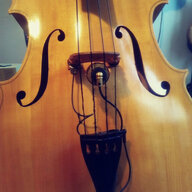
Thanks for the response. I'm not cranking the amp I have it set at 2. Problem is it has wicked feedback. I was wondering how to set the EQ. I know all my problems are within my EQ settings, but finding where to start to set them is proving to be a task. Where should I set the sliders?
Conceptually you need to consider the bass, pickup, amp, and speaker to be one instrument. Each component has an impact on the resultant sound, and there is a feedback loop that travels through all components. The more volume you need, the stronger the feedback loop will become. The feedback loop accentuates any resonances in the frequency response of the system and makes them stand out. Corrective EQ is intended to reduce the amount of energy that occurs at resonance points. This prevents feedback and can also even out the frequency response if you do it right.
The problem is not within your EQ settings. Most likely the EQ on your amp is not flexible enough to deal with the problem. Tone controls tend to have a fixed frequency center and they impact a wide range of frequencies. In order to control the feedback you need either a parametric EQ that can be dialed to a specific frequency with a very narrow notch, or you can use actual notch filters.
Often a preamp designed for acoustic instruments will have one notch filter. In my experience you benefit from 4-5 notch filters.
Although recently discontinued, the Empress ParaEQ would be a good choice for a utility EQ in a pedal format. The ParaEQ would be considered semiparametric because bandwidth is not continuously variable. Instead you have a toggle for each band that allows you to select narrow, medium, or wide bandwidth filters. The ParaEQ also has a 1 meg ohm input impedance, which is pretty much the minimum you want with a piezo.
A 31-band graphic EQ can also be used. The frequency centers are fixed, but the bandwidth is relatively narrow as each band cover approximately 1/3 octave. Essentially you identify the problem frequencies and dip the closest band. Sometimes the problem is almost dead center between two bands, so you dip both bands.
You can try dialing out problem frequencies with the EQ on your Hartke, but the filters are a bit too wide (approximately one octave) to do it well. Here is the process. Turn the gain up until you are just on the verge of feedback and notice any tones that pop out. If you can identify the tone, this is the first frequency to dip. If not, reduce the overall gain slightly.
Now, starting with the bottom fader on your graphic EQ, slowly bring the fader up to see if it causes feedback. You need to use judgement rather than simply applying a cut to all faders that produce feedback. So at this point you are just assessing what's going on. Run the fader as high as it will go without feedback and then set it back to 0. Now do the same thing with the next higher fader. After you have checked two faders make a decision on whether you should apply a cut or not. Actually the first time you do this, go through all of the faders one at a time just to get a feel for it. It take experience and practice to use this process well.
With a 31-band graphic I use a very similar process. Instead of boosting one fader at a time I boost two adjacent faders. After I move the original two faders back to 0, I move up one fader (the top fader from the previous test). Boost two adjacent faders again, one that you have previously boosted and one new fader. After you have tested three adjacent faders you can judge if a cut is needed on the two lowest faders, and which fader the cut should occur on. Again, sometimes the feedback is midway between the faders and you dip both, but if the problem seems significantly closer to one fader, only dip one.
When you use a narrow notch, you can cut really deep and it will have very little impact on the overall sound. As you widen the bandwidth, you will generally need to use less and less cut because a wide, deep cut will gut your sound.
Also, all of the components in the system must work well together, and result will be limited by the worst component in the signal path. I don't have any idea what pickup that is, but it looks very cheap. If the pickup is not very good, you are unlikely to get a good sound.
Also, piezo pickups generally need to be plugged into an input impedance of 1 Meg ohm or higher. I believe the input impedance of your Hartke 7000 is only 100K ohms. If the input impedance is too low, it tends to cause a nastiness in the high mids and bass response may not reach as low as you want. You probably need some sort of buffer or preamp with a higher input impedance.