• TalkBass has been independent since 1998. Add your voice.
    Create a free account to reply to discussions, view embedded media, and browse with fewer display ads.
    Join freeLog in
    Want zero display ads or expanded classifieds tools? Compare plans.

Shims: The lazy mans fix??

Status
Not open for further replies.
Some people here are confused.

Almost no Fenders have actually tight neck pockets. The 3-bolt mechanism did make things a lot worse since there was much less friction between neck paint and body wood (one side resting on the metal plate opposite the adjustment screw). But this wasn't made better or worse by different neck pocket quality in the 1970ties. The mechanism was a bad idea.

I've actually discovered a counter-example to this the last couple of days; my MP Jazz bass which I'm in the process of defretting. $500 and made in China, but the neck heel/body pocket were so tightly machined the neck actually stayed in the instrument after removing the screws.

As for shims, I decided to shim this one because of the removal of the frets. I used 2 slices of the maple veneer I used to fill the fret slots, for approx. .040" of shimming. I'm glad I did this since after I strung it back up I still actually have some travel on the E and G string saddles.

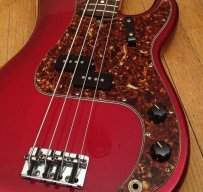
Here's pics of it strung up and waiting for the neck jig (on the FedEx truck right now) so I can level and final sand/finish the board. The other pic shows the shim, probably the hardest part of the whole job was making those to preeeecisely fit the entire neck pocket....

But this is the first Fender I've ever seen with a super tight neck pocket, like my G&L..... Probably the new ones all have similarly good QA on the neck/body joint these days.

LS
 

Attachments

  • IMG_0118.jpg
    IMG_0118.jpg
    31.7 KB · Views: 123
  • IMG_0117.jpg
    IMG_0117.jpg
    41 KB · Views: 117
one question.if the hardness/compressability of the shim makes a difference in tone/sustain then what does the paint under the bridge do. i have heard of folks taking the paint off this connection point but i dont think its a common mod.also i have stripped a fender body and the finish is quite thick and flexible under the surface.is this relevant to this debate?
 
Just because You haven't succeeded in doing that doesn't mean no one else has either.

Oh, I don't doubt you, and I admitted the feasibility of what you describe. It sounds perfectly logical.

But I'll just share my experience after 38 years playing and tinkering with bass guitars: To have a ski jump that developed from an improperly applied shim reversed by a differently configured shim is one of the relative rarities in the world of bass repairs. It amounts to heroics verging on magic in my book.

The last few ski jumped necks I encountered could only be thoroughly and certainly cured by a partial de-fret, re-plane the fretboard, and re-fret.

Also, I would be willing to bet the average TB member would be unsuccessful using a corrective shim, or any shim for that matter, to totally cure a ski jumped neck.

My .02 cents.
 
Some people here are confused.

Almost no Fenders have actually tight neck pockets. The 3-bolt mechanism did make things a lot worse since there was much less friction between neck paint and body wood (one side resting on the metal plate opposite the adjustment screw). But this wasn't made better or worse by different neck pocket quality in the 1970ties. The mechanism was a bad idea.

No offense dude, but considering the information you have posted in this thread, you are the most confused person here.
 
A bad idea adopted by Peavey: the "micro tilt". Maybe they know better than the anti-shim factions, just maybe. Considering how many rave about their T40's (well deserved raves) it must work very well indeed. Again, a shim is an adjustment technique. Period.
 
one question.if the hardness/compressability of the shim makes a difference in tone/sustain then what does the paint under the bridge do. i have heard of folks taking the paint off this connection point but i dont think its a common mod.also i have stripped a fender body and the finish is quite thick and flexible under the surface.is this relevant to this debate?

People who ascribe to this, can also tell the difference when their speaker cables are swapped end-for-end.
 
I never measured it, but I would bet that polyurethane is harder and less compressable
than wood.

Removing the finish on the neck heel or from under the bridge is a lot like moving your
amp inside your speaker cabinet to eliminate the speaker wire.
 
The last few ski jumped necks I encountered could only be thoroughly and certainly cured by a partial de-fret, re-plane the fretboard, and re-fret.

Also, I would be willing to bet the average TB member would be unsuccessful using a corrective shim, or any shim for that matter, to totally cure a ski jumped neck.

My .02 cents.

This is a bit of a head-scratcher, how is shimming intended to be a treatment for a ski-jump? Puzzled look, here.....

Like you said, a ski-jump is a defect in the fingerboard. My L2K had one from new right in the middle of the board around the 12 th fret area. I monkeyed with the "micro-tilt" which was on the older L2K's, to try to compensate for it (lower the action towards the heel) but that adjustment to the neck doesn't treat the ski-jump itself.

My Jazz bass which I just got through defretting, ended up with a veeery slight ski jump after the initial work of putting the wood strips in the slots. Without the frets, the neck can be weakened slightly and that's what happened to this bass. The only fix was to level it with the radius beam starting with a little bit of relief and taking off wood at each end. It's fine now, with a good flat board with the truss rod only moderately tight.

But something like a defret pretty much demands shimming the neck afterwards. Everything on a fretted bass is constructed with the height of the frets taken into account. When they're gone, the neck is just too deep in the pocket. Especially after levelling the board, you're just screwed unless you shim the neck back up.

My Jazz bass took 4 slices of maple veneer as shims (about .080" at the end of the final battle of the war) to get the fingerboard back up to a reasonable height. And the G string saddle is still bottomed out right where the action is where I want it.

There's no effect on the stability or tone that I can detect, except for a strengthening and sharpening of the dead spot at the C# on the G string (old 6th fret). I suspect this is because the neck/body joint is now much firmer than it was before (that neck isn't just on there it is On There), increasing the "Q" of the resonances in the neck/body combination.

Other than that, the tone is absolutely outstanding and the bass sets up correctly. So there are no drawbacks to shimming as long as you do it in such a way that you maintain a good firm joint.

And this is a reminder of why I'd never try a defret on a neck-through lol.

LS
 
This is a bit of a head-scratcher, how is shimming intended to be a treatment for a ski-jump? Puzzled look, here...

You'll need to ask T-Bird (see his earlier posts). His explanation kind of makes sense, but in a very specific and unique circumstance that involves considerable luck and magic if you ask me. It's akin to restoring a twisted neck. It can be done if the planets align, but don't get your hopes up.

Once a piece of wood has distorted, returning it to its proper shape naturally (without cutting or sanding) is extremely difficult. Ask anyone who works with wood.

I'm with you. I can only see a shim being useful in the relatively rare circumstance that the pocket-to-heel relationship is not correct, the neck sits too low or high relative to the bridge, and only altering the angle of the neck in the pocket, or filling in the pocket, can allow for properly adjusting bridge and saddles.

I also stand by my assertion that people use shims far too often and as a placebo for issues that should be addressed and corrected separately without the use of a shim.
 
I'm with you. I can only see a shim being useful in the relatively rare circumstance that the pocket-to-heel relationship is not correct, the neck sits too low relative to the bridge, and only altering the angle of the neck in the pocket can allow for properly adjusting bridge and saddles.

Not as rare as one might think but the physical relationships hold true, nonetheless. A wonky neck (ski jump, bump, dip, twist, etc) remains a wonky neck irrespective of its planar interaction (i.e. addition of shims) with the body and strings. Attempting to "normalize" the ski jump via shim placement and then manipulating the other 90% of the neck to compensate is fruitless and all-too-frequently kicks the neck into the dreaded "S" curve. Ask yourself: what portion of the neck shows the most dynamic change in response to truss rod adjustments?

Riis
 
Not as rare as one might think but the physical relationships hold true

Yeah, I admit this is pure speculation, but I've owned a boatload of bolt-neck guitars and basses in my 54 years, and I've only seen a small percentage that really had that poor of a heel-to-pocket relationship to consider shimming. Considering the somewhat high percentage of players who claim to use shims rather routinely, I doubt all that shimming is really necessary or the real cure for any issues the guitar might have.
 
I don't understand the geometry behind this assertion.

Since a shim only changes the angle of the neck, a permanent ski jump should have the same impact on a shimmed or un-shimmed neck.

Think reverse shim. It places the "ramped" part of the neck level with the top of the body. Setup follows including trussrod adjustment with the possibility of the addition of a flat shim to raise the neck so the saddles aren't bottomed out. It's worked for me in several instances.
 
Not as rare as one might think but the physical relationships hold true, nonetheless. A wonky neck (ski jump, bump, dip, twist, etc) remains a wonky neck irrespective of its planar interaction (i.e. addition of shims) with the body and strings. Attempting to "normalize" the ski jump via shim placement and then manipulating the other 90% of the neck to compensate is fruitless and all-too-frequently kicks the neck into the dreaded "S" curve. Ask yourself: what portion of the neck shows the most dynamic change in response to truss rod adjustments?

I've done it..no "S curve" resulted.
 
I've done it..no "S curve" resulted.

Do me a favor: take a straight edge and do a segmental on the fingerboard. I'm kinda curious as to what you're seeing where in terms of "relief" amongst the different regions of the fingerboard. Since we're addressing lift, place the emphasis on the 17th-24th frets which should typically be flat. Sidenote: "relief" is a misnomer as it normally denotes a natural and/or desirable fingerboard curvature which enhances the playability of an instrument...a lift does not.

Riis
 
Just a thought, but is anyone familiar with Buzz Feiten's ideas about shimming? He considers that adding a shim to a guitar's neck pocket de-couples the neck and body to some extent, and in his opinion this improves the sound. I'm not necessarily saying I agree with this, but it raises an interesting point. Namely, if a shim does change the sound perceptibly, who's to say it has to sound worse and not better? Surely that's open to the same subjective judgements as everything else about instruments and their tone?
i've read about this theory, and even briefly talked with buzz about it once on the phone; looking back, i think i have a counter-theory for what actually happens:

he describes loosening the bolts of a strung-up guitar, slipping the thin plastic shim into the gap on the headstock side, then re-tightening, then saying the guitar sounded better, more resonant, afterwards. it even worked on floyd-rose guitars, where the saddle break angle remains unchanged with bridge height adjustments.

i suspect it was actually just the process of loosening, then re-tightening, the neck screws while the strings were on! that's the old G&L setup trick, which allows the string tension to pull the end of the neck up hard against the body, often improving the resonance.
 
as for shims and "ski ramps", there's no connection there, either cause or cure.

the ramp usually happens where the neck transitions from round to square, which is before it even gets to the body!

shimming the ski-ramped neck is just raising the action, no different than raising the saddles. (zoob's "planar interaction" between the neck and the strings is unchanged.)
 
Status
Not open for further replies.