• TalkBass has been independent since 1998. Add your voice.
    Create a free account to reply to discussions, view embedded media, and browse with fewer display ads.
    Join freeLog in
    Want zero display ads or expanded classifieds tools? Compare plans.

Short scale 8 string

I have been wanting an 8 (octave) string for a while now and decided that it was a good excuse to start a new build.

The specs:
- 8 string tuned Ee Aa Dd Gg
- 30" scale
- Alder body
- Bolt on Maple neck
- Pau ferro fingerboard
- Schaller bridge and gotoh tuners.
- EMG 40DCX pickup and electronics

The design:
8 string 30".jpg


I started working on the neck, cutting 2 lamination out of a blank of maple, planed using a combination of hand plane and Bruce's router jig, then glued with a contrasting veneer in between:
IMG_20190803_151238.jpg

IMG_20190804_144145.jpg
IMG_20190804_144104.jpg
IMG_20190804_155852.jpg
IMG_20190804_161739.jpg
IMG_20190804_163048.jpg
IMG_20190805_104733.jpg
IMG_20190805_113037.jpg


I then put a 13° angle on the headstock:
IMG_20190805_151954.jpg
IMG_20190805_153740.jpg
IMG_20190805_155824.jpg
IMG_20190805_161033.jpg
IMG_20190805_171830.jpg


Routed the truss rod channel:
IMG_20190806_161956.jpg
IMG_20190806_163904.jpg
IMG_20190806_171421.jpg
IMG_20190806_171440.jpg


Slotted the fingerboard once planed to thickness:
IMG_20190807_111955.jpg
IMG_20190807_141212.jpg
 
Wow. Saw the thread title, not realizing which sub-forum it was in, automatically thought "probably wants a Hagstrom". How much more wrong could I have been? (No shade towards Hagstrom, just that this design is extraordinarily :drool:-worthy!!!) Subbed!
 
  • Like
Reactions: CTv
Very nice, love the body shape. Interesting that you decided to string it with the octave strings below the fundamentals. Care to share your reason for that?

I mostly play with a pick nowadays so it seemed logical to build it like this, that way I hit the bass strings first on my downstroke. Still, I turned my previous build (a 4 string) into a 2x2 tuned Aa Dd to give it a go and it felt fine.
4x2.jpg
 
I started the finishing process on the body; First a few coats of caned white nitro primer:
IMG_20190821_142359.jpg

Then a few coats of sherwood green nitro and a few coats of clear:
IMG_20190829_132325.jpg

While the paint is drying, I finished shaping the neck:
IMG_20190822_150708.jpg


And started levelling, crowning and polishing the frets:
IMG_20190828_144727.jpg

IMG_20190829_154354.jpg
IMG_20190829_154438.jpg


I put a first coat of Tru oil on the neck:
IMG_20190829_160128.jpg

The build is moving along without any major issues for now; a few more coats of Tru oil and once the Nitro is fully set and cured I should be able to start assembling the Bass.
 
The finish is dry enough for assembly; I'm not 100% happy with it, kind of sloppy in places but nitro is so soft and thin that I think it'll relic quickly with use and give character to the instrument; anyhow:
IMG_20190907_154400.jpg
Shaping the nut and installing the strings:
IMG_20190909_151508.jpg
IMG_20190909_162515.jpg
IMG_20190910_133233.jpg

Now this is where I got into a bit of a setback. The Schaller bridge is very nicely made but has questionable design choices. First the holes that hold the strings toward the ball-end are the same size, meaning that the bass strings are hold securely in place but smaller (guitar) ball-ends snap through it with too much string tension so I resorted to a little trick:
IMG_20190910_134842.jpg
Also, the saddle's width and position mean that with a central string position you have around 10mm between bass and octave. I did file the strings grooves with an offset but I still have around 7mm between strings which is too much for my taste:
IMG_20190910_134906.jpg
Soooo, I decided to cut another set of saddles, slightly wider, out of brass, to allow me a little more leeway. I'll also make another nut out of brass. And finally, I'll build a string holder bar out of aluminium that ill screw behind the bridge, with holes the correct size for the ball ends not to go through:
IMG_20190910_140115.jpg
IMG_20190912_154507.jpg
IMG_20190912_165507.jpg
IMG_20190913_142747.jpg
IMG_20190913_153711.jpg

More updates soon. I'm waiting for the threading tool I ordered for the saddles and should get it tomorrow.
 
The finish is dry enough for assembly; I'm not 100% happy with it, kind of sloppy in places but nitro is so soft and thin that I think it'll relic quickly with use and give character to the instrument; anyhow:
View attachment 3537498 Shaping the nut and installing the strings:
View attachment 3537499 View attachment 3537501 View attachment 3537502
Now this is where I got into a bit of a setback. The Schaller bridge is very nicely made but has questionable design choices. First the holes that hold the strings toward the ball-end are the same size, meaning that the bass strings are hold securely in place but smaller (guitar) ball-ends snap through it with too much string tension so I resorted to a little trick:
View attachment 3537503 Also, the saddle's width and position mean that with a central string position you have around 10mm between bass and octave. I did file the strings grooves with an offset but I still have around 7mm between strings which is too much for my taste:
View attachment 3537504 Soooo, I decided to cut another set of saddles, slightly wider, out of brass, to allow me a little more leeway. I'll also make another nut out of brass. And finally, I'll build a string holder bar out of aluminium that ill screw behind the bridge, with holes the correct size for the ball ends not to go through:
View attachment 3537505 View attachment 3537506 View attachment 3537507 View attachment 3537508 View attachment 3537509
More updates soon. I'm waiting for the threading tool I ordered for the saddles and should get it tomorrow.

Very nice work overall! I like your design. Some clever little features, like the way you did the truss rod access notch. And yes, the hardest part about an octave bass is the hardware details needed to fit the strings accurately in relation to each other. And they've got to be positioned right or the bass will be a bear to play. I went through a lot of engineering and machining to make the hardware for the Marvin 10-string basses.

One thing that I think you missed is the layout of the tuners. When you do the layout in the computer, you have to position the tuners so that the strings end up tangent to the diameter of the tuner posts. It looks like you positioned them more by overall visual alignment. And some of your strings are going to rub on other posts. Unfortunately, with an octave bass, the tuner layout always ends up looking strange. I wrestled with it on the 10-string. The best technical solution doesn't look right. But it works when the strings are on. So, Keith had to shape the headstock around the funny-looking tuner positions.
 
One thing that I think you missed is the layout of the tuners. When you do the layout in the computer, you have to position the tuners so that the strings end up tangent to the diameter of the tuner posts. It looks like you positioned them more by overall visual alignment. And some of your strings are going to rub on other posts. Unfortunately, with an octave bass, the tuner layout always ends up looking strange. I wrestled with it on the 10-string. The best technical solution doesn't look right. But it works when the strings are on. So, Keith had to shape the headstock around the funny-looking tuner positions.

Yes, designing a good working and visually pleasing headstock is a struggle. I actually did draw one that allowed me a straight string pull but as you said it looked wonky; I got used to it after a while but it didn't match the body design very well so I scraped it.
- Tête 1 - copie.jpg
The current headstock has a straight pull on the bass strings and not the guitar ones but they should hopefully be clear of rubbing the tuning posts by a hair's width.
- Tête 2 - copie.jpg
I find that this design problem is mainly due to using guitar tuning machine and their shorter key shaft. If one was to use similar tuners, all bass for ex, it'll make things easier.
 
Yes, designing a good working and visually pleasing headstock is a struggle. I actually did draw one that allowed me a straight string pull but as you said it looked wonky; I got used to it after a while but it didn't match the body design very well so I scraped it.
View attachment 3538097
The current headstock has a straight pull on the bass strings and not the guitar ones but they should hopefully be clear of rubbing the tuning posts by a hair's width.
View attachment 3538098
I find that this design problem is mainly due to using guitar tuning machine and their shorter key shaft. If one was to use similar tuners, all bass for ex, it'll make things easier.
You could use a banjo style tuner where they key sticks straight out of the back

Something like this

https://www.amazon.com/Steinberger-...59&hvtargid=aud-829758849484:pla-796050013636
 
As an Amazon Associate, TalkBass may receive commissions from qualifying purchases made via links on this site.
You could use a banjo style tuner where they key sticks straight out of the back

Something like this

MARCH (MULTISTRING) MADNESS...32 and counting

Interesting idea for a future build, I'll have to check if it can take a bass string gauge.

Great Build!

I build a lot of 8s, 10s, and 12s. Here's a thread that addresses many of the issues you're having including the 471-8, string/tuner choices, and headstocks.

MARCH (MULTISTRING) MADNESS...32 and counting

Many thanks, very informative. Out of curiosity did you ever build one with the bass strings above the octave ones like I'm doing and if so how much did it impact your headstock design compare to the other way around?
 
Many thanks, very informative. Out of curiosity did you ever build one with the bass strings above the octave ones like I'm doing and if so how much did it impact your headstock design compare to the other way around?

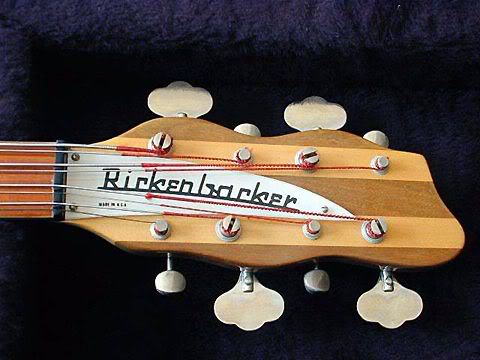
You're welcome. I've never built one with bass strings on top but here's how Rickenbacker did it. The potato headstock as it's known.

rP7k891.jpg


They later switched production to a standard Ric headstock with octaves on top. Here's a discussion:

Headstock change to Rickanbacker 8 string bass question