Enjoy the benefits of a premium membership!
Upgrade Account
-
TalkBass has been independent since 1998. Add your voice.
Create a free account to reply to discussions, view embedded media, and browse with fewer display ads.
Join free Log in
Want zero display ads or expanded classifieds tools? Compare plans.
You are using an out of date browser. It may not display this or other websites correctly.
You should upgrade or use an alternative browser.
You should upgrade or use an alternative browser.
Short Scale Bass WIth The Least Neck-Dive
- Thread starter Lamphun_Lamyai
- Start date
More options
Who Replied?


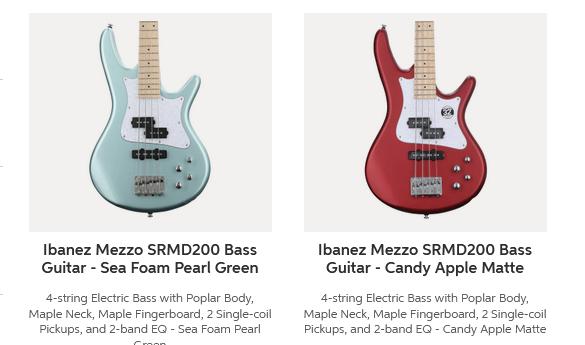
I have tried so many short scale basses looking for the same things you are. Outside of headless basses, Ibanez SR necks and headstocks are the lightest I have come across. The only issue is that there are no models with this headstock in a 30” scale. The Mikro is an option at 28.6”. The other option is the Mezzo, SRMD200, which is 32”. I love my Mezzo and have virtually no neck dive. Unfortunately, it appears that the mezzo has been discontinued.
I also have a Bronco, which isn’t too bad. The thing that gets me with the Bronco is the slab body. During a long gig, the lack of contour starts to get to my forearm. This is the only thing keeping me from buying a Gretch Junior Jet.
When I finally decide to fully commit to going 100% short scale, the EHB line will be my choice. I have played on a 4 string and a 5 string. They are amazing. My wife didn’t like the colors, otherwise one of them would have come home with me that day.
Good luck.
I also have a Bronco, which isn’t too bad. The thing that gets me with the Bronco is the slab body. During a long gig, the lack of contour starts to get to my forearm. This is the only thing keeping me from buying a Gretch Junior Jet.
When I finally decide to fully commit to going 100% short scale, the EHB line will be my choice. I have played on a 4 string and a 5 string. They are amazing. My wife didn’t like the colors, otherwise one of them would have come home with me that day.
Good luck.

View attachment 7130315
View attachment 7130313
That was one of the things I was looking at with the Sterling Stingray Short Scale...for comparison. The bridge is mounted close to the base of the guitar body and seems to shorten the reach on the fretboard. A couple of reasons I'm opting for short scale basses is my relative hand size (smallish for a guy) and how far I need to reach to get to the frets closest to the nut. I have minor shoulder issues in my left deltoid which makes hanging out on the first few fret an exercise in discomfort after playing for awhile or anytime playing the 34 inch scale bass. Welcome to old age. But yeah, I did notice that! Another question I should probably be asking seasoned bass player is "what is the downside to this particular bass guitar?" Given the position of the horn and the length of the neck and shape of the head-stock, I'm thinking neck-dive shouldn't be an issue with the Stingray SS.
I needed a 3" strap on that bass to avoid neck dive.
I went through a similar search and found 2 factors that threw many recommendations out of the window for me.
1) Most online/youtube reviewers play basses and measure neck dive with the bass resting flat on their knees. Some basses balance well like that. But I play exclusively with a strap, with the neck pointed up at about 45 degrees.
One example (of many) is the often-recommended Gretsch G2220 short-scale, which some people call well balanced. The strap button is at the 15th fret! I've played at least 4 in different stores. While a couple balanced okay on my knee, they all had serious neck dive on a strap.
2) Wood density and manufacturing differences. I recently tried a number of Sonic Broncos. I bought 2 of the same model from different stores and brought them home. The weight difference between the two was only 1 ounce, but one had significant neck dive and the other balanced well. Weighing them at either end revealed that one had a heavier neck and lighter body than the other. Same bass, same color, same COO, same dimensions, manufactured a couple of months apart. documented here
I've had the same experience with other basses. I've tried 4 different Squier Vintage Modified Jaguars. All had bad neck dive, but there are a ton of reviews saying they balance okay (if you get a good one).
I've tried 3 different Sterling Stingray Short Scales. 1 neck dove a bit, 1 had okay balance, and the last, a Toluka Lake Blue RAYSS4, balanced great (all on straps).
I add this: all of the Ibanez Mikros I currently own and have previously owned and played have balanced beautifully.
It stinks that you can't try before you buy. I would highly recommend buying from a vendor that allows returns/exchanges in case you get one that you're not happy with.
1) Most online/youtube reviewers play basses and measure neck dive with the bass resting flat on their knees. Some basses balance well like that. But I play exclusively with a strap, with the neck pointed up at about 45 degrees.
One example (of many) is the often-recommended Gretsch G2220 short-scale, which some people call well balanced. The strap button is at the 15th fret! I've played at least 4 in different stores. While a couple balanced okay on my knee, they all had serious neck dive on a strap.
2) Wood density and manufacturing differences. I recently tried a number of Sonic Broncos. I bought 2 of the same model from different stores and brought them home. The weight difference between the two was only 1 ounce, but one had significant neck dive and the other balanced well. Weighing them at either end revealed that one had a heavier neck and lighter body than the other. Same bass, same color, same COO, same dimensions, manufactured a couple of months apart. documented here
I've had the same experience with other basses. I've tried 4 different Squier Vintage Modified Jaguars. All had bad neck dive, but there are a ton of reviews saying they balance okay (if you get a good one).
I've tried 3 different Sterling Stingray Short Scales. 1 neck dove a bit, 1 had okay balance, and the last, a Toluka Lake Blue RAYSS4, balanced great (all on straps).
I add this: all of the Ibanez Mikros I currently own and have previously owned and played have balanced beautifully.
It stinks that you can't try before you buy. I would highly recommend buying from a vendor that allows returns/exchanges in case you get one that you're not happy with.
Last edited:
Since you've been playing for years I'm guessing you already know both of these, but figured I'd toss them out anyway.
Side note 1:
Like you, I don't have huge hands, either. I've found neck width to be another significant factor in comfort. In isolation, the two TMB30's I tried (41mm nut width) had some neck dive and felt okay but not great for me to play. But playing them back-to-back against basses with 38mm widths, like the Mikro, Bronco, and latest RAYSS4 Sterling Stingray, revealed that the thinner necks felt much better to me.
Similarly, the previous generation of Broncos (Affinity) were 41mm and also felt not-as-comfortable. The new Sonic series are 38mm and feel wonderful to me.
Side note 2:
I've found zero correlation between bass cost and bass comfort. I've played a lot of higher-cost basses that I was hoping to buy but passed on, as their shapes or balance or weight or neck finish made them less comfortable. Beautiful, yes. Great sound, yes. Good fit for me, no.
Side note 1:
Like you, I don't have huge hands, either. I've found neck width to be another significant factor in comfort. In isolation, the two TMB30's I tried (41mm nut width) had some neck dive and felt okay but not great for me to play. But playing them back-to-back against basses with 38mm widths, like the Mikro, Bronco, and latest RAYSS4 Sterling Stingray, revealed that the thinner necks felt much better to me.
Similarly, the previous generation of Broncos (Affinity) were 41mm and also felt not-as-comfortable. The new Sonic series are 38mm and feel wonderful to me.
Side note 2:
I've found zero correlation between bass cost and bass comfort. I've played a lot of higher-cost basses that I was hoping to buy but passed on, as their shapes or balance or weight or neck finish made them less comfortable. Beautiful, yes. Great sound, yes. Good fit for me, no.
Last edited:

I have a tmb30. I fixed the neck dive issue with Gotoh GB350 tuners and I extended the strap button on the horn.
Gotoh GB350 tuning machines are a drop-in replacement if the Gotoh ferrules (14mm outer diameter) are placed into the TMB factory ferrules, (14mm inner diameter) and a new screw mounting hole is drilled.
I used a ceiling fan pull chain pendent to extend the horn. It was cheap and easy to install. You'll need a longer screw.

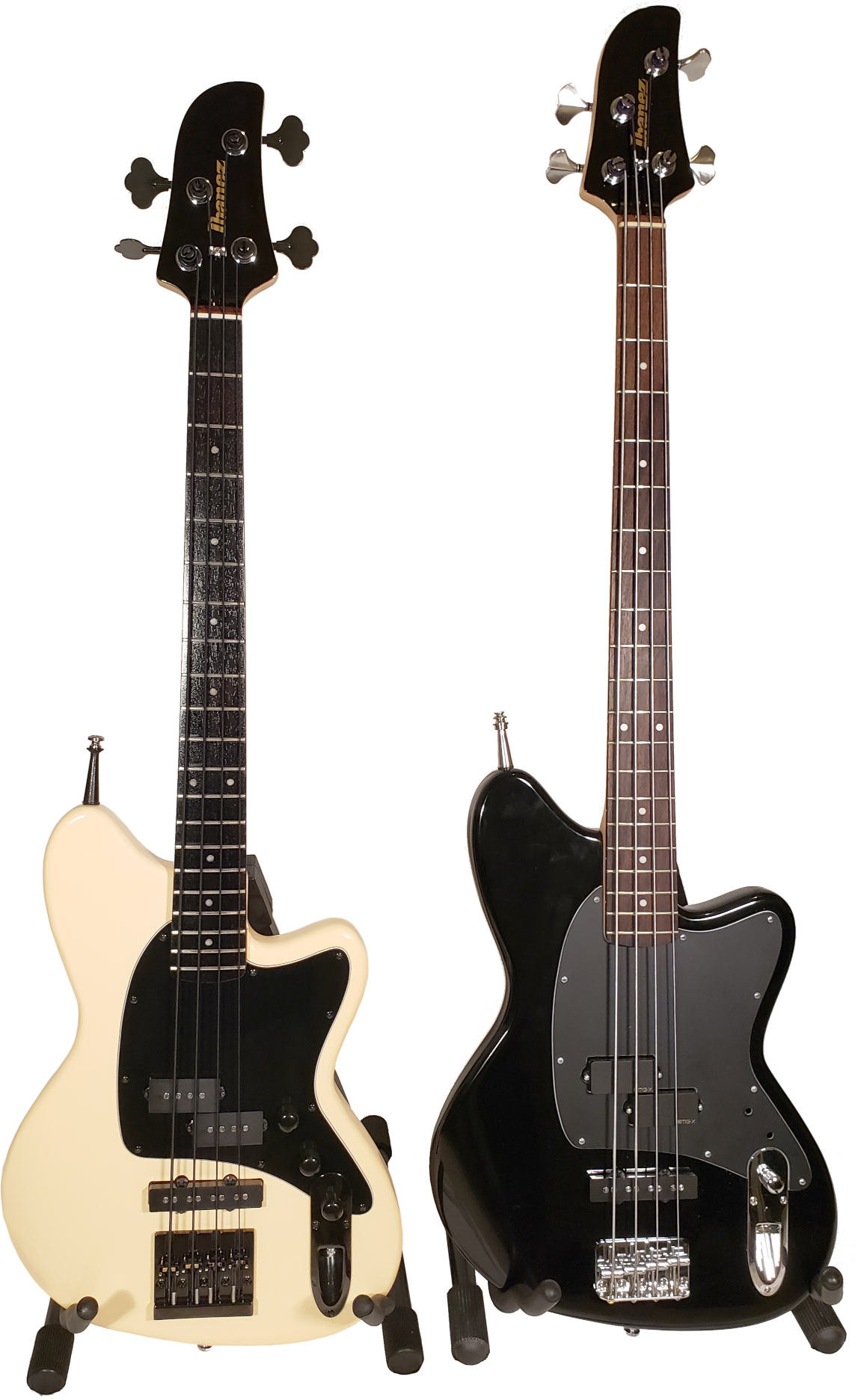
tmb30 (left), tmb100 (right)
You may try to add the horn extension first and see if it sufficiently reduces neck dive. If not, then change the tuning machines. I love my tmb30 now
Gotoh GB350 tuning machines are a drop-in replacement if the Gotoh ferrules (14mm outer diameter) are placed into the TMB factory ferrules, (14mm inner diameter) and a new screw mounting hole is drilled.
I used a ceiling fan pull chain pendent to extend the horn. It was cheap and easy to install. You'll need a longer screw.
tmb30 (left), tmb100 (right)
You may try to add the horn extension first and see if it sufficiently reduces neck dive. If not, then change the tuning machines. I love my tmb30 now

Great idea!!I used a ceiling fan pull chain pendent to extend the horn. It was cheap and easy to install. You'll need a longer screw.
View attachment 7130647

Since no one else has mentioned it, in addition to other suggested fixes, using a strap with a suede-like back (as opposed to a smooth finish) really helps.
As for basses with no neck dive, and as someone who has owned a lot of short-scale basses, I agree that Mustangs, Musicmasters, and Broncos can be inconsistent. Especially vintage Mustangs, they can vary widely. A Mosrite isn't likely to neck-dive, because the body is a freakin' boat anchor, and not something you want to play for 3 hours standing up. (Ask me how I know this.) An EB-3 will neck dive, because it doesn't have much body weight. My Kustom K-200 balances surprisingly well, given that it's semi-hollow. I have different Warmoth models, all of which balance well. Guild Starfire II balances well. The Guild might be a good upgrade choice, though you may have trouble finding one in your locale and in your price range. I got mine for $749 new, but I think that was a fluke.
As for basses with no neck dive, and as someone who has owned a lot of short-scale basses, I agree that Mustangs, Musicmasters, and Broncos can be inconsistent. Especially vintage Mustangs, they can vary widely. A Mosrite isn't likely to neck-dive, because the body is a freakin' boat anchor, and not something you want to play for 3 hours standing up. (Ask me how I know this.) An EB-3 will neck dive, because it doesn't have much body weight. My Kustom K-200 balances surprisingly well, given that it's semi-hollow. I have different Warmoth models, all of which balance well. Guild Starfire II balances well. The Guild might be a good upgrade choice, though you may have trouble finding one in your locale and in your price range. I got mine for $749 new, but I think that was a fluke.
I recently bought a Sire Marcus Miller U5 for 600.00 US. No neck dive and nice tone with La Bella flats. Not quite P Bass tone but can be dialed in to the point that my band mates don’t hear the difference when we’re playing. An affordable option perhaps.
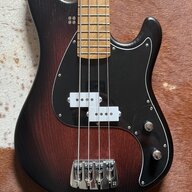
A Sire U5 is a good option - I had one for a bit that had a little lean towards the neck that would be easily resolved with a set of ultralite tuners. Probably an affordable option if you're not looking for Stingray flavor.
edit: I additionally like the U5 for the slimmer neck and nut width compared to the chunkier TMB30.
edit: I additionally like the U5 for the slimmer neck and nut width compared to the chunkier TMB30.
Last edited:

Neck heaviness is all about weight & balance. The bass has a center of gravity and the heaviness depends on where that CG is in relation to the strap buttons.
CG half way between the strap buttons == perfect balance.
CG between buttons but close to the upper horn button == neck heavy but probably won't move.
CG closer to neck, no longer between strap buttons == dive city.
Ultralight tuners are the biggest single swap you can do to improve balance. Adding a heavy bridge can help as well. Extending the upper horn button or moving the body-end button to the back of the bass further from the edge can help but they are awkward changes.
The best solution is ultralight tuners, 2x2 headstocks & strap buttons that reach to the 12th fret with the bridge mounted near the end of the body.
CG half way between the strap buttons == perfect balance.
CG between buttons but close to the upper horn button == neck heavy but probably won't move.
CG closer to neck, no longer between strap buttons == dive city.
Ultralight tuners are the biggest single swap you can do to improve balance. Adding a heavy bridge can help as well. Extending the upper horn button or moving the body-end button to the back of the bass further from the edge can help but they are awkward changes.
The best solution is ultralight tuners, 2x2 headstocks & strap buttons that reach to the 12th fret with the bridge mounted near the end of the body.
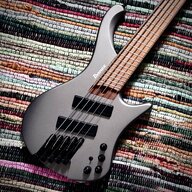
I picked up a TMB30 as my first short scale bass nearly 3 years ago, didn’t know a thing about neck dive at the time (oops). Since then, I’ve tried several straps, replaced the tuners, along with other mods - but it never sits quite right.
This past summer I was spoiled with an EHB 1005sms and WISH I had started with that in the first place. The moral of my story is you may be able to make the TMB work for you (I still play mine), but you’ll likely be happier with any of the great suggestions in this thread.
This past summer I was spoiled with an EHB 1005sms and WISH I had started with that in the first place. The moral of my story is you may be able to make the TMB work for you (I still play mine), but you’ll likely be happier with any of the great suggestions in this thread.

I have a Danelectro Longhorn that weighs 6lbs and has no neck dive, and the neck is perfect. They can have a bit of a nasally tone, but it sounds great live, and I find I can add bass to even out the tone. I get lots of compliments on the sound live.

That was actually one of the SS basses available to me. Buyer's remorse. Can't find it now.Ibanez Mikros
Right now I'm finding that the local music stores in Thailand's primary cities (Bangkok and Chiang Mai) are just empty of bass guitar gear that I'm interested in buying. I'm guessing it may have to do with it being year end, so hopefully they'll be reordering new stock later in the year. Short scale basses are very difficult to find now (let's not even talk about SS strings for bass, I had to order mine from the US and <gag> eat the 30% tariff and taxes>, and the Fender bass amp I'm interested in buying is impossible to find right now. I can't even special order equipment. Typical Thai music store vendor response is: "ไม่ได้" - "Can not." I'm tired of that response. I've heard that too many times since last October when I began looking for a SS base. We'll see mid-year.
As far as replacing the tuners, it's going to be problematic.
First - finding Gotoh GB350 tuners lightweight tuners in Thailand is going to difficult (see what I just wrote above). I may be able to order them from the US, but US vendors are hit and miss when it comes to their willingness to ship internationally. I checked Amazon US and didn't see the Gotoh GB350 tuners specifically listed.
Second - I can't find a Luthier in Thailand. I went through that dog and pony show two years ago when I had intonation problems (uneven intonation on the upper frets of the E and A strings) on my Stratocaster. So making hardware modification to a guitar is going to be difficult and I'm just not comfortable doing it myself. Not having access to a luthier is a real pain in the butt.
Actually the question that is really bugging me is this: Why would a guitar manufacturer engineer a guitar body that has inherent neck-dive built-in to the design when it would seem an easy enough engineering/design task to make sure that the guitar was designed to have no neck-dive at all, especially considering that most guitarist don't really want to deal with neck-dive issues? And yet?
Put an arm through a strap - and the neck.......dives baby, dives! Btw - my 34 inch scale bass and my Epiphone Les Paul both do this to. A balanced guitar should stay horizontal. So, this really is a design issue dealing with center-of-gravity. How odd that many guitar manufactures choose not to design well-balanced guitars. Thoughts as to why?

Put an arm through a strap - and the neck.......dives baby, dives! Btw - my 34 inch scale bass and my Epiphone Les Paul both do this to. A balanced guitar should stay horizontal. So, this really is a design issue dealing with center-of-gravity. How odd that many guitar manufactures choose not to design well-balanced guitars. Thoughts as to why?
Last edited:
I actually mentioned the Junior Jet/G2220 in an earlier post, as a bass I've played that balanced well on a strap. That particular instrument - borrowed from a friend - was certainly much heavier than I expected. I'm betting that weight, plus the wide strap, helped it behave, but you're right. The strap button is on the 15th fret, and looking at pics, I would immediately think it would have serious neck dive.One example (of many) is the often-recommended Gretsch G2220 short-scale, which some people call well balanced. The strap button is at the 15th fret! I've played at least 4 in different stores. While a couple balanced okay on my knee, they all had serious neck dive on a strap.
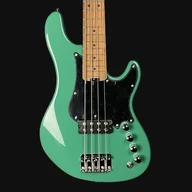
Sometimes aesthetics win out over practical considerations. I can’t understand why people play Gibson Thunderbirds, either, but they have their devotees. If pure functionality was the only factor we’d all be playing Steinbergers.Actually the question that is really bugging me is this: Why would a guitar manufacturer engineer a guitar body that has inherent neck-dive built-in to the design when it would seem an easy enough engineering/design task to make sure that the guitar was designed to have no neck-dive at all, especially considering that most guitarist don't really want to deal with neck-dive issues? And yet?
If you’re looking at the Sterlings, they’re already quite light, and replacing the tuners with Hipshots makes them even lighter. I have two and with a wide Levy’s Leathers strap I have no neck dive.
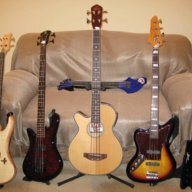
I recently got a Mikro lefty bass, and it is both small and light (perfect size for enlightened guitarists!). While some view it as a "budget" or "student" bass, it's received positive reviews for its strong P/J pickups. Any neck dive on your bass should be taken care of with a grippy, suede or suede-like strap. Check out such items for sale on Reverb or eBay from an international seller, and best of luck!I bought an Ibanez Short Scale bass sight-unseen as I literally could not find a music shop in Chiang Mai Thailand that carried any short scale basses to try out. Unfortunately it has terrible neck-dive and makes playing standing up a real uncomfortable chore. On top of that I can't find a reasonable priced 4 inch strap here in Thailand either.
Considering that I'm playing bass a lot (I played guitar for two years in a half-assed manner, but when I picked up a bass I simply "Switched On") I'm considering an upgrade to a better short-scale bass with little, or preferably, no neck dive as well as a quality build and good sound. I'm eyeing Sterling by Musicman Stingray Short Scale bass but I'm also open for suggestions. Any bass I buy in Thailand will cost me 30% more than the same guitar in the US due to tariffs, so I want to try to keep the cost around $1000 USD. And as well, no music store will stock it so I will also have to buy this sight-unseen. It sucks not being able to "try before I buy" but it is what it is. I gotta rely on suggestions. Thanks!
Last edited:
Often a quick tell that a bass is balanced is if the bridge is right at the edge of the butt end of the bass. Not perfect, but the neck has to be really long, or the body exceptionally light to get neck dive if the bridge is tight to the end.

Ibanez Mezzo PJ has no neck dive issue..... meanwhile build quality are great !