• TalkBass has been independent since 1998. Add your voice.
    Create a free account to reply to discussions, view embedded media, and browse with fewer display ads.
    Join freeLog in
    Want zero display ads or expanded classifieds tools? Compare plans.

Short scale fatigue

I'm glad I brought this up because I thought it was a "me" issue lol. Lots of good input I'll have to put to the test. I can't remember if I had the issue sitting down because I was mostly standing up when I had them, but now I'm a bedroom player so it may make a difference.
 
  • Like
Reactions: Lobster11
I'm glad I brought this up because I thought it was a "me" issue lol. Lots of good input I'll have to put to the test. I can't remember if I had the issue sitting down because I was mostly standing up when I had them, but now I'm a bedroom player so it may make a difference.

Aha! So this might be more about sitting vs. standing than about scale.

Personally this makes perfect sense to me. When standing I hold the bass at a medium height, with the neck angled upwards about 30-45 degrees. Having the body lower makes it easier to keep my plucking wrist straight, and having the neck higher makes it easier to keep my fretting wrist straight. I just can't get that same ideal position when sitting: The body is too high, and if angle the neck upward I can't comfortably reach the lower positions.

If I were you, I'd simply start by standing for a practice session to see if the problem goes away, and if it does you can try to figure out how to mostly closely replicate the same position when sitting.
 
I can't remember if I had the issue sitting down because I was mostly standing up when I had them

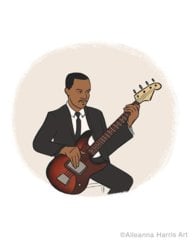
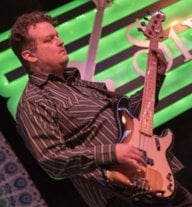
Sounds silly, but sometimes makes sense to look at yourself in a mirror to check your wrist position for these issues. Please note: The neck angle is important, but the wrist position is key, and it is a function of your arm's length and other factors. See two extremes below, Dave Cox with the CC Riders (60 degrees angle) and James Manning with Billy Preston, I guess his long arms and fingers allow him to keep his wrist straight even with the the bass almost horizontal. Lobster11 idea of replicating the position is a good one.


  • Like
Reactions: Lobster11
I do have the fatigue from small necks. I can’t say I had any issues while playing a JMJ, but other shorties with even thinner necks have caused lots of arm pain. Could be those are just under your tolerance.

Glad I’m not alone then. I dig the vibe but don’t want to invest in something that I’m gonna continue having the same problems with.
I’m not sure these are the same problems (although I could be wrong). It sounds like OP is talking about the scale length, not the thickness of the neck. If that’s the case, than any scale bass with a thin neck would create the same fatigue issues just as any scale bass with a thicker neck should resolve the problem.

So, is it the neck or the scale length @ItsmeSantiago ?
 
  • Like
Reactions: CTW68
I’m not sure these are the same problems (although I could be wrong). It sounds like OP is talking about the scale length, not the thickness of the neck. If that’s the case, than any scale bass with a thin neck would create the same fatigue issues just as any scale bass with a thicker neck should resolve the problem.

So, is it the neck or the scale length @ItsmeSantiago ?
... or is it actually about sitting versus standing, as per the most recent posts?

I think it's more the length of the neck coupled with the stumpiness of the body. The nut is 1-1/2" on the shorties I've played like my jazz basses. However, it could be a standing vs sitting thing as well. It seems I've become a science project. I'm gonna see if a local shop has a short scale to mess with this weekend and I can let you both know the finidngs.
 
I get terrible pain in my shoulders if I play a SS for too long. I'm not a big person; my body is just used to the standard size.
Not to derail the thread from OP's issue, but...

In a related thread someone (sorry I can't remember who) recently suggested the importance of "opening your shoulders." I won't attempt to explain what he meant, but I feel like the phrase well captures something important akin to, but not exactly the same as, "don't slouch." With that in mind, it seems to me that a short-scale bass might not force you to "open your shoulders" in the same way as a longer-scale bass might. In the end this might be a posture issue.
 
Given your wingspan, what attracted you to short scale as opposed to standard ? Could the problem be at the nexus of technique and ergonomics? I am 5’9”, medium build, and I find short scale difficult/annoying. Standard scale feels normal, medium scale is loads of fun, but short scale is just a pia to me! Of course, everyone is different, but given it’s your third try, maybe it’s just not the scale for you.
 
  • Like
Reactions: Lobster11
This is how I believe it works, but I do not have any background in physiology or kinematics.

It's possible that the kinematics of you body are not well matched to short-scale bass.

Another possibility: The hand geometry and associated mechanics are changed enough that it impacts which muscle groups are used. In other words it causes you to either use different muscles or use muscles in a different way.

So it may be a matter of conditioning to build strength and endurance with the new hand shape.

There may be some aspect of developing the necessary coordination and control to efficiently play with the modified hand shape. Without sufficient coordination and control their a tendency to use too much force and/or to clench.

An explanation of what I mean by clench. Muscles typically work in pairs. One muscle closes the joint and the other opens the joint. Ideally you don't engage both muscles at the same time. When you clench, both muscles are engaged. This means the muscles that are actually trying to do the intended motion have to exert more effort to generate the optimum level of force at the finger tip.

By learning fine motor control you use the optimal force to press the string to the fret. The opposing muscle may have some light tension in it to help with control, but it should not be applying significant force that opposes the intended movement.
 
Given your wingspan, what attracted you to short scale as opposed to standard ? Could the problem be at the nexus of technique and ergonomics? I am 5’9”, medium build, and I find short scale difficult/annoying. Standard scale feels normal, medium scale is loads of fun, but short scale is just a pia to me! Of course, everyone is different, but given it’s your third try, maybe it’s just not the scale for you.
I like the tone and it was a good option for the groups I was playing in at that time.
 
I get fatigue when the neck is too thin front to back, but have no problems with short-scale basses. Although, the only short-scale bass I used during long gigs was a gretch, so I don't have much experience with them.

Edit: I also played a violin bass that was very uncomfortable for a lot of different reasons.
 
I’m wondering if anyone else experiences this or if I need to make an adjustment, but whenever I play a short scale my arms and hands start to get sore and very quick. I’m relatively tall and thin with a wide wingspan and I don’t have these issues otherwise.

I’ve owned a JMJ and an Epi EB-0 and loved the sound of both but I’d get two songs in and my arms would ache. Any suggestions?

Not sure if these are related but both instruments could never stay in tune either. Like I’m tuning in between every song. The JMJ had stock strings the whole time and I’d be horribly flat by song’s end. Skill issue?

Interesting; I observe the opposite. I became primarily a short scale player some years ago, although I also play some medium and long scales.

As far as my left arm, I like the shorter reach on the short scale and find it less fatiguing. The right hand is the same for me, as I'm really playing in the same position. I'm a dedicated flats player, but I doubt that makes any difference.

I suggest the differences may be a result of either technique or how the bass is positioned.
 
  • Like
Reactions: 21Pastorius12