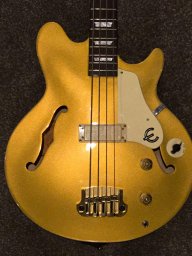
I dunno, my Jerry Jones Longhorn with lipstick pickups, 30" scale, is plenty bright, as bright as any regular passive P or J.

TalkBass has been independent since 1998. Add your voice.
Create a free account to reply to discussions, view embedded media, and browse with fewer display ads.
Join free Log in
Want zero display ads or expanded classifieds tools? Compare plans.



Thanks, and everyone elseString tension is a big reason, but there are many variables, including that the relative pickup positions tend to be different.
Ah, that makes sense, and I think is kind of (very?) similar to my hypothesis, but far more clearly put!Shorter scale means thicker string in relation to length, which will produce less overtones since it can't vibrate as freely in the higher frequencies.
I think you can see it this way: If the string is very short, its behaviour will approach a beam instead of a string. It will simply be too thick and stiff to give anything but the fundamental resonance frequency when plucked. A longer, more flexible string will do all sorts of things that the shorter can't.Ah, that makes sense, and I think is kind of (very?) similar to my hypothesis, but far more clearly put!

That's exactly what I was trying to say with my 1mm vs 1 km long string of same linear density etc illustration.I think you can see it this way: If the string is very short, its behaviour will approach a beam instead of a string. It will simply be to thick and stiff to give anything but the fundamental resonance frequency when plucked. A longer, more flexible string will do all sorts of things that the shorter can't.


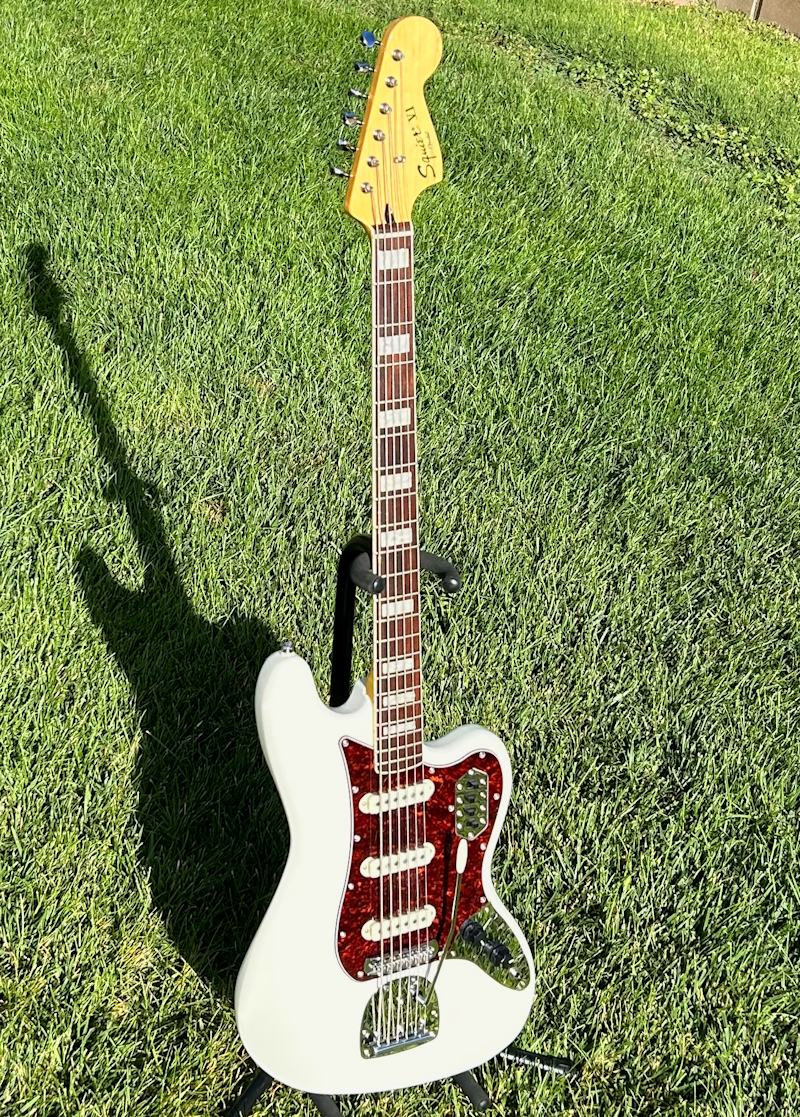
why does a short scale sound boomier / darker?
I think the question should be:Do longer, extended scales reach a point of being too thin and bright?





Thanks! Thats the bit I was wondering about.The reason some resonances / harmonics on a 34” scale string vibrate more (or less) than the resonances / harmonics of a 30” scale string tuned to the same pitch is due to the characteristics of the two strings (mass, diameter, stiffness, length, tension, ratio of length to diameter, anchor points, etc.). The location of pickup as mentioned above can make a harmonic stand out or not.
I don’t know that tension *alone* affects harmonics.Thanks! Thats the bit I was wondering about.
So if same strings on both, from your list there its tension affects resonance of harmonics (as well as fundqmental freq - I didnt think of that), and length to diameter (and others I guess).
So, my next question is going to be, do you know what the physics behind those effects are? Eg why/how does tension affect relative resonance of the different harmonics. And is the bending stiffness (not modulus) the reason for the length to thick ratio effect?
Probly the answer to all that is, 'that's complicated'
I've done teaching/research in scaling other things (ship resistance, composites etc) and so these 'scaling effects' interested me.
Sorry for being a Geek, but I'm too old to stop asking questions now.
Thanks!I don’t know that tension *alone* affects harmonics.
First of all, the resonant harmonics of two strings tuned to the same pitch are the same even if the two strings are of different lengths. The resonant harmonics are a matter of mathematics. So if a string is tuned to 41.2 Hz, the second harmonic is 82.4 Hz (f1 x 2) and the third harmonic is f1 x 3 = 123.6 Hz and so on.
The difference is that the harmonic frequencies “develop” or “ring-out” more on a longer vibrating length than they do on a shorter vibrating length.
The harmonics become a greater content of the total sound on a longer scale as compared to a shorter scale. The notes on a shorter scale length will have less harmonic content and more fundamental content, which is the primary reason shorter scale basses seem to have less brightness than longer scale.