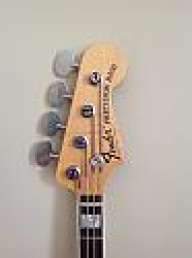
Cool Ivan - I'm sure many guitarists would agree with you regardless of the Fender-bashers out there. And your relic-ing looks authentic so far - good work! Back to the Flee sig J, upon studying it last night I know that if I were to have purchased it I would 'rot-rod' the distressing. (take it further and make it look more authentic) One aspect that stops short is the exposed wood sections. The surrounding 'banks' of the wear area do not graduate. It was probably done using a mask over the bare wood areas when spraying and the edges are thin but (too) crisp. I would use a fine emory cloth and taper the edges until smoothly transitioned. Also, I couldn't tell if the shell pink had a primer under it. Like on yours, you see traces of the white primer under the top colour. So the transition is top-coat/primer/wood - all leveled smooth. I would have also added traces of the original mute screws and wear. In fact, the Flee trib doesn't even have holes for a bridge cover, and the neck cover and tug-bar holes are not drilled into the body. (they are on the pg) Silly details, but this is what I'm talking about when saying a relic'd finish can be skillfully done - meaning it alludes to real and logical player wear (not just a randomly scratched up finish) by someone who has studied pictures or a real distressed instrument. I have created a few more artistic versions so far but am very tempted to do a serious distressed finish. I would use my very player-worn '66 P-bass as a reference and painstakingly recreate it's beautiful look. Needless to say, no dragging it on the street will be involved.
View attachment 2790332
View attachment 2790333



 Anyone who can step onstage with Pink Floyd, Michael Jackson, and then The Orb has a grip on many styles of music, IMO.
 BMM is one of those colours that comes in many varieties, but usually not as nice as his P & J examples. Interestingly enough, my band leader Cherie plays an Epi hollow-body in a shade of BMM close to his. (the coloured lights make it look more pink)