• TalkBass has been independent since 1998. Add your voice.
    Create a free account to reply to discussions, view embedded media, and browse with fewer display ads.
    Join freeLog in
    Want zero display ads or expanded classifieds tools? Compare plans.

Sire Bass Club!

What color/wood combination do you own?

  • Bright Metallic Red/ Ash

    Votes: 17 1.6%
  • Bright Metallic Red/ Alder

    Votes: 33 3.2%
  • Natural/ Ash

    Votes: 173 16.7%
  • Sunburst/ Ash

    Votes: 104 10.0%
  • Sunburst/ Alder

    Votes: 165 15.9%
  • White/ Ash

    Votes: 86 8.3%
  • White/ Alder

    Votes: 122 11.7%
  • Black/ Alder

    Votes: 104 10.0%
  • M3

    Votes: 28 2.7%
  • M7

    Votes: 85 8.2%
  • I'm a heretic - I don't own one yet, but I'll see the light soon enough!

    Votes: 243 23.4%

  • Total voters
    1,039
  • Poll closed .
I noticed that the output of the J pickup on my P8 is quite a bit lower than that of the P pickup, especially on the D and G strings. I raised it up and angled it towards the higher strings but the difference is still quite noticeable. Does anyone else see a similar behaviour?

It's not a big issue since I'm more interested in the P-bass tones anyway and in my experience it takes a lot of skill (more than I currently have, anyway) to make a solo'd J bridge pickup sound good. Still, interested in what you all have to say about this

Edit: In case it's relevant: I put Chromes on but it was similar with the factory strings.
 
Last edited:
Hi!
Another one of my questions, just to help me unnerstan things gooder

My U5 with La Bella's on sounds brighter than my Sonic Bronco with Tonerider Apex Classic pickup amd Ernie Ball Cobalt Flats on

I love the sound of both, I'm not going to change either, but, I am a inquisitive cat:

I can see that body type of wood and shape, neck shape and wood and even, apparently fingerboard wood, and other things could be responsible for some of this, but

is it mainly (after strings) the pickups (and their positions that would be affecting the tone here?

As a science orientated guy, I would think that the main things would be, (in this order):

1. Strings (as they are what are vibrating (also guitar structure, but that's kind of secondary)
2. Pickups (as they are what are 'picking up' and transferring these vibrations), and where they are (as this affect where they 'pick up' the vibrations from the string, relative to nodes etc)
3. Other stuff (body wood and size and shape, neck ditto, fingerboard ditto,)


I am assuming same pre-amp (none here) amp and cabs etc to get rid of these

is that about, ball park, usually, generally, back of a ciggy packet, etc etc correct
 
As a science-oriented fella m'self, but admittedly with ZERO luthiery credentials, I've always expected that strings and pickups are going to be the primary determining factors of tone. Neck wood and body wood are next, I'd expect. That is, I think pickups and strings have the greatest capacity to change tone, then changing neck and fingerboard wood and then body wood.

Flame wars may ensue, but hey, take my opinions as from a fella with ZERO luthiery experience.
 
  • Like
Reactions: LeighOnSea
Setting aside technique factors like how and where you pluck the strings, in my opinion/experience, the most important things that affect a solid body electric instrument's sound are:
Strings
Pickups (both type and position)
Scale Length
Electronics (passive/active, EQ, etc)

Everything else makes such a minor difference that they concern me more for aesthetic/style reasons than tone reasons. But I'm also not going to say they make zero difference; just not enough to dramatically alter the tone created by the factors listed above.
 
Thanks, so I think the difference in tone between my two short scale basses is mainly because of the different pickups and positions then - the different strings (LA Bellas and EB Co flats) cant 'overcome' that difference.
I'm happy with that as they sound very different

now that my curiosity is piqued ....

scale length affects tone because of tension?
1768254286846.png


so for same frequency (f) and strings (u), a short (30") scale will have just over 3/4 (0.78 ish) the tension of a long scale (34")?

How does that tension affect the tone? You will still have the same fundamentals and harmonics. Are some damped out easier with lower (higher?) tension? or is it something else

sorry, I'm a Geek
 
Last edited:
1768255162501.png


Take the 5th harmonic there.
On the short scale bass the distance between the peaks will be shorter than on the long scale
And for a given string there is a limit to the curvature it's easy to bend into it
So, the shorter the scale, the more this 'resistance to bending at high curvatures' comes into play, so the higher harmonics are more subdued on a short scale bass so it sounds more mellow
That makes sense to me

But then, my wife tells me I am mad

What does she know? She is just a clinical psychologist
Yes it is sometimes challenging living with a psychologist
but not as challenging as living with me
 
Not as much a scientist/engineer as you are! But I can tell you that lower tension will yield a darker tone. Not sure why -- lower amplitude overtones?
This isn't rocket science. Take a piece of string pull on it, pluck it, and pull tighter. The frequency of oscillation increases and the harmonics are forced into the shorter wavelengths, with lower amplitude. Proportion of harmonics shifts into higher registers. Therefore it sounds brighter.

They taught a course called "Physics of Music" at college. Only physics course I was interested in taking.
 
  • Like
Reactions: mrperkolator
View attachment 7409868

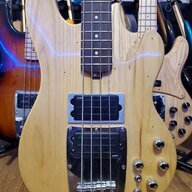
NBD in the form of this Sire M6.

Positives: amazing sound, form factor, built like a tank.

Not-so-positives: headpiece cover is a hindrance when fretting a low F on the E-string, bridge knobs, D-string tuner "runs out of room" when tuning to pitch.

How does one obtain the replacement tuning knobs?
Turns out the original D string had too much slack when it was installed; I put a spare one on and there's tuning room to spare.
 
I believe the intonation screws are on the end directly facing the bridge pickup so it might be tricky getting an adjustment wrench in there. As far as I know, moving the tuner assembly is not required.
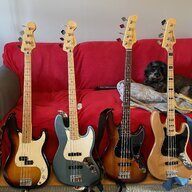
Hope they are Allen heads so you can use an angled tool! Even so, inner strings would be difficult. Still not as bad as my Lightwave -- each individual complete string bridge/sensor assembly has to be moved to intonate!
 
Sure Z3 - any thoughts?

Hello looking to add something different to my bass collection and the Sire Z3 has caught my attention. I've got a Sire Jazz V3P and the playability and build quality are excellent for its price point.

Before I pull the trigger im looking to see if anyone has owned one and if they can give me some advice?

Specifically what is the neck like? How heavy is it? What's the tone like when the active circuit is engaged? Any issues with neck dive?

Lastly I don't have the cash for a proper muisc man so if anyone recommends a different bass my max budget is £350.

Cheers!
 
  • Like
Reactions: Memnochthebass
Sure Z3 - any thoughts?

Hello looking to add something different to my bass collection and the Sire Z3 has caught my attention. I've got a Sire Jazz V3P and the playability and build quality are excellent for its price point.

Before I pull the trigger im looking to see if anyone has owned one and if they can give me some advice?

Specifically what is the neck like? How heavy is it? What's the tone like when the active circuit is engaged? Any issues with neck dive?

Lastly I don't have the cash for a proper muisc man so if anyone recommends a different bass my max budget is £350.

Cheers!
I have the sparkly one...neck is thicker than your V3P with 41.4 mm at the nut, but extremely comfortable(to me)... weight comes in at a little over 9.4 lbs(4.6 kg), not neck divey at all, but I use a thick padded strap while standing and play classical style while sitting. The pickup is ceramic and wired in series, so the output is a little on the high side, but the preamp is pretty good for dialing in a tone that you'd like. I ended up putting a Bartolini quad coil and a 3 way switch for mine, but it's an extremely solid instrument stock, in both construction and sound.

Hope that helps!