• TalkBass has been independent since 1998. Add your voice.
    Create a free account to reply to discussions, view embedded media, and browse with fewer display ads.
    Join freeLog in
    Want zero display ads or expanded classifieds tools? Compare plans.

Six String (bass) theory help

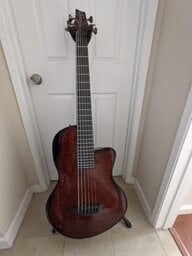
A few months ago I got a six string warwick corvette. Love the sound, the feel, just everything about this bass. Ive only just been recently using the thing to its potential a bit more and am incorporating the low B and high C into my playing though am relying on my ear more then anything to hear if a not fits, rather then actually knowing the theory of scales very well. (a small amount, but not much). Ive been picking things up mostly by playing something until it sounds good and then going back and working out what scale Im playing...kinda the wrong way around.

Just in short...Im looking for anything to do specificaly with six string basses. From chord charts to some songs I can learn (at an intermediate level of playing) that will utilize the six strings and allow me to explore the bass fully.

And yes, before anyone tells me to I know I could just google some things but I dont really want to go through 171,000 results so please just specific sites or song titles etc if you can.
 
As a long-time 6 string player, I have to say that there's no such thing as 6 string theory. What I would suggest is learning your theory better, but specifically NOT in relation to 6 string. If you know your notes, scales, and chords at a fundamental level, you'll know how the extra notes you now have available on the 6 slot into that. This is not instead of applying your ear, it's in addition or in parallel to doing that.

You don't need specific songs to utilize the 6 string. You can play any song on a 6 string. Take a line you know, and try playing parts of it in a lower register, if that seems appropriate. Or play it in the same register, but different fingering.

Be aware that it's easy at first to overuse the low notes on the low B, simply because of the novelty of having them. Whanging around on that low string can get tiresome and lose its effectiveness. As an example, i do some work for one guy who says, only half-jokingly, that he won't pay me if he hears a note lower than the low D on the low string.

Be aware also that the high string generally doesn't sound as fat as the G string, so the same notes on the high C may not cut through as well as the same notes on the G string or the D string. I've found the highest string, in general, to be more useful for solos and featured melodies than for general playing, but of course there are exceptions to everything.
 
Just to expand on Richard Lindseys post. Look at songs that where you had to move around alot on the four string and play it on the 6 string. You may find that alot of the notes are under your fingers without having to move your hand. This in turn helps to figure out scales. Sometimes it can be hard on a 4 string to figure out the scale if the lines are all over the place, well for me anyway, especially if you learnt scales going up and down vertically on the fretboard.

Another good idea is to learn songs in standard notation but dont move your hand, this will help learn the notes on the fret board that lie under your fingers in certain positions. Don't get me wrong, if you played the songs live you may want to select notes further up the neck on a low string to get the desired tone, but for the purpose of learning notes and getting used to using the B and C strings this worked great for me.
 
As a long-time 6 string player, I have to say that there's no such thing as 6 string theory. What I would suggest is learning your theory better, but specifically NOT in relation to 6 string. If you know your notes, scales, and chords at a fundamental level, you'll know how the extra notes you now have available on the 6 slot into that. This is not instead of applying your ear, it's in addition or in parallel to doing that.

You don't need specific songs to utilize the 6 string. You can play any song on a 6 string. Take a line you know, and try playing parts of it in a lower register, if that seems appropriate. Or play it in the same register, but different fingering.

+100

So they say about ERB's: the extra strings are your strings. Examples of where people use them are far and few in between, so you might as well make your own ways to use them. You will find this to be a very educational process.
 
I've recently picked up the 6 string as well and what I've found that helps a lot when it comes to raw theory is understanding and practicing your scales through the extra octave you have access to in just one hand position.

I also try to go through and transcribe songs that I've known how to play over to 6 string format. Guitar Pro works great for transcription if you want to learn it quickly. If you know a song that on a standard 4 string bass would require a dropped D tuning, play the exact same notes in standard tuning utilizing your new low string. Depending on genre, this can make it very benificial or a lot harder on you. Same goes for the higher range. Play it however you're most comfortable.

As for bands, Dream Theatre is the only one I can think of off the top of my head currently.
 
A few months ago I got a six string warwick corvette. Love the sound, the feel, just everything about this bass. Ive only just been recently using the thing to its potential a bit more and am incorporating the low B and high C into my playing though am relying on my ear more then anything to hear if a not fits, rather then actually knowing the theory of scales very well. (a small amount, but not much). Ive been picking things up mostly by playing something until it sounds good and then going back and working out what scale Im playing...kinda the wrong way around.

Just in short...Im looking for anything to do specificaly with six string basses. From chord charts to some songs I can learn (at an intermediate level of playing) that will utilize the six strings and allow me to explore the bass fully.

And yes, before anyone tells me to I know I could just google some things but I dont really want to go through 171,000 results so please just specific sites or song titles etc if you can.


if you want to really have fun with it, try tapping out chords. play the roots on the B,E, or A and tap out the rest of the chord on the D, G, and C

"Scarred" is a song by Dream Theater that is a simple introduction to what im saying.
 
if you want to really have fun with it, try tapping out chords. play the roots on the B,E, or A and tap out the rest of the chord on the D, G, and C

"Scarred" is a song by Dream Theater that is a simple introduction to what im saying.

+1
The action is typically lower on a 6 string and will make tapping a bit easier. There's a specific tutorial on youtube by Victor Wooten where he explains exactly what Mad Bassist was describing with chords. I can't link to it since I'm at work and my employer is very concerned about the sanctity of their employees virgin eyes, :rollno: but it shouldn't be too hard to track down.

 
Among the best free bass tutorials around is; http://wheatsbassbook.org/ It sounds like you can breeze through the beginning pretty quickly.

For me, the #1 reason to play a 6 string is for the extended, low to high, range available without changing positions. So maybe it's time to learn the scale patterns so the notes above & below the range of a 4 string become obvious.

Don't get me wrong. Having ears you can trust is really valuable. So is knowing where to find the next note in a scale & being able to play scales to changing chord patterns. You already see the value. You already know time spent, brings results. Patience will serve you well. 8-)