• TalkBass has been independent since 1998. Add your voice.
    Create a free account to reply to discussions, view embedded media, and browse with fewer display ads.
    Join freeLog in
    Want zero display ads or expanded classifieds tools? Compare plans.

Double Bass Size matters! (7/8 v 3/4)

Hey bassers! I just had a thought/question and wanted to ask/share with y'all.

I'm currently playing a 7/8ths Christopher...I love this bass to death and as it's the only double bass I've ever owned, it feels like home. I notice though that a lot of players use 3/4 size basses.

For those of you who have played or owned both, what are your likes/dislikes advantages/disadvantages comparatively between the two sizes.

I'm still getting thru simandl 1...finally up to Fsharp. This book is taking much longer than it should have (over a year now, eeps...to think I can play real music on an EB), imo, but I guess with as many breaks as I've had to take, it's natural. But, I want to start getting into some solo literature, especially Bach, and I wonder how much easier it might be on a smaller bass--or would my technique be flushed down the toilet as because the size difference causes so much of a technique shift?

Thanks for the thoughts and opinions! Cheery cheers. :D
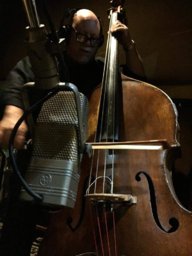
 
size matters, inasmuch as a bass can be uncomfortable. pretty much all the dimensions are what you are looking at (string length, rib depth, size of upper bout, shape of shoulders, overstand), so it's hard to give any generalizations, you just have to try something to know if it will work for you - it all depends on your preferences. i would suggest that you try to find a 3/4 to play on if possible and form your own opinions. play as many basses as you can in fact. be sure to find out the string length and get a general feel of the size/shape of the upper bout while playing in thumb position. note how the neck feels in lower positions and at the heel. these are the things that will make a difference. I went from a 42" string length to 41" recently, and it definitely made things easier for me, but some people are comfortable on even larger string lengths.
 
thanks for the thoughts, square. i think you're right-it's hard to generalize with such a question. when i got my DB, i simply took a local professors word for it and ordered a certain bass. i did choose to go 7/8ths though as i figured more bass-more boom. hehe. now that i am increasing my technique though, i think i could use a little more mobility. i need to find a bass shop near pittsburgh.
 
yeah no reason to change from an instrument you already like unless you feel that you have the need and money to get a better one. As for size, i'd say it really depends on YOUR size. You will adapt your technique to different string lengths, but as with all things, there are advantages and disadvantages to each length, and how you choose is up to you. IMO, a string length 43 or bigger is going to make things a little harder in the future with all that flashy fast stuff ;) but other than that, you should naturally adjust.


 
good point. also, the same string length can feel different depending on the shape and size of the neck and how it relates to the geometry of your hand, so the number only means so much. still, it's a general guide that can be helpful. again, you can only form a good opinion when you play on an instrument for a little while.
 
I don't get it, how can string length effect the playability of a bass?
String length is defined as the distance between the string nut by the pegbox to the bridge. A bass with an effective string length of 44" has a whole lot more space between notes than one with 41" or 42". Often the long distances are beyond the reach of a small to average hand. Hence the 44" bass can be significantly harder to play than the 41". There are many other factors that contribute to playability obviously but this one is not a small issue.
 
I have a Christopher 7/8 flatback, and it was setup by a pro with a 41.5 inch String Lenth. What makes it 7/8, as far as I can tell, is not the SL, but that the lower ribs are WAY wider than what's considered a 3/4 bass. On it's side, the bass its easily 3-4" taller than other basses in a section.

I used the Christopher as my orchestral bass because it indeed had a bigger sound and better projection that the 1930's Pfretzschner (3/4) that I upgraded to after I'd been playing a couple years. I later found an older German 3/4 that had as big and immediate a sound as the Christopher, but that also had a more complex quality in the sound it produced. That's the only reason I have stopped playing the Christopher, really - the complexity of sound just wasn't there. I'd imagine in 40-60 years, if it gets played, it could develop that.

As to finding another bass, I think you're on solid ground with the Christopher from what I can tell and from my own experience. Unc Toad's comment is spot-on ; if you like it, and it's working for what you're doing, no reason to actively look to replace it. I would advise, however, to always be willing to play other basses and go to shops whenever you can. You might find something that takes your breath away and you can reasses how your current bass is meeting your needs. I don't think whether a bass is 3/4 or 7/8 will be as big a factor as overall timbre and playability - and some 3/4 have thicker necks and longer SL than my 7/8. I'd think your's would be the same.

brian casey
aka Tanglehead
 
I have a Christopher 7/8 flatback, and it was setup by a pro with a 41.5 inch String Lenth. What makes it 7/8, as far as I can tell, is not the SL, but that the lower ribs are WAY wider than what's considered a 3/4 bass.

That's mostly it, at least for instruments built recently, at least that's what I read not long ago on Link Removed. A student asked me about the differences, and there's not that much scale length difference between 3/4 and 7/8.

Best

Sidecar
 
The division between 7/8 and 3/4 is very messy and even the chart on the double bass guide is arbitrary at best.

Scale length is usually not the most dramatic difference either way.
 
The division between 7/8 and 3/4 is very messy and even the chart on the double bass guide is arbitrary at best.

Scale length is usually not the most dramatic difference either way.

As I understand it, an instrument is 7/8ths if the maker called it 7/8ths, and 3/4ths if the maker called it 3/4ths. If the maker did not register an opinion (or is deceased), then the current owner or shop gets to decide what to call it. If you buy it, you can call it what you like, and no one can tell you differently.