• TalkBass has been independent since 1998. Add your voice.
    Create a free account to reply to discussions, view embedded media, and browse with fewer display ads.
    Join freeLog in
    Want zero display ads or expanded classifieds tools? Compare plans.

Small Class-D Amp Heads. What validates the 'Warm' sound ?

Lol, I don't know what part Aged Horse gave the 'like' to here...Probably the fact that they discontinued the BQ-500..I had a BAM-200 and now a BQ-500. There is nothing wrong with my BQ-500. I like everything about it, but...you know how this story goes, always looking for something else to buy..its that GAS problem. The only problem with me is, I will just go out and 'do it'..I don't have a pile of money but I do put my music gear like on the top of my priority/spending list and always make it happen.
No, the part about all amps being voiced differently...
 
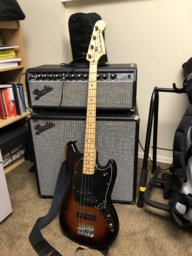
Alrighty, strings changed, tunes jammed, wife annoyed... my work here is done. :D Thanks for the compliments on the bass! That is my baby, known to all my friends as Bassby. It even made it on our Christmas card the last two years, haha!

So the TC BQ500 is a great amp, and probably the best value in its class. I also had had the aforementioned MarkBass LM BL250 and sold that awhile back, but still have the TC for now.

I like the 4 band EQ, and it always gives me plenty of clean power. I haven't gigged it hard or anything... my church setting is pretty mild. We have a mediocre setup and no subs, so I run through my own rig and not FOH. We're also pretty small, seating about 200 max pre-rona. We do have a caged drummer, but I don't hafta do anything crazy to blend in. In this setting I don't need any extra drive or grit... but I DO like some. :D I'm not a pedal guy. Bass -> instrument cable -> amp -> speaker cable -> cab. Dat's it.

Have you pumped up the gain on your BQ500 for some grit/OD? If so, what do you think about what came out? Did you like it? If you liked it, then awesome! :bassist:

I, sadly, didn't like it. At. All. For me, this is not a gain stage designed to create pleasant harmonics/overtones/allthestuffagedhorse said. To me it just sounds like when the batteries were dying in my old JVC KaBoom Box but I kept the woofer level cranked to +6 anyway.

I don't really have a whole lot of experience with compressors, but I often left the "Thrust" on just a smidge and I kinda liked it, I think. It also has a bit of an eq circuit in there I believe, but I used it so sparingly I didn't really notice much of a difference. It wasn't something I NEEDED, and I don't miss it since I have been using other amps the last few months. I did NOT like it set anywhere past 10 oclock. Just got squishy and weird after that to me. If you LIKE that feature, realize it's something you'll lose with a Tone Hammer. I think the Ashdown has a compressor though, right?

As for the banana to beefsteak comparison, it is this: you eat a banana as-is. It is simply what a tree produced, and you eat it. To me, the BQ500 takes what it gets from the bass and makes it louder. Yes, you have a 4 band eq, but it doesn't really impart any additional mojo or character of its own. That IS NOT a bad thing! Especially if you have a great sounding bass!:laugh:

The Tone Hammer/TT800/and I'm hoping the GK Legacy and Ashdown RMII ... are the beefsteaks. You can take that meaty signal, ground and hot from your bass, marinate it with some tasty harmonic content and add rich overtones of pleasant pre-amp clippings, putting out that sear and sizzle that you just can't get with a banana.

Vanilla vs rocky road
Ford vs Ferrari (but not like in the 1960s)
Carrier pigeon vs AlGore's very own internet

Nothing wrong with any of those things, and they all do their task. Heck, vanilla is actually my 2nd fav ice cream, and I have 2 Fords!

From the reading I did and now the experience I've had with the Tone Hammer, there is actually a lot happening with the gain and drive knobs. They are NOT traditional in function like on a tube guitar amp or something. I don't know the parts/math behind what's happening there, but those two knobs alone get me about 85% of the way to where I want to be before even touching the eq. A little searching here on TB and you'll find other people whom have better explained what's going on behind the faceplate of that little wonder. Sadly, Aguilar did NOT write a great manual like Agedhorse, Chef, and I forget other dude... the manual for the TT800 reads like a friendly tone-wizard's textbook, explaining which knob does what and WHY!

Though the Aguilar press department didn't keep up, I feel there are similar levels of elegant tone engineering in the amps of both brands, though their goals and the way they go about them are different.

I'm expecting to be similarly impressed with the GK Legacy, and curious but not overly optimistic about the Ashdown.
 
Last edited:
Ashdown RM Guide to "Warm Tone"

Since several of you are curious about the Ashdown RM (I don't see many of them around), I'll describe how I get a nice warm sound out of mine.

I have an RM800, but the controls are the same on the entire RM series.

First, set your input level properly.
Make sure "Drive" "Shape" "Comp" and "EQ" are all turned OFF.
Set your bass to whatever volume you usually play at. (This is usually 100% unless you have an active bass)
Conveniently, Ashdown gives you a full analog VU meter, not just a "clip" LED.
Play hard.
Adjust the "Input" knob until you're peaking in the red zone of the VU meter. The needle shouldn't be hanging out there...just saying hello when you really dig in.
If you don't do this, you either won't get any drive at all, even when you switch it in (too low) or you'll be always hearing some grit (too high).

Next, if you want a little compression (who doesn't?) turn on the COMP switch and twist the knob until you have enough.
The RM800 can squash hard, so for a natural "warm tone" you shouldn't need more than 9 or 10 oclock.
Err on the side of "slightly too little comp" because the drive will compress your signal too.
If it squashes you too hard even with minimum compression, turn down the "Input" knob a bit.
If you can't get enough compression, turn "Input" up. (Both the comp and the drive have fixed thresholds, so to change where they kick in, you have to change the input level.)

Next, adjust the EQ.
Turn on the EQ switch (important! otherwise the EQ is disabled) and turn the entire top row of knobs to 12 oclock (flat).
For "warmth", you generally want to turn up the lowest two bands of the EQ, and take a bit off the top two bands.
How much you want on the middle knob depends on taste and gig volume. In a bedroom you'll generally suck out a lot of mids. At gig volume you'll leave them in or even boost them a little. Don't suck out too many, or you'll be left with mud.

Now, adjust the drive.
Turn the "Drive" control to minimum (7-8 oclock) and turn on the "Drive" switch.
For a "warm" tone, you usually want just a touch of drive, maybe 8-9 oclock. Too much will get gritty...but try it and see what you like.
If the drive sounds "buzzy" even at low settings, your input level is too high: turn "Input" down. If you don't get enough drive even at high settings, your input level is too low: turn "Input" down.

NEVER use the "Shape" button! It's a giant bass boost and mid suck...basically "slap tone in a box," exactly what you don't want.

This should get you in the ballpark for a good all-around "warm tone."
Now you can go back and fine-tune.
Good luck!
 
My Mesa Subway D-800 with stack of two Subway 115s sounds warm to me, depending on settings but not very far from "flat", and depending on the bass and playing technique. (I do almost always have the cabs' high frequency horns turned all the way off though.)

I don't think the YouTube demos of the amp that were around a couple of years ago did it any favours though, they didn't sound warm to me, but in person it sounds great.

They are all solid state. No tubes here. The controls on the front are to adjust the range of frequency's they say they cover. Set all these Class-D heads flat (with respect to what the MFG says would be a 'flat' setting) and use your own super duper EQ pedal/Parametric, wouldnt you be able to dial in almost the same sound between heads but with perhaps different EQ settings, again, because one heads 'flat' setting might not be equal to anothers?
This seems to be saying all solid state or all class D heads have basically the same core tone. Why would that be true?
 
  • Like
Reactions: Dominic DeCosa
I'm no expert, but it seems like a simple plot of frequency response might not give a very complete picture of how an amplifier sounds. I'd guess the other factors needed to describe it are to do with harmonic distortion (even on sounds we'd call clean) and dynamic behaviour. Certainly I've had different amps which were each supposedly flat at certain settings, but simply did not sound the same as each other however they were adjusted.
 
Where does this come from, just passed down from others saying the same thing? They are all solid state. No tubes here. The controls on the front are to adjust the range of frequency's they say they cover.
Warm to me is the opposite of sterile and in your face/piercing. IME the presence or absence of tubes have little to nothing to do with it. A Mesa Carbine (which is also class AB) has a tube in the preamp and at literally no setting would anyone I know ever describe it as warm - I own the M3, M6 and M9 and am just sharing my personal experience. I also own a TH500 (class D) and despite being all SS it does have a very warm, vintage tube amp kind of voicing. If you want to compare only class D, all SS heads, you can easily substitute the GK MB series heads for the Carbines here.

IMO what makes heads sound different has to do with the engineer's design goals relative to their playing feel and voicing. For me warmth is about the harmonic richness in the notes and a softer edge, as well as a less present upper end and tighter, less deep/sub-oriented lows in the overall voicing. We can all name tight, crisp, fast/quick heads that shoot notes at you like a missile (Carbines/GK MB's would be a good example). We can also all name heads that have a loose, smooth, more relaxed kind of note presentation (TH would be a good example here).

As for whether it's just repeating a story or real, I don't know anyone who could play or listen to a Mesa Carbine/GK MB compared to a TH and not be able to identify that they were two different amps. As for the specifics of the topology/circuit designs, what electrical component choices were made in the circuitry, if they had tubes or not, etc., I suspect only a few of our engineering types might be able to guess right.
 
Last edited:
I would like to know what 'technically' makes one think that one Class-D amp head has a 'warmer' sound than another. Talking about the 300 to 500 watt range here. I get to reading that the main conclusion is that the Aguilar Tone Hammer and the Ampeg PF-350 are by far the 'warmest' heads. Where does this come from, just passed down from others saying the same thing? They are all solid state. No tubes here. The controls on the front are to adjust the range of frequency's they say they cover. Set all these Class-D heads flat (with respect to what the MFG says would be a 'flat' setting) and use your own super duper EQ pedal/Parametric, wouldnt you be able to dial in almost the same sound between heads but with perhaps different EQ settings, again, because one heads 'flat' setting might not be equal to anothers? If there is any viable truth to this, and I hope someone can point it out technically to me, I will be the first one to ditch my TC BQ-500 head and buy someone else's proven 'warmer' Class-D head, but you gotta tell me which one to buy and why.

My MB Fusion (Tube preamp) going through an 8 x 10 was a good balance of warm, thick and still clear. However, we don't have the 8 x 10 anymore so I use my old 4 x 10. It's a bit thinner sounding so I added a bit more gain.

I don't really get all the Class D criticisms, just like with solid state amps. And I know "nothing beats the real thing" because, yes I've heard it and played through it. I have a solid state combo I use with another band, I put a Sansamp in front of it and they love the sound.

I feel some folks on here forget to just play.
 
I went through several class D heads and found them to be sterile and lack "warmth" with the exception of the Genz Benz Streamliner. Even though I'm over 60, I find that the weight difference is not worth the lack of tone and character. Of course this is IMHO.
 
  • Like
Reactions: TC.65
I’ve always thought of warmth as a pleasing amount of clipping/distortion due to saturation in the signal chain. Not a buzz saw or anything, just a bit of wool. Some Class D emulate this pretty well, but I tend to prefer an outboard analog device if I need that tone.
 
I'm no expert, but it seems like a simple plot of frequency response might not give a very complete picture of how an amplifier sounds. I'd guess the other factors needed to describe it are to do with harmonic distortion (even on sounds we'd call clean) and dynamic behaviour. Certainly I've had different amps which were each supposedly flat at certain settings, but simply did not sound the same as each other however they were adjusted.

This is what I came to say. I am by no means savvy of the technical aspects of it, but my understanding is that each amp has a certain amount and type of saturation and compression available in the system, separate from any “drive” switches. We don’t perceive it as overdrive or distortion, but that’s what makes one amp sound warmer, cleaner, more sterile, chewy, etc. The EQ, whether it’s the baked in sound or the available adjustment ranges, goes into the sound as well.

So when you hear about most class D amps sharing the same power component, it doesn’t mean they’re all completely clean amplification with a different eq section tacked on to the front end. There is much more going on.
 
From the reading I did and now the experience I've had with the Tone Hammer, there is actually a lot happening with the gain and drive knobs. They are NOT traditional in function like on a tube guitar amp or something. I don't know the parts/math behind what's happening there, but those two knobs alone get me about 85% of the way to where I want to be before even touching the eq. A little searching here on TB and you'll find other people whom have better explained what's going on behind the faceplate of that little wonder. Sadly, Aguilar did NOT write a great manual like Agedhorse, Chef, and I forget other dude... the manual for the TT800 reads like a friendly tone-wizard's textbook, explaining which knob does what and WHY!

Though the Aguilar press department didn't keep up, I feel there are similar levels of elegant tone engineering in the amps of both brands, though their goals and the way they go about them are different.

I did contact Aguilar in the past with specific questions and in every case, got an email back where someone with profound knowledge on the topic answered my questions to my full satisfaction.
I've never asked about specifics concerning the drive and gain knob. These are complex. You can get a lot of different sounds by using one of them or both to get your grit and breakup.

I've bought and sold a few heads in the recent past, but the Tonehammer stayed.
I would like an Orange Terror Bass 1000 at some point, but that's just to have an amp that is capable of driving my speakers to their full potential.
I like a warm sound. Deep and fat, if possible, but not too much of the harsh clanging.
 
  • Like
Reactions: musicman556
I would like to know what 'technically' makes one think that one Class-D amp head has a 'warmer' sound than another. Talking about the 300 to 500 watt range here. I get to reading that the main conclusion is that the Aguilar Tone Hammer and the Ampeg PF-350 are by far the 'warmest' heads. Where does this come from, just passed down from others saying the same thing? They are all solid state. No tubes here. The controls on the front are to adjust the range of frequency's they say they cover. Set all these Class-D heads flat (with respect to what the MFG says would be a 'flat' setting) and use your own super duper EQ pedal/Parametric, wouldnt you be able to dial in almost the same sound between heads but with perhaps different EQ settings, again, because one heads 'flat' setting might not be equal to anothers? If there is any viable truth to this, and I hope someone can point it out technically to me, I will be the first one to ditch my TC BQ-500 head and buy someone else's proven 'warmer' Class-D head, but you gotta tell me which one to buy and why.


In reading all these responses on how each person relates their amp head to the ‘warmth’ factor, at the moment, I don’t think I would really benefit from the specific design of one Class-D 300-500 watt head to another with regards to how the amp designer built it to have the final output product sound a certain way based on tone, texture, dynamics, voicing and harmonic structure particular to that amp head and it’s pre-amp section and front panel controls. Although I’d really like to benefit from it and that would require change on my end. Sometimes change is tough. I would not have any problems buying a new head though. That’s covered under GAS pains I think..

Because, my situation is that I only play my bass in my room here at the house, but I take it as serious as someone who does play out at a bar, church or VFW hall. For the past 4.6 years of playing each and every day, I have slowly sculptured the sound/tones that I am very happy with and I think it would be hard to change all that to reap the benefits of what some of you explain. For starters, I was violently opposed to playing with any trace of overdrive or grit or dirt. Just pure clean bass notes. Also playing at home only, I fall into the category of one f those people who like that signature sweet sound of general mid-scooping, the bedroom bass sound I guess. I am a pedal person and always have stuck to the thought of set my amp head flat, get rid of all the tone knobs on my bass (which I have done, there is just a single volume on each bass now) and make all my tone adjustments with my pedals, like parametric EQ and my Two-Notes LeBass and whatever other pedal I have that can manipulate tone. So right there I have pretty much disqualified what an amp head can really do versus another one. This is where my pre-conceived notion that if I set the amp head flat and adjust all my gear in my little room here, I can make any 300-500 watt Class-D head sound the same so what’s really the point of buying a different one.

No, change is not set in stone here though, there is hope. A while back I wanted to play around with the idea of ‘dirt’ in my sound. I bought a Darkglass Microtubes X pedal and though it sounded like marbles in coffee can. Horrible. I sold it. Then I bought the Microtubes Vintage. Sounded too much like old school ‘fuzz’, like in some Early Metallica songs. Not my thing. It was probably doing exactly what it was designed to do but I wasn’t having it, I sold it. Then I watched Rick Beato break down Megadeth/Symphony Of Destruction and he was playing the bass part though a Microtubes 900 amp and I thought the foundational (and there wasn’t much) ‘dirt’ sound was what I was searching for but the mids were too high. So I bought the B7K pedal and copied his amp settings in his video and by Golly, I found my ‘dirt’ sound I can learn to love, and my B7K pedal will handle that for me. I also have the Wampler compressor pedal and I really like the ‘color’ and change that it does to my sound so that is my comp pedal.

So see how I have all my tone and signal shaping bases covered already by pedals and not at the amp head nor at the bass guitar end, and the environment I play in, I don’t think I would benefit from a different amp head unless I made major change elsewhere here. It’s just that I got this sound in my head of a Fender Jazz bass (I used to have one) being plucked by a finger (I only play with a pick, never learned fingers) directly through a Class-D amp head and these beautiful sounding, warm ‘stubby’ (or sustaining) bass notes are coming out of the 15” speaker..and I think to myself, hmm, maybe I can buy a ‘warmer’ amp head and replicate that with what I already have. Let me ask on Talkbass what conveys the ‘warm’ sound from one 300-500 watt Class-D amp head to another. You all have pretty much told me. So what am I supposed to do, set up a completely different rig next to mine, buy an Ashdown or Tone Hammer, plug straight in and make a change. I’m certainly into the ‘buying’ part..just not maybe the ‘change’ part yet now.
 
Everything you posted is also true of class d amp heads.

I can't tell if you are intentionally trolling, or if you just have an entirely different idea of bass amplification then the majority of the players. When you have such a different take on things, the path to satisfaction is often long, hard, frustrating and expensive.
 
Everything you posted is also true of class d amp heads.

I can't tell if you are intentionally trolling, or if you just have an entirely different idea of bass amplification then the majority of the players. When you have such a different take on things, the path to satisfaction is often long, hard, frustrating and expensive.


I have been on TB for 2.5 years now. I looked up my posts, 475 of them here. Not once has that word ever been associated with any of my 475 posts. I only belong to only 1 'Social Media' website, and that is TB here. No FaceBook, no Twitter, no TikTok Clock or whatever it is and no LinkedIn. Nothing but this place. I'd rather read pdf tech notes or SIP traces than get caught up in any of those 'Social Media' attributes (that word). Of course I have heard that word but I never wasted my time to bother to look it up to see what it really meant. Just didn't care, whatever it meant, it wasn't me as I write from the heart and head with the sole intention of gaining knowledge and maybe making someone crack a smile here and there. I just looked it up now, and yes, it still just wasted my time. Like I said, I play only ever at home in my room with what I got and how its setup. Never once in a band setting and its been 4.6 years now. I'm always looking to buy something new and maybe use that in addition to what I have but I'm not gonna buy it just cause everyone and their friend label it as 'insert words here', without any hint of technical design that makes it appear to actually sound like 'insert words here'. I don't use the compressor or overdrive that's built into my amp head now and I set all the tone controls flat. I keep the gain at 1/2 and use the volume so I purposely don't get any grit out of the amp head. Everyone writes in how they set their amp head with all of its controls and the sound it produces. I have rendered all of that stuff useless over here. So I'm wondering what the hell would be the difference to my ears in Class-D amp heads when I don't use anything on the amp head to begin with. Maybe I was expecting to hear something like, well, amp head 'A' has this circuit in it that no other head has and it does this and that to the signal, but I didn't. What I'm reading is how when you set this knob and that knob and push that button, you get this sound, and there is absolutely nothing wrong with that, I guess it is the translation of my special circuit theory, partial to one amp head and not the other. Do I want to take what I have read here and try it out? Damn sure yes! And I would buy the Ashdown RM-300 just to do so, based on what I read here, if I were up to making big change with other things in my sound/tone quest, but I don't think I'm ready to do that. Yes, the last part you wrote about the path as it relates to my 'take' on things, you are 100% correct on all counts.
 
I guess some players are never satisfied with the tone they’re getting. With so many choices of instruments, amps, strings, speakers, enclosures, effects etc. I would be confused as well.
Does someone else have a problem with your set up? Has anyone told you to change your tone as it is distracting?
Plug in and play, lay down the bottom line and enjoy what you’re doing.
Trying to micro-analyze sound is a black hole in which there is no bottom.
 
Last edited: