• TalkBass has been independent since 1998. Add your voice.
    Create a free account to reply to discussions, view embedded media, and browse with fewer display ads.
    Join freeLog in
    Want zero display ads or expanded classifieds tools? Compare plans.

Small PA: Carvin V Yamaha

I have the Carvin LM-12's and that small 10 lb class D amp powered mixer. I use it for solo guitar/vocals thing. It works great. Granted, the LM's aren't in the catalog anymore so your PM12's would be a couple lbs heavier. Load-in and load out is a breeze. If you're moving this gear around, then it'd be much easier than the 42 lb Art 312A's. Probably not as loud, but way easier to move around. I'd sell your small mixer and buy one of the Carvin powered mixer packages; I think those proprietary power supplies for the small mixers are a pain in the ass. Buy the PM-15's if you need more poop. Many musicians have commented on how my rig sounds damn good. Granted, I'm not pushing it to high levels; but it's clean, crisp, and solid....and light. And it wasn't expensive, and with the line out I can expand if needed.

Powered speakers are great, since the amp is matched for that speaker, yada yada. But damn, they're heavy. And your cable suitcase gets heavier with the need for more XLR cables and A/C extension cords. The Carvin package comes with speaker cable; I cut one of mine in half (well....60-40 instead of 50-50) and I sold the other speaker cable and the microphones that came with it. Easy stuff.

That, and buy the drummer a pair of hot rod sticks. Damn drummers ruin everything.
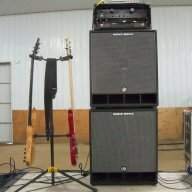
 
I am beginning to think ANY of your opinions are... unhelpful. Your elitist, derogatory attitude aside, you don't seem to know basses either. The Yamaha Attitude Standard is the low grade model, MSRP was around $800 new but I payed $350 for it used, 17 years ago. I know, it's "junk." The Warwick FNA was a different story. After lots of saving, 12 years ago I payed $1050 for it. New. No Sale. MSPR: $1499. So the store did a decent markdown from MSRP.

Well look up the price of a Billy sheehan attitude and a warwick FNA jazzman and get back to me. Both are at least 2 grand. If you want to buy junk powered speakers knock yourself out. If you want to buy something worth owning you will need to spend probably a minumum of about $600.00 a speaker unless you can find something used.
 
Well look up the price of a Billy sheehan attitude and a warwick FNA jazzman and get back to me. Both are at least 2 grand. If you want to buy junk powered speakers knock yourself out. If you want to buy something worth owning you will need to spend probably a minumum of about $600.00 a speaker unless you can find something used.

I realize that the Billy Sheehan attitude is a very expensive model. I realize that the Warwick FNA Jazzman is also very expensive. Those are not what I own. Those are not what I wrote that I own.

Granted, the Warwick would probably be pretty confusing to figure out. My receipt actually labels it as WARWICK ALTUS4 CORVETTE ALTUS. If you go to the Warwick website and look up FNA under discontinued basses, it shows you my EXACT bass. Same color and everything. FNA - Formerly Named Altus, or some such thing (so the story goes).

But to the real point. Clearly you favor the sound that high quality gear provides. Who wouldn't. I have a week old Shuttle 6.0 that I see you also have. And while it sounds quite a bit better than my old (mid 90's era, 80W) Peavey TKO, that thing was all I had since I bought it new, for about $350 in 96' or so. And it worked fine for what I needed it for. The lows are a little muddy, and it barely keeps up playing with a loud drummer, but it worked, and I was able to play. And most importantly, the sonic differences you are implying are things that most people won't even notice, unless they are musicians. How many people do you know that go to pandora and listen to music through the LAPTOP speakers? I know a few, and I just shake my head, but they are getting what they want from it. And there's nothing wrong with that.
 
I own the Carvin 1200 as well and I love it. My only concern is pushing 4 monitors so I also purchased their 4 channel power amp that I can run a couple of subs off of and two other monitors if the venue calls for it. The mixer has a handy mono out with a x-over built in for subs.

The only downside to this mixer is that there are only 2 monitor mixes. Other than that I absolutely love it.
 
I realize that the Billy Sheehan attitude is a very expensive model. I realize that the Warwick FNA Jazzman is also very expensive. Those are not what I own. Those are not what I wrote that I own.

Granted, the Warwick would probably be pretty confusing to figure out. My receipt actually labels it as WARWICK ALTUS4 CORVETTE ALTUS. If you go to the Warwick website and look up FNA under discontinued basses, it shows you my EXACT bass. Same color and everything. FNA - Formerly Named Altus, or some such thing (so the story goes).

But to the real point. Clearly you favor the sound that high quality gear provides. Who wouldn't. I have a week old Shuttle 6.0 that I see you also have. And while it sounds quite a bit better than my old (mid 90's era, 80W) Peavey TKO, that thing was all I had since I bought it new, for about $350 in 96' or so. And it worked fine for what I needed it for. The lows are a little muddy, and it barely keeps up playing with a loud drummer, but it worked, and I was able to play. And most importantly, the sonic differences you are implying are things that most people won't even notice, unless they are musicians. How many people do you know that go to pandora and listen to music through the LAPTOP speakers? I know a few, and I just shake my head, but they are getting what they want from it. And there's nothing wrong with that.

Well sorry about the bass confusion.:) I didn't know how old they were when I looked at your profile. The point I was trying to make is that alot of musicians will skimp on the PA when that is way more important IMO. Nobody in the audience cares what the bass sound like but it is a different story if they can't hear/understand the vocals. I wasn't trying to single you out.
 
Well sorry about the bass confusion.:) I didn't know how old they were when I looked at your profile. The point I was trying to make is that alot of musicians will skimp on the PA when that is way more important IMO. Nobody in the audience cares what the bass sound like but it is a different story if they can't hear/understand the vocals. I wasn't trying to single you out.

As a musician, I need good equipment. That comes first. I will always need my bass and my amp. And I can't get the gig without them. So I have very good equipment.

But the PA is needed for small gigs and maybe only for this band. The next band may already have a kick ass PA. So there is less incentive for me, as a band member, to shell out good money for the PA.

We have a "working" PA. Does it sound good? No, but the audience doesn't seem to care. As Low_Ryder alluded to, a lot of people don't seem to care about fidelity :rollno:

However, they can hear the vocals, so everybody is happy.
 
Well sorry about the bass confusion.:) I didn't know how old they were when I looked at your profile. The point I was trying to make is that alot of musicians will skimp on the PA when that is way more important IMO. Nobody in the audience cares what the bass sound like but it is a different story if they can't hear/understand the vocals. I wasn't trying to single you out.

No worries. I do agree with the point you were trying to make. In a performance, you have to think about your audience, and a lot of people will only notice the bass if it's a sizzling solo, or if we screw up. Hopefully not at the same time. :p The vocals are the most important thing for many listeners.
Unfortunately the financial situation will limit me from getting the PA I'd really like, so I have to figure out what will do a good job, even if it is less than stellar. And I'd like it to be something that I can build on, which is why I was originally thinking passive speakers, power amp, mixing board, etc. It's so modular, that different parts can be upgraded one at a time. Or, different rack gear can be added that will do what those powered speakers apparently have built in. I guess.
 
Or, different rack gear can be added that will do what those powered speakers apparently have built in. I guess.

Not really. The DSP that's put into the powered boxes carefully (well, hopefully...) take into account the shortcomings of the driver, the size of the box, the desired crossover, etc. and do it in such a controlled environment that you'd have to be one hell of a knob-tweaker to do as well in a live situation. Everything is already optimized for that box. You still need to add reverb, compression,yada yada on your own, of course.
 
not sure how many chn mixer you need. But I purchased a Mackie 808s for our smaller gigs (couple hundred people and less). We are not a rock n roll band so we dont need a million watts of power to run...but the 808S paired with our JBL MRX 515 always did a great job. We always get compliments on our sound. It is a great little combo mixer, lots of power, digital effects built in, you can split the amp to run mains and mon's. Lots of options with this board. It may or may not be for you...but something to take a look at......... Good Luck in your search.
 
So I guess I'm not really sure what DSP is. I've seen it mentioned a lot, and I thought I even read on some website what it was, but I can't find it. Do all powered speakers have it? Or just the ones that specifically mention it?

And I just saw at the local music store, a PA on consignment. It's a powered Yamaha mixer, the EMX800ST I think, a pair of EV Force 12's for mains, and a pair of EV Force monitors, they looked like 8's or maybe 10's. (I just ran in real quick for strings and didn't have time to take a closer look.) They were carpeted and a bit dusty, but not too bad. They were asking $800, or was it $899. How does that sound?
 
So I guess I'm not really sure what DSP is. I've seen it mentioned a lot, and I thought I even read on some website what it was, but I can't find it. Do all powered speakers have it? Or just the ones that specifically mention it?

And I just saw at the local music store, a PA on consignment. It's a powered Yamaha mixer, the EMX800ST I think, a pair of EV Force 12's for mains, and a pair of EV Force monitors, they looked like 8's or maybe 10's. (I just ran in real quick for strings and didn't have time to take a closer look.) They were carpeted and a bit dusty, but not too bad. They were asking $800, or was it $899. How does that sound?

DSP- Digital signal processing. I'm not sure if they all have it but any worth owning do. Don't have any experience with the yamaha mixer and the EV speakers you mentioned.
 
This is the "Frankenstein" PA I use (fairly cheap)....

Yorkville passive YX112s x 2 - $250 each new - great sounding 37LB neo PA cabs
behringer mixer. works great. built in effects sound very nice. - $100 new
Peavey IPR 1600 $250 used/shipped. Lots of power!
7 band eq pedal for a little tone shaping

Certainly not the most high-tech "amazing" PA out there, but using it for vocals and kick drum only, it puts out plenty of volume for private parties or small/medium venues. We could always rent subs if needed but never have.
 
You need to be squinting a bit closer at the specs.

Carvin normally rates their products in RMS, Program and Peak. For example, a PM12a powered speaker has a 400W RMS amp built in. That would translate to 800W Program (in Yamaha-speak) and probably (conservatively) 1200+W Peak. It weighs 27 lbs (and these things have been drop tested to 8'). That's a $279 speaker and it's powered.

The Mackie Thump 12a powered speaker rates its amplifier at 400W *PEAK*. Likely half or less that number RMS wattage. Max output is 115 dB. It's underpowered and not even in the same league as the Carvin, but costs $269.

The Yamaha A12 is a *passive* speaker that rates at 150W RMS, 300 Program and 600W Peak. It weighs 34 lbs and is likely made of wood and covered with rug. That's a $229 *passive* speaker.

The Carvin equivalent passive speaker is rated at double the power, has 3 dB more sensitivity (this is like doubling your power), weighs just 24 lbs and costs $179.

Why does this seem like a no-brainer to me?
 
We use a DCM2000L in our practice space for vocal PA and occasional bass amp. Works fine, feels pretty solid, doesn't need turning up past about one-and-a-half. No experience with their mixer or PA speakers though.

But generally - good enough for Zappa is good enough for me.
 
Carvin can put this together for under (barely) $1000 with a DCM1000 and the PM12's for mains and monitor. I can get quite similar gear from Musicians Friend for about $1100, and it would be Yamaha A12 for mains and monitor, and the P3500S amp. I didn't analyze every spec side by side, but the systems seem quite similar.

The Yamaha doesn't come close to the Carvins.

Note that Yamaha avoids identifying whether their amps are putting out PEAK, Program or RMS power. The difference between these ratings can be as much a magnitude of 5X for the same amplifier output. All Carvin ratings are in RMS power.
You might check also check on the Carvin HD1500 instead of the DCM1000L. Same price, lighter weight, more power.

In short, you need to look more carefully at the specs. While they may SEEM similar, they're not.
 
The Yamaha doesn't come close to the Carvins.

Note that Yamaha avoids identifying whether their amps are putting out PEAK, Program or RMS power. The difference between these ratings can be as much a magnitude of 5X for the same amplifier output. All Carvin ratings are in RMS power.
You might check also check on the Carvin HD1500 instead of the DCM1000L. Same price, lighter weight, more power.

In short, you need to look more carefully at the specs. While they may SEEM similar, they're not.

who cares about the so-called power ratings.:rolleyes: The important specs are frequency response and spl. The powered carvins are not even bi-amped.
 
who cares about the so-called power ratings.:rolleyes: The important specs are frequency response and spl. The powered carvins are not even bi-amped.

The LM12As I have (apparently discontinued) are biamped; the PM12As (current replacement) aren't. I don't think that's a necessity or even necessarily an advantage for those cabinets. Is there a reason you consider it important? I've used both of these cabinets (the LM and PM series) and really don't hear a difference.

Regarding frequency response and SPL -- these are claims that, like "so-called power ratings" are often...uh..."optimized" by advertising departments. I've run basic frequency response analysis on about half a dozen of these cabinets (sine sweep, mostly) just to see what was there for EQing purposes, and the Carvins do far better than most of the higher-end cabs in that regard. None of them are flat, of course, including the far more expensive QSC K-series, but in terms of what you can get out of both the top and the bottom (with the bottom probably a bit more important), they're excellent. As for SPL -- note that the sensitivity ratings on the passive versions of the Carvins are very high, meaning that you'll get a higher SPL from one watt than you will on those with lower sensitivity ratings. Add to that the higher actual power available, and you have a louder speaker with lower THD than the competition. Was there something I missed?
 
Yes they do because they have DSP built in. Many are bi-amped which is also a plus.
A DSP is a Digital Signal Processor, which can be tasked for a LOT of different purposes by simply changing the software. They've been used to run Coke machines, act as modems, run gaming consoles, serve as core processors for modelers and much, much more. Having a DSP in the system means nothing, and in some cases it can simply mean that you're using firmware to make up for problems inherent in the basic architecture that you've chosen. What it does NOT mean, simply by its inclusion, is that you have a better piece of gear.

Bi-Amping (and tri-amping) is an excellent way to increase the efficiency of a large system. Its use in small systems is good, but you'll often realize some efficiency gains that will be lost to complexity and cost. Often the electronic crossovers in cheaper speakers are over simplified. In substituting a 400W RMS amplifier for a 350W RMS (300W + 50W) biamped system, you get a result that's virtually identical in efficiency with the benefit of reduced complexity (fewer failure points).