• TalkBass has been independent since 1998. Add your voice.
    Create a free account to reply to discussions, view embedded media, and browse with fewer display ads.
    Join freeLog in
    Want zero display ads or expanded classifieds tools? Compare plans.

Double Bass So, I took the end pin challenge ...

Here's my entry: off-the-shelf hardwood table leg from local hardware store, $2.50. Remove bottom caster and drill to accept a double-threaded hardened steel spike and rubber ball protector from New Harmony Music (Invalid Link Removed about $16 plus shipping. Remove top threaded stud and drill to accept a 3/8" hardwood dowel, $0.95. Made two different lengths, one for the high stools at the concert hall and one for my low-height, fold-up travel stool (shown in place on the bass).

Haven't tested it much yet, but initially, I thought that the sustain on the A string was improved.

FWIW,

Chris

table_legs.jpg

Screen Shot 2015-09-21 at 3.44.09 PM.png
Screen Shot 2015-09-21 at 3.44.01 PM.png
endpin_long.jpg
endpin_short.jpg
 
  • Like
Reactions: rolandm and DC Bass
So, to report my findings, I played an all-acoustic benefit the other afternoon, and interestingly enough, I could just about hear my bass by itself with no monitors over the acoustic guitar and vocals coming out of the monitors. Thank goodness they actually gave me a monitor, though, as I was really yankin' on the strings to get volume. Sounded really good, and you could hear the openness of the wood and the resonance of the bass didn't seem as choked.

I used the Walnut for this one.
 
I have a carved Shen Willow. Might one think that a willow endpin would be a good place to start? (I'm not familiar with the properties of willow, so I don't know whether it would be a good candidate for the purpose.)

Considering that Traeger sort of linked this to specific gravity of wood, and Walnut, Spruce and Willow all have roughly similar specific gravity, I'd theorize that there's no reason you couldn't use Willow. I'd give it a whirl if you can find a Willow dowel in the appropriate size, or turn one yourself.
 
I looked up the densities here. Wood Densities

Walnut in general does sit at the higher end of the three, obviously, but both Spruce and Willow hold a similar level of density range to one another, and can achieve a density similar to Walnut, although they are typically lower. Guess it depends on the growth of the wood, the drying process, etc.

My point is, it's close enough to give it a whirl and see how he likes the results.
 
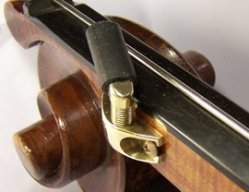
I've created a wood endpin design I call the BeginPin. It incorporates a collar that pressure fits the wooden peg (5/8") so there is no poking with the thumbscrew.
I make my own pegs. I've used:
Ebony
Roasted Maple
Satinwood
Holly
Honduras Rosewood
West Indies Rosewood
Wenge
Orange Osage
Ipe
Curly Cherry
Jarron
Adiroba
Ironwood
Sapele
Purple Heart
Lacewood
Bloodwood
Bocote
Teak

All the store bought:
Maple
Walnut
Birch
Mahogany
Oak

And I'm trying carbon fiber rods and tubes.

It's still early in the process for me. I'm trying to map the differences but as you might suppose there are many variables. Given that each bass responds differently, I am mostly interested in characteristics that can be consistently noticed regardless of the specific instrument. I may never get there!

But safe to say, there is a difference and given that it's SO easy to switch between them, I think it's an exciting way to fine tune your sound.

It's trial and error but a heck of a lot easier than adjusting the sound post, shaving the bass bar, switching stings, etc.
 
Yeah John!!!!! Do you have a pattern duplicator on your lathe or are they all hand cut? I've been trying to figure out how to get that 17:1 taper consistent and accurate without spending $1000 for some big bolt on accessory.

I'll add to the confusion. My carved bass likes an oversized very hard curly Michigan red maple, my giging old rebuilt ply bass is happiest with a 1 1/4" od hollow titanium (3/2 alloy) tube that was fabricated from my broken Litespeed bicycle frame- the same ones that the old aluminum basses tend to like, and I have a new batch in progress that are 1" hollow carbon fiber and carbon / Kevlar tubing to go with the matching carbon fiber armor plated bridges.....and on most of the light colored models with nice figure, I bust out the airbrush and give them a color coordinated little sunburst finish.

Great thread- accessable, practical, and affordable with lots of folks showing a willingness to experiment and go beyond!

j.
condino.com
kaybassrepair.com
 
I have one of John's Begin Pins on an older Czech flatback that I just finished restoring. Curly Cherry, which both looks and sounds great. Sound aside, I really like that it functions well every time. As far as bass fittings go, wood clamped against wood makes a lot more sense to me than metal clamped against metal...
 
I'll jump on this train, too...
I wasn't thrilled with the factory pin, so I did this for fun and because I'm a tinkerer. I also went with the New Harmony spike / ball end and threaded it into a piece of oak baluster (from Home Depot) that had enough material for one full size and two "shorty" pins. The end that inserts into the plug is a cutoff from another steel pin. Sound? No striking first impressions, but I will do some swapping for comparisons to my full steel pin and report back.
shortyoak.JPG
 
I have an Onyx endpin with both ebony and rosewood sticks on one bass and no problem (knock wood!) with breakage. They key may be that I have already cut the pins (which are very long) down by over a 1/3rd. The ebony gives a more direct "orchestra" sound; the rosewood a warmer but softer "solo" sound. On my other bass I have 3 pins: a Cameleopard carbonfiber (which makes the bass sound loud, clear and slightly boring); a titanium pin that feels like it doubles the instrument's volume; and a maple pin that makes the bass sound its best, fullest and warmest (but not as loud as the titanium).

There's no guarantee or implication that any one else on other basses would get the same results. Just reporting in

Thanks
Louis
 
Have you tried turning a full, plug-sized end pin out of a wood you liked, and if so, did you like the results, or not?

I had a broken stock wood endpin on my '52 Kay C-1 (the receiver had split and the pin wouldn't stay put). As a temporary measure I turned a scrap of hundred-year-old oak into a solid endpin to fit straight into the block taper, with a groove for the stock tailwire. I was surprised at how it opened up the voice of the bass.

I have a box blanks of various hardwoods to try out one of these days.