Robo, like you I suspect the OP's issue is definitely not afterlength tuning, but rather something metallic like solidcore twang or maybe even an alu TP. I asked for it before; maybe we'll hear. Might even turn out to be an end-pin rattle.
Anyway, this thread has diverged a bit into afterlength tuning, so I'll share some more research on the matter. As I said earlier, conventional 'wisdom' is 6x the open string pitch, = 31 semitones, = 2 octaves + a fifth, = approximately 1/6 of the open string length (and yes, I previously forgot to mention stiffness as another important factor). Early sources go back as far as 250 years, and in 1895 Riechers presented this as a 'scientific' rule. The topic has yet to go out of fashion, and was for instance also addressed at the 2013 SMAC. The conventional rule of 1/6 still stands, but it is commonly recognised that many other factor play a role, notably TP weight, TG length, TG material, ... Furthermore, it is most definitely not an analytical (or scientific) truth, but rather a subjective choice. And while the rule of 6ths is most frequently quoted, particularly pertaining to the smaller family members like violin & cello, I have also seen 1 recommendation of 2 octaves + a fourth = 29 semitones = 5.34x open pitch, specifically for the DB.
Why the pitch relationship in the DB would be different from the rest of the family is is unclear to me, and sofar I have just gone with the conventional rule of 1/6 in length (so that's 7" on a 42" DB), without giving it much further thought.
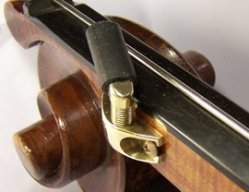
I have also just checked what that means in pitch, and with a Spiro A that gives me pretty much 2 octaves + a fifth = 31 semitones. But: not so for the other strings. The higher Spiro's appear to go a bit higher, and strings with a double wrapped core (like Honeys) go much lower. And of course if you put a clip for your 1/4" jack between the A-D you're completely up the brown river, without a paddle.
Personally I'll just stick with what I've done sofar (1/6 in length), as that conveniently fits conventional strings & TP's.