• TalkBass has been independent since 1998. Add your voice.
    Create a free account to reply to discussions, view embedded media, and browse with fewer display ads.
    Join freeLog in
    Want zero display ads or expanded classifieds tools? Compare plans.

Double Bass Software for analyzing intonation

Uhm..why not simply have a digital tuner (a dime a dozen on the net) and then simply check, as randomly as you like, if the note you are playing is in tune? Granted it is not post-analyzing but to me by the time you've taken the wrong steps (eg examining the results post playing) the horse has bolted.
Just a thought.
 
  • Like
Reactions: neilG
I hate to sound cynical, but I really don't see the use of what you're trying to do. Intonation is relative for a start - relative to how your fellow musicians hear their playing and tuning. It's no good you being bang on that B flat within a cent if someone else is playing it 5 cents flat because that's how they feel it. Your ears always were and always will be the best intonation tool. Mr Mopley is also right - it's better to judge your intonation as you're playing, not afterwards. YMMV of course
 
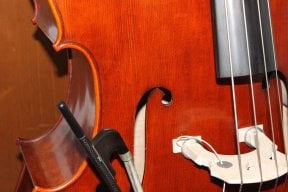
I keep the KLIQ Ubertuner clipped to my bridge when I'm working on intonation. It reacts quickly enough to be useful, and it won't snap into a useless piece of plastic as easily as the Snark does. I find it useful for position jumping exercises. It gives visual feedback that matches what my ears are telling me.
 
Uhm..why not simply have a digital tuner (a dime a dozen on the net) and then simply check, as randomly as you like, if the note you are playing is in tune? Granted it is not post-analyzing but to me by the time you've taken the wrong steps (eg examining the results post playing) the horse has bolted.
Just a thought.


I hate to sound cynical, but I really don't see the use of what you're trying to do. Intonation is relative for a start - relative to how your fellow musicians hear their playing and tuning. It's no good you being bang on that B flat within a cent if someone else is playing it 5 cents flat because that's how they feel it. Your ears always were and always will be the best intonation tool. Mr Mopley is also right - it's better to judge your intonation as you're playing, not afterwards. YMMV of course

Thank you, I'm not disagreeing. I thought I made it clear in my posts that I'm doing (or know) what you suggest already. I'm looking for another arrow in the quiver.
 
I keep the KLIQ Ubertuner clipped to my bridge when I'm working on intonation. It reacts quickly enough to be useful, and it won't snap into a useless piece of plastic as easily as the Snark does. I find it useful for position jumping exercises. It gives visual feedback that matches what my ears are telling me.
I don't think this is a good idea at all. This looks like a rare case where I am in agreement with @jheise It is more useful to look at what you have done to monitor progress than check as you go. Looking a tuner while your playing isn't going to help - you are just going to fool yourself by adjusting.
Looking at a chart your intonation over a series of practice sessions will give you a very honest picture of whether you are making progress.
 
  • Like
Reactions: longfinger
Regarding Melodyne: I downloaded the trial version to correct the bass part on an asynchronous project a I did where I neglected to check the tuning of my bass before recording. Interestingly, the track was largely in tune except for the open G string. The take was really good, too, so I didn’t want to redo it. With Melodyne, I was able to snap the open G notes into place and save the track.

What was far more interesting to me in the end was being able to see on a graph how notes that sounded in tune to me stack up on a grid. Most of the notes that sounded fine to me registered as sharp, then became less so during the sustain. There are several possible reasons for this:
1) Pizz notes go slightly flatter as they decay because as the string excursion from the initial stroke diminishes, it slightly increases the vibrating length of the string.
2) I adjust subconsciously (and sometimes consciously) by rolling the stopping finger based on what I am hearing.
3) It’s possible I just hear certain intervals a little wider than the algorithm that the software uses to measure the “correctness” of the pitch.

Probably the real answer is some combination of the three. Still, it was interesting to see an excerpt charted out like that. I played with trying to use the software to tune in some of the fingered notes, but it ended up being a game of aural whack-a-mole: Snap one note where the software thinks it should be, and the ones around it suddenly sound off in context. I ended up just cleaning up the open G notes and calling it a day.
 
at least there is no vibrato on an open string. That poses another set of issues...

Actually, in Melodyne, it doesn't cause an issue at all, but using pitch correction software is not something that I want to be a part of my regular workflow. That's what practice is for!
 
  • Like
Reactions: jheise
Actually, in Melodyne, it doesn't cause an issue at all, but using pitch correction software is not something that I want to be a part of my regular workflow. That's what practice is for!
I noticed when I started seriously working on my intonation that my ear preferred the natural harmonic intervals over the equal tempered versions. I think I was sensitive to the harmonic resonance of the other strings. I had to learn to hear the equal tempered pitches as correct.
 
But what is your arrow aiming at? Once you are clear, the target will be easier to hit..
My reading is that he wants an honest graph of what he is actually playing - it is not about correcting in the moment but having data to look at after the fact to compare over the course of groups of practice sessions. It is not a bad idea.
It is a great way to see what practice materials work best.
 
My reading is that he wants an honest graph of what he is actually playing - it is not about correcting in the moment but having data to look at after the fact to compare over the course of groups of practice sessions. It is not a bad idea.
It is a great way to see what practice materials work best.
OK, to each his own, I guess, guys. My take has always been that here's a reason that string players retune their instruments so frequently, and you can't compensate for that only by muscle memory - you must be using your hearing to close the feedback loop. Which has to be somewhat instantaneous. Plus the tuning will not always be A = 440, so you need to have the ability to hear tuning and micro adjust after hitting the note. But like I said, if the approach post playing works, using software, and you are able to go back and find what worked, for a specific set of strings, finger position, angle of bass and what have you, all the better for your playing.
 
  • Like
Reactions: M0ses
OK, to each his own, I guess, guys. My take has always been that here's a reason that string players retune their instruments so frequently, and you can't compensate for that only by muscle memory - you must be using your hearing to close the feedback loop. Which has to be somewhat instantaneous. Plus the tuning will not always be A = 440, so you need to have the ability to hear tuning and micro adjust after hitting the note. But like I said, if the approach post playing works, using software, and you are able to go back and find what worked, for a specific set of strings, finger position, angle of bass and what have you, all the better for your playing.

Honestly, I think you misread and misunderstand my intention on why I started this thread completely.
It was never like "ok, I ditch all other sensible approaches and don't use my ears any more. Instead, I'll use software to rate my intonation". It's about adding another tool for analysis in the case that you probably won't go back listening to a full 45min recording of your playing. Naturally, you also still use your ears to listen to your recordings, too.
 
  • Like
Reactions: damonsmith and Xad
Get an oscilloscope. You’ll need to know frequencies for each note and can only track one note at a time but it’s instantaneous feedback. And you can correct and replay instantaneously.

But would that be pedagogically useful?

I’m not a fretless or DB player but are there exercises for “find X note in all positions on the fretboard”? An oscilloscope, tuned for a specific frequency, would tell you if you’re hitting your marks or not.
 
I have the cello drone app on my phone - think it is great. I don't believe it locks you into any tuning system. It is about accuracy and having enough sensitivity and facility between your hands and ears to hit a mark in the moment, whether that mark is an 440 A dead center or a G tuned just so to make an upright piano and guitar blend together.
Just like a metronome shouldn't make you stiff, it should just get you into the right place.

Love the cello drone app and use it every day to practice modes through the cycle.