• TalkBass has been independent since 1998. Add your voice.
    Create a free account to reply to discussions, view embedded media, and browse with fewer display ads.
    Join freeLog in
    Want zero display ads or expanded classifieds tools? Compare plans.

Somebody gave me some WRONG advice

The position of your bass is going to be a major factor in what sort of grip technique you use. Use the grip/positioning that's comfortable for you. As you build strength in your playing hand remember to stretch your hand when it gets tired, give it a little rest and go again. Stretch!!
 
I am self-taught and never completely comprehended exactly what good left-hand position was when reading about it. It is only now that I am an intermediate level player and playing more complex lines that I have begun to notice the dull pain in the back of the hands after playing. This issue actually just began for me in the past few days and today after reading this thread, I sat down and decided to figure out fretting hand position once and for all (gingerly). This thread, combined with the image below, made it finally click what was meant by thumb symmetry with the middle finger, and I immediately saw how my pain was caused by the bad angle between these fingers.
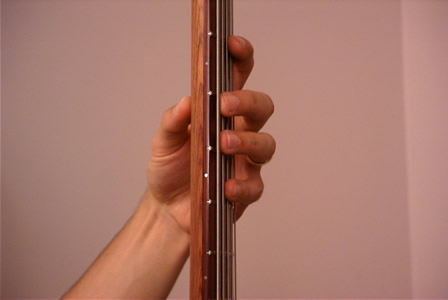
feb08-frethand_fig6.jpg


One thing I am still wondering about is about the amount of force other people use when fretting. I read some people here talking about being able to press the strings down with out their thumb on the back of the neck. If I try to do this, it seems to encourage the dull feeling at the back of my hand. Does it make sense that a bit of pinching may be required for people like me, with long, presumably weaker fingers? In the picture I posted above, it looks like there is definitely a bit of pinching going on. When the whole "thumb in line with the second finger" thing finally clicked, it seemed that the little bit of pinching actually felt good, taking the pressure off the back of my hand. ...So what's the deal with pinching? Always bad?
 
I am self-taught and never completely comprehended exactly what good left-hand position was when reading about it. It is only now that I am an intermediate level player and playing more complex lines that I have begun to notice the dull pain in the back of the hands after playing. This issue actually just began for me in the past few days and today after reading this thread, I sat down and decided to figure out fretting hand position once and for all (gingerly). This thread, combined with the image below, made it finally click what was meant by thumb symmetry with the middle finger, and I immediately saw how my pain was caused by the bad angle between these fingers.

feb08-frethand_fig6.jpg


One thing I am still wondering about is about the amount of force other people use when fretting. I read some people here talking about being able to press the strings down with out their thumb on the back of the neck. If I try to do this, it seems to encourage the dull feeling at the back of my hand. Does it make sense that a bit of pinching may be required for people like me, with long, presumably weaker fingers? In the picture I posted above, it looks like there is definitely a bit of pinching going on. When the whole "thumb in line with the second finger" thing finally clicked, it seemed that the little bit of pinching actually felt good, taking the pressure off the back of my hand. ...So what's the deal with pinching? Always bad?
Is that YOUR position?

I notice that it is the tip of your thumb that putting pressure on the neck,which might be the cause of the pain. I actually use more meat on the neck by using the part above the joint of the thumb, not the tip.
It is true that everybody's body is different but the right posture is the key for me.
 
I wish Fergie's videos had less negative comments.

Havic's video (already posted) is a good one.

I also like those posted by Fergie Fulton (another TBer, as is Havic).

https://www.youtube.com/watch?v=OM-rkoy2H8I&list=PLrFrn-zToNWl__no6289yDvuZq-pNMRQG

There's also a "Part 2" as well as other videos about ergonomics on Fergie's page.

When I first started playing, I stuck with the "thumb in the middle of the neck" position. Developed some tendinitis at the base of my left thumb. Now I go with what feels natural instead of forcing my thumb into some "textbook correct" position.
 
<snip>
Rigidity of teaching is not the answer.

Mark

+1

I agree that there are some general guidelines, but this is a real point of contention for me. I find that instruction that is overly rigid and does not take variation of individual physiology into consideration is just as likely to lead to injury as is a "wrong" technique.

bass.pl - There's More Than One Way To Do It
 
Or I don't play the bass on a ''right'' way. Let me clear this up : I was fooling around with an old friend of mine who plays bass for about 5 years now. He showed me some stuff with his fretting hand and he said to me : ''Always keep your thumb on the same ''line'' with you middlefinger.'' However, I don't because it hurts my hand a lot and I can play easier with my thumb just between my indexfinger and middlefinger or sometimes even to the ''left'' side of my indexfinger.


My friend told me this will increase the change to get CTS and should use his method.. But that can't be right (or does it)?

Keeping your thumb and middle finger in line isn't a bad piece of advice, but I guess where you have your bass on your body and how the angle works is a factor. If you have it down low, keeping your thumb and middle finger in line can get hard; you don't want to bend your wrist at an unnatural angle. If you have it higher up, then playing the middle frets should be very easy with that kind of position. However, if you have it up very high and have a long neck, then playing around the first three frets with that positioning would be very hard as well.

A lot of this advice is to keep bass players from hooking their thumb over the top, which can slow you down a little bit. Also, the idea is to put your hand in the right position so your fingers have a nice arc to the fret board. I tend to be lazy about this and rest may fingers flat on the board, which makes quick runs hard for me if I'm not paying attention.
 
I am self-taught and never completely comprehended exactly what good left-hand position was when reading about it. It is only now that I am an intermediate level player and playing more complex lines that I have begun to notice the dull pain in the back of the hands after playing. This issue actually just began for me in the past few days and today after reading this thread, I sat down and decided to figure out fretting hand position once and for all (gingerly). This thread, combined with the image below, made it finally click what was meant by thumb symmetry with the middle finger, and I immediately saw how my pain was caused by the bad angle between these fingers.

feb08-frethand_fig6.jpg


One thing I am still wondering about is about the amount of force other people use when fretting. I read some people here talking about being able to press the strings down with out their thumb on the back of the neck. If I try to do this, it seems to encourage the dull feeling at the back of my hand. Does it make sense that a bit of pinching may be required for people like me, with long, presumably weaker fingers? In the picture I posted above, it looks like there is definitely a bit of pinching going on. When the whole "thumb in line with the second finger" thing finally clicked, it seemed that the little bit of pinching actually felt good, taking the pressure off the back of my hand. ...So what's the deal with pinching? Always bad?


My thumb is never on the tip like that, but rather further down onto the fat part with the joint bent inward (not locked tight, though).
 
"No right or wrong way to play bass", that is a justification comment that only the player can make....it will see many things that can be wrong as being right because it is what the player gets from it in the immediate that matters.......not the long term.
But there are right and wrong ways to uses your hands, that justification comes from what we know about current medical knowledge based on hand use in general....not just bass playing.

Justification.......that is the biggest single factor for music related injuries. Justification leads to mis-use and over use and that leads to injuries. A player will justify what another player does as what they can do. They look no further than that, they do not see how that player got to that point, all they see is the use and justify their situation to be the same and validate its use on that justification. :)
 
Keeping your thumb and middle finger in line isn't a bad piece of advice, but I guess where you have your bass on your body and how the angle works is a factor. If you have it down low, keeping your thumb and middle finger in line can get hard; you don't want to bend your wrist at an unnatural angle. If you have it higher up, then playing the middle frets should be very easy with that kind of position. However, if you have it up very high and have a long neck, then playing around the first three frets with that positioning would be very hard as well.

A lot of this advice is to keep bass players from hooking their thumb over the top, which can slow you down a little bit. Also, the idea is to put your hand in the right position so your fingers have a nice arc to the fret board. I tend to be lazy about this and rest may fingers flat on the board, which makes quick runs hard for me if I'm not paying attention.

I am self taught and keep my fingers arced but see so many players with their fingers flat to the fretboard that I thought I was doing it wrong. Now I agree that there is no generic right or wrong way to play but this makes me feel more at ease with my left hand technique.
 
I am self taught and keep my fingers arced but see so many players with their fingers flat to the fretboard that I thought I was doing it wrong. Now I agree that there is no generic right or wrong way to play but this makes me feel more at ease with my left hand technique.

I watched some videos of my favorites after reading this thread.

What seems to happen is that there is a lot of "action" when the player moves to the higher register, and at this point adopts a "guitarists" way of playing, with the thumb aimed at the middle finger and the fingers arched. When playing in the lower register, the grip on the neck sometimes changes, again relative to how the player wears their bass.

I guess the real trick is finding something that is both comfortable and functional. Sometimes playing the "right" way hurts a little until you get used to it, just like playing at all in the beginning hurts your fingertips a little until you get used to it.
 
Thing is, that I've tried several heights for playing bass and each time I've had a lot of pain when I had my thumb behind my middlefinger.

So for that reason I prefer to have it just between my indexfinger and my middlefinger.

Keeping your thumb and middle finger in line isn't a bad piece of advice, but I guess where you have your bass on your body and how the angle works is a factor. If you have it down low, keeping your thumb and middle finger in line can get hard; you don't want to bend your wrist at an unnatural angle. If you have it higher up, then playing the middle frets should be very easy with that kind of position. However, if you have it up very high and have a long neck, then playing around the first three frets with that positioning would be very hard as well.

A lot of this advice is to keep bass players from hooking their thumb over the top, which can slow you down a little bit. Also, the idea is to put your hand in the right position so your fingers have a nice arc to the fret board. I tend to be lazy about this and rest may fingers flat on the board, which makes quick runs hard for me if I'm not paying attention.
 
I watched some videos of my favorites after reading this thread.

What seems to happen is that there is a lot of "action" when the player moves to the higher register, and at this point adopts a "guitarists" way of playing, with the thumb aimed at the middle finger and the fingers arched. When playing in the lower register, the grip on the neck sometimes changes, again relative to how the player wears their bass.

I guess the real trick is finding something that is both comfortable and functional. Sometimes playing the "right" way hurts a little until you get used to it, just like playing at all in the beginning hurts your fingertips a little until you get used to it.

I was just looking at the pic in your avatar. Notice the thumb sticking up above the fingerboard. I noticed mine doing it last night at practice, not always, but sometimes. Also, my fingers were fairly flat, not on their tips. My thumb would move back behind the neck when needed, but I'm just saying that there's a lot to be said for relaxed playing.

[Not disputing anything you said, only looking at that pic.]
 
The picture I posted yesterday was not of me. It was a pic I found of someone demonstrating relaxed hand position. I had the dull pain in my fretting hand yesterday but after trying that position, the pain went away and I played a good three hours last night in a band setting and today I have no dull pain to speak of.
 

Latest posts