Nile is awesome. Great riffs on legendary songs and he uses that icy clean solid state tone perfectly. That tone exemplifies what solid state does best, in terms of guitar amplification.
As a contrast, check out SRV’s tone on Little Wing or Angus’ tone on Rock and Roll Ain’t Noise Pollution. Listen to how dynamic those tones are. They can change the sound by how light they play and with their guitar volume knob. That offers a whole other level of control and expression with their instrument. You can hear exactly what their fingers are doing. Not icy clean, not solid state. You can argue that SRV bumped his tone with a solid state pedal, but you can’t bump up a solid state amp’s front end like that and get that response. You need tubes to do that.
With solid state (at least some solid state) you can get some of that effect, but maybe not as wide a range. In my experience it works best with turning up a lower-gain channel loud, rather than using a high-gain channel...but that's true to some extent with tube amps too.
I think some of what's going on is that whether you use tubes or solid-state, cranking up a lower gain channel LOUD gets you some grit from the amp, and maybe a different feel and changing dynamic response as it nears the limit of what the amp's power supply can do in a linear fashion...but it also pushes the speaker, giving more grit and a further compressing effect. You back off, or roll the guitar volume back, or both, and it goes clean. You dig in and whack it, and it barks and feels more compressed. The texture and overtones you hear will likely differ from what a pushed all-tube clean amp would deliver, but sometimes, and for some people, that's okay.
I agree with your SRV and AC/DC examples...those are great examples of hearing a player work the amp by varying input levels. The King's X example I posted earlier is pretty crunchy all the way through, but some of their stuff features really cool clean-to-dirty work using the Lab Series solid state rig. One tune that comes to mind is "Pleiades," from "Gretchen Goes To Nebraska."
Apart from the obvious cleaner/dirtier tones in the verse/chorus, there's a long sort of "chordal breakdown solo" that starts off as sort of an edgy almost-clean at around 2:12, and cycles through the chords every 15-20 seconds. Each time through he rolls up the guitar volume a little more so you hear it get crunchier in discrete steps. It really lets you hear the range of what one channel can do with only picking hand input and guitar volume settings changing its behavior.
Ty Tabor used the dirty channel only on the Lab Series, but having played on of those once, I'd call that dirty channel kind of "medium gain." The range of "clean to dirty" is maybe not as wide as in the examples you mentioned, but there was no Tube Screamer action going on here...just an active-pickup Strat Elite and the higher-gain channel of a L5, slaved through a Crown power amp and 4 x 12 cabs.
EDIT: two other songs where you hear some Ty Tabor Lab Series clean-to-dirty are "We Are Finding Who We Are" from "Faith Hope Love," and "Summerland," from "Gretchen Goes To Nebraska." The unusual solid-state tone is really evident on the latter of the two:
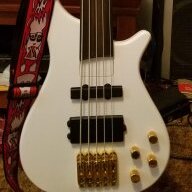
The King's X bassist, Doug Pinnick, used a weird rig too. As I recall it was a rackmount SVT-something with the highs EQed out, combined with various crunchy guitar amps with the lows EQed out...using graphic EQs. Seems one of the times I saw them the guitar amp was a red-knob Fender Showman tube head, and one of the times it might have been some kind of Traynor head. Some of the songs, like "We Are Finding Who We Are," have sparse sections where you can hear dirty, gritty bass highs sustaining and kind of rattling behind the guitar. The effect is interesting but never came across on the albums like it did live. In real life, Pinnick's bass tone was weird but massive and awe-inspiring. Like, internal organs being rearranged. It really seemed like their odd gear choices evolved together and made sense when heard together. I think I drove home from the '92 show I went to, at the Blue Note in Columbia, MO, with my gall bladder in my foot and my colon where my lungs are supposed to be.
One of the things that I thought suffered when Ty made the switch to Zion guitars and Mesa amps for "Dogman" was that the band's sound became more dominated by this big bristling distortion sound, whereas before the guitar and bass oddness seemed more complementary.