

Enjoy the benefits of a premium membership!
Upgrade Account
-
TalkBass has been independent since 1998. Add your voice.
Create a free account to reply to discussions, view embedded media, and browse with fewer display ads.
Join free Log in
Want zero display ads or expanded classifieds tools? Compare plans.
You are using an out of date browser. It may not display this or other websites correctly.
You should upgrade or use an alternative browser.
You should upgrade or use an alternative browser.
More options
Who Replied?

Hi Tony! I believe they would have been Schaller M4 back then. Check the position of the mounting screw.
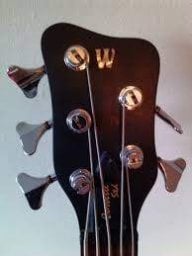
Hi John! It's a fretless Spector I sold a friend and he's trying to swap gold to black hardware. I've found out these are 12mm bushings.
Does anyone know where is the best place to order these nowadays?
Thanks!

Any store, really. Thomann USA has Schaller M4 in stock. Just search around on other sites and you'll find'em.Hi John! It's a fretless Spector I sold a friend and he's trying to swap gold to black hardware. I've found out these are 12mm bushings.
Does anyone know where is the best place to order these nowadays?
Thanks!
View attachment 4935121
Any store, really. Thomann USA has Schaller M4 in stock. Just search around on other sites and you'll find'em.
The problem I'm having is the Schaller M4 has two different size bushings, 12 and 14mm. This Euro requires a 12mm and all I've found online are 14mm - including Thomann USA.
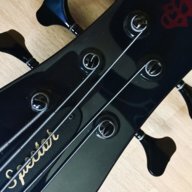
unfortunately no: the old style Schaller with 12mm bushings have been discontinued a long time ago and are practically sold out everywhere. As you found out, the current M4 90 have modified to match the common Gotoh GB size.Hi John! It's a fretless Spector I sold a friend and he's trying to swap gold to black hardware. I've found out these are 12mm bushings.
Does anyone know where is the best place to order these nowadays?
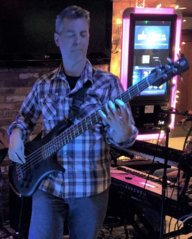
Selling my late '90's Spector NS-4CR, this is one beast of a bass for the money;
For Sale - Spector NS-4CR late '90's
For Sale - Spector NS-4CR late '90's

Cheers dudes and dudettes!
After migrating from a Spector Euro 4LX to Fenders for several years, I am back in the Spector club
I received today my 2008's Spector Euro LX with 35' which has probably a 130-45 string gauge from the previous owner (need to ask him) and he had it on B Standard. I need to downtune to G# standard with the hope to learn some Suffocation and Cannibal Corpse stuff, but when I did it the buzz is evident even with the action a bit high, but I guess that is somehow normal in a 35' scale versus Suffo Boyer's panned neck of 37'.
I can live with it but I guess that for my Spector Euro 35' I would need a 135-50 to avoid that fret buzz tuning on G# (which is not that bad to be honest, I will try to find out if I can live with it).
Btw, does anyone know why the Spectors have the pin for the strap in the bridge end so high in the upper wing of the bass?. It makes the bass almost need to be played perpendicular to the body. I mean the pin in the upper horn is natural, but the other one should be where the Fenders has it, kind of in the symmetric bottom of the brigde?
I had similar issue with a B.C. Rich Warlock 5 and had to modify it to make it playable, but I am afraid that if I bring it to the luthier to make a hole in the bottom closer to the symetrical part of the body I would make the bass loss its value. Anyone had similar issue? I use to playe the bass quite vertical, kind of contrabass style (more like teh suffo guy).
After migrating from a Spector Euro 4LX to Fenders for several years, I am back in the Spector club
I received today my 2008's Spector Euro LX with 35' which has probably a 130-45 string gauge from the previous owner (need to ask him) and he had it on B Standard. I need to downtune to G# standard with the hope to learn some Suffocation and Cannibal Corpse stuff, but when I did it the buzz is evident even with the action a bit high, but I guess that is somehow normal in a 35' scale versus Suffo Boyer's panned neck of 37'.
I can live with it but I guess that for my Spector Euro 35' I would need a 135-50 to avoid that fret buzz tuning on G# (which is not that bad to be honest, I will try to find out if I can live with it).
Btw, does anyone know why the Spectors have the pin for the strap in the bridge end so high in the upper wing of the bass?. It makes the bass almost need to be played perpendicular to the body. I mean the pin in the upper horn is natural, but the other one should be where the Fenders has it, kind of in the symmetric bottom of the brigde?
I had similar issue with a B.C. Rich Warlock 5 and had to modify it to make it playable, but I am afraid that if I bring it to the luthier to make a hole in the bottom closer to the symetrical part of the body I would make the bass loss its value. Anyone had similar issue? I use to playe the bass quite vertical, kind of contrabass style (more like teh suffo guy).

Raising a glass tonight to the memory of one of the Club OGs, Chris Loe. Just an all around great dude, so funny and humble. He probably forgot more than I'll ever know about playing bass.
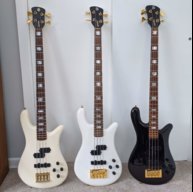
The problem I'm having is the Schaller M4 has two different size bushings, 12 and 14mm. This Euro requires a 12mm and all I've found online are 14mm - including Thomann USA.
You used to be able to get 12mm bushings from Hipshot that would work with their Ultralite tuners. If that's something your friend would consider, it's worth a shot. I did that for an NS5CRFM that I swapped to black hardware on. I'm not sure if Hipshot still offers them though, so you'd have to ask.

Cheers dudes and dudettes!
After migrating from a Spector Euro 4LX to Fenders for several years, I am back in the Spector club
I received today my 2008's Spector Euro LX with 35' which has probably a 130-45 string gauge from the previous owner (need to ask him) and he had it on B Standard. I need to downtune to G# standard with the hope to learn some Suffocation and Cannibal Corpse stuff, but when I did it the buzz is evident even with the action a bit high, but I guess that is somehow normal in a 35' scale versus Suffo Boyer's panned neck of 37'.
I can live with it but I guess that for my Spector Euro 35' I would need a 135-50 to avoid that fret buzz tuning on G# (which is not that bad to be honest, I will try to find out if I can live with it).
Btw, does anyone know why the Spectors have the pin for the strap in the bridge end so high in the upper wing of the bass?. It makes the bass almost need to be played perpendicular to the body. I mean the pin in the upper horn is natural, but the other one should be where the Fenders has it, kind of in the symmetric bottom of the brigde?
I had similar issue with a B.C. Rich Warlock 5 and had to modify it to make it playable, but I am afraid that if I bring it to the luthier to make a hole in the bottom closer to the symetrical part of the body I would make the bass loss its value. Anyone had similar issue? I use to playe the bass quite vertical, kind of contrabass style (more like teh suffo guy).
Moving the strap pin actually helps to shift the center of gravity to aid with potential neck dive due to the upper horn only reaching the 15th fret combined with the neck being a little longer because of the 24 frets.
It was done for a reason, much like Dingwall put the strap pin on the back of the upper wing of their Dbird and Drocs so they don't neck dive like a traditional Thunderbird or Mockingbird. Moving the strap pin up the body provides a small amount of lift to the neck to compensate for the upper horn strap pin position.

If you are asking why the bottom strap pin isn't dead center like 98% of other basses,Btw, does anyone know why the Spectors have the pin for the strap in the bridge end so high in the upper wing of the bass?. It makes the bass almost need to be played perpendicular to the body. I mean the pin in the upper horn is natural, but the other one should be where the Fenders has it, kind of in the symmetric bottom of the brigde?
I had similar issue with a B.C. Rich Warlock 5 and had to modify it to make it playable, but I am afraid that if I bring it to the luthier to make a hole in the bottom closer to the symetrical part of the body I would make the bass loss its value. Anyone had similar issue? I use to playe the bass quite vertical, kind of contrabass style (more like teh suffo guy).
I'll tell you what the man (Stuart) himself told me over the phone at least 30 years ago.
For those of you old enough to remember, almost all guitar stands were the old style fork design.
The NS body style has always been more svelt than most other bass bodies.
So the issue is/was that it would sit too low in the bottom fork of the stand, which means,
the bass's weight would rest on the bottom strap pin on the floor vs the bottom fork of the stand.
This would be even worse if you're using some kind of a strap lock as the pin would be extended even more.
This all made the bass very unstable in the stand.
I also feel this makes the bass ride more snugly and comfortably on my body.
I asked him the question because I had (and still do) always move the bottom strap pin dead center.
I always had wondered why Spector didn't.
Last edited:
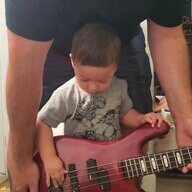
Opinions on the Coda 5 Pro?? I have the opportunity to snag one for cheap with the plastic still on the pickguard.
Never played one, but if it's cheap enough to flip if you don't like it I'd take a shot.Opinions on the Coda 5 Pro?? I have the opportunity to snag one for cheap with the plastic still on the pickguard.
I recall reading an [This invalid link has been removed] with Stuart Spector from 7 years ago (great read, btw) where he listed some of the earliest bassists to play a Spector, including Prakash John, Doug Wimbish, etc. I'm curious if anyone knows on which recording (album and/or song) a Spector was first used?

If you are asking why the bottom strap pin isn't dead center like 98% of other basses,
I'll tell you what the man (Stuart) himself told me over the phone at least 30 years ago.
For those of you old enough to remember, almost all guitar stands were the old style fork design.
The NS body style has always been more svelt than most other bass bodies.
So the issue is/was that it would sit too low in the bottom fork of the stand, which means,
the bass's weight would rest on the bottom strap pin on the floor vs the bottom fork of the stand.
This would be even worse if you're using some kind of a strap lock as the pin would be extended even more.
I think Spector was pulling your leg a little bit.
Most of the Spector users I knew fixed that by just bending the tongs on the bottom fork in a bit. I have no issues putting mine on those kinds of stands, and I have A-frame stands at home that also benefitted from at the carrying "tongs" bent in a little bit. Even the earliest Spectors that didn't yet have a svelte body shape had their strap-pin off-centre:

Maybe ask Ned Steinberger if he remembers why he kept the strap button off-centre on the NS shape? He kept experimenting with strap-button positions well into the Steinberg years.
Btw, does anyone know why the Spectors have the pin for the strap in the bridge end so high in the upper wing of the bass?. It makes the bass almost need to be played perpendicular to the body. I mean the pin in the upper horn is natural, but the other one should be where the Fenders has it, kind of in the symmetric bottom of the brigde?
Do you wear yours high above the hip? Have you tried lowering your strap a little bit? I have always found Spectors need to sit a bit lower and then they naturally slide to the right (on a right-hand bass) and neck-tilt upwards a bit.

Opinions on the Coda 5 Pro?? I have the opportunity to snag one for cheap with the plastic still on the pickguard.
I played one once and thought it was a fantastic jazz bass. If the price is good as mentioned and you like jazz basses give it a go I'd say
Do you wear yours high above the hip? Have you tried lowering your strap a little bit? I have always found Spectors need to sit a bit lower and then they naturally slide to the right (on a right-hand bass) and neck-tilt upwards a bit.
I am trying to find the right spot. I started slightly above the hip, but I found out that I feel more confortable a bit lower because being right handed, the left shoulder tension hurts as the nut stays above my eyes, so it makes me lose the natural shoulder relaxed position. I found out that with the neck diagonal to the body, the nut should not be higher than the nose level, so the shoulder is always in its natural position.
Maybe, but I doubt it.I think Spector was pulling your leg a little bit.
It was certainly a legitimate issue and I had some A-frame stands that actually broke.
Not because they're weak. Quite the opposite.
The fork rod/metal was so thick and strong, the weld at the frame point would fail first.
Plus, like I said, I much prefer the way the bass rides on me with the bottom pin centered anyway.


