• TalkBass has been independent since 1998. Add your voice.
    Create a free account to reply to discussions, view embedded media, and browse with fewer display ads.
    Join freeLog in
    Want zero display ads or expanded classifieds tools? Compare plans.

Spector content: Haz Lab 9V versus Tone Pump

Aug 29, 2012
5,241
2,393
Germany
A couple of days before I did run a Haz Lab 9V simulaton in LTspice to figure bass/treble frequency response of the ciruitry.

It can be seen frequently that owners of Euro Spectors swap the Tone Pump with the Haz Lab 9V in a hopeness to get the "original" USA sound out of the instrument.


Here you are with some usefull information about the Tone Pump on board electronic which was designed by engineer Petr Michalík in the Czech Republic.

Invalid Link Removed

Rather than the usage of a dual OP-Amp the Tone Pump circuitry is a discrete design that uses J-Fet transistors. The circutry is capable to generate some even order harmonics at overload range.


Most of "generic" tone control circuits (such as the Haz Lab 9V) are designed as Baxandall tone stack.
There is nothing wrong with a Baxandall tone stack but also nothing mystic stuff in it.


Tone Pump frequency response
Invalid Link Removed
We can notice a "built in" HPF that cuts off sub harmonic content.
The treble reponse acts rather smooth and centers at about 5..6kHz.


The Haz Lab 9V is designed as "generic" Baxandall tone stack

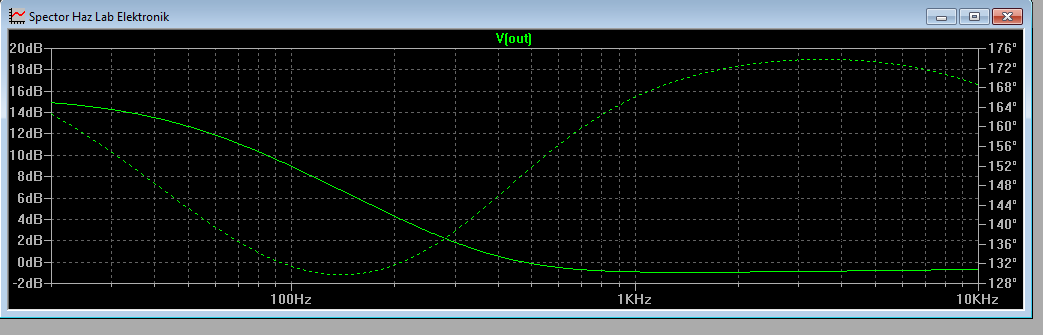
Here you are with low response for bass boost.
(for the record, the second "dotted" line you can see in the pic is the phase response. Please try to ignore this line)
upload_2019-9-7_23-2-8.png

There is nothing extraordinary noticeable with this type of a "shelf" filter.

Treble response Haz Lab
upload_2019-9-7_23-8-16.png

Nothing extraordinary noticable with the reponse.
Except the fact that the treble boost acts very broad and covers pretty much of rather typical midrange content as well.

Haz Lab bass/treble boost response.
upload_2019-9-7_23-22-16.png


So what does this all mean?
I have got two different spector bass guitars
USA NS-2O
CZ NS4-CRFM

The Haz Lab 9V (or its licensed Korea/Japan copy) fits very well to my NS-2O.
The very "broad acting treble supports very well the basic sound characteristic of the (USA) instrument.
The bass response characteristic is nothing but "generic" standard.


My NS4-CRFM comes with the EMG BTS circuit. The factory setting for the treble shape is Off/On.
This setting provides a very similar treble response shape such as is for the Haz Lab 9V.
Unfortunatelly the basic sound characteristic of the instrument is noticeable different versus my NS-2O.
The basic sound of the NS4-CRFM is more "airy" with more "agressive" attack.

I have got a Mighty Mite copy of the Haz Lab laying around here, mainly meant to serve as spare parts for my NS-2O. I don't think it was a good idea to swap the BTS for this Haz Lab clone due to the very broad sounding treble response with the Haz Lab circuit clone.

If any then I would replace the BTS with the Tone Pump cause the Tone Pump treble shape acts more smooth at the treble content which likely fits way better to the basic sound of my NS4-CRFM

At the other hand side with the BTS treble shape setting "On/On" I'm pretty much satisfied with the total sound of the instrument.

We do frequently read that the Haz Lab 9V electronic is the way to go to get the famous Spector growl.

The plots shown above show clearly that there is nothing extrardinary envolved with this on board electronc. No magic things (Spector growl) nor anything mystic is involved. Its quite generic Baxandall tone stack. Nothing else.

Unfortunatelly the holes in the body have to be enlarged to fit the pots shaft diameter of the Haz Lab.
I think it must be a pain in the ass to notice eventually that a Haz Lab upgraded instrument tries to refuse to sound the same such as an USA made instrument.
Furthermore a totally different sound than expected (too sharp/edgy) may eventually give reason to sell a modded instrument!

USA made Spectors come (almost always) with Pau Ferro or Maple fretboards.
CZ made basses come (almost always) with a Rosewood fretboard.

And indeed that's the main, and likewise essential, difference of my two Spectors.
 
We do frequently read that the Haz Lab 9V electronic is the way to go to get the famous Spector growl.

The plots shown above show clearly that there is nothing extrardinary envolved with this on board electronc. No magic things (Spector growl) nor anything mystic is involved. Its quite generic Baxandall tone stack. Nothing else.

You likely have never thoroughly analyzed the HAZ circuit. There is something unique happening in the first amplification stage. The BTS and HAZ both use the sane Bax tone stack but they definitely do not sound the same. The first stage of the BTS is simply a unity gain buffer. The first stage of the HAZ is where the magic happens. You are not going to capture that with a Bode analysis at the output jack or via an LTSpice simulation.
 
Last edited:
Sorry to say bro but I try too hard on the meaning of your words. You know I'm a German guy who sometimes sucks on language barrier.

I think you could benefit from extending this to more basses. I have rebops with tonepmps, emg bq and SNCpre haz clones as well as a US Spector. There’s a commonality it tone that’s isnt just fingerboard wood. Geometry maybe?
 
  • Like
Reactions: TonyP-
You likely have never thoroughly analyzed the HAZ circuit. There is something unique happening in the first amplification stage. The BTS and HAZ both use the sane Bax tone stack but they definitely do not sound the same. The first stage of the BTS is simply a unity gain buffer. The first stage of the HAZ is where the magic happens. You are not going to capture that with a Bode analysis at the output jack or via an LTSpice simulation.
There is nothing magical happening with the first stage of the Haz Lab.

Basically we have a passive RC LPF at the output of stage 2 that rolls of the response beyond f3 900Hz.
We also do have a HPF Shelf at stage 1 which boosts the response above 900Hz.

Without the stage 1 HPF but stage 2 LPF shelf active the response for a flat bass/treble setting would look like the following
upload_2019-9-8_19-5-5.png


With stage 1 HPF shelf active but stage 2 passive LPF deactive we get the following response
upload_2019-9-8_19-4-1.png


With both HPF and LPF active for a flat EQ setting bass/treble we have got the following total response
upload_2019-9-8_19-6-49.png


Although we have some loss in response of -1.2dB the total response can be regarded as flat response.


In total we have got a boost of treble content at the initial stage 1 but also do have a passive network at the output that compensates the boost and thus provides a flat total response.

This design technique is often used to improve SNR numbers of a circuitry/board.
If proper designed there is no impact (soundwise) on the total "audible" performance of the schematic.
We have to take into account that the haz lab board is quite large (vers a smallish modul like the Tone Pump) that shows rather longish signal traces so I think its not so bad to have an "inaudible" HPF/LPF cicuitry that helps to improve SNR at the output.
Either way, these two filters both in combination are not suited nothing at all to call for any magical Spector growl.
 
Again, an LT spice simulation will not capture what you have missed.

It would be worth your effort to run a harmonic distortion analysis on the output of the HAZ preamp. Once you see the results, you will understand why the HAZ preamp 'growls' in the way that it was designed to do. The hi-midrange boost that happens in the first amplification stage is directly responsible for this sonic coloration that is key to the signature Spector sound.


There is nothing magical happening with the first stage of the Haz Lab.

Basically we have a passive RC LPF at the output of stage 2 that rolls of the response beyond f3 900Hz.
We also do have a HPF Shelf at stage 1 which boosts the response above 900Hz.

Without the stage 1 HPF but stage 2 LPF shelf active the response for a flat bass/treble setting would look like the following
View attachment 3532866

With stage 1 HPF shelf active but stage 2 passive LPF deactive we get the following response
View attachment 3532864


With both HPF and LPF active for a flat EQ setting bass/treble we have got the following total response
View attachment 3532868

Although we have some loss in response of -1.2dB the total response can be regarded as flat response.


In total we have got a boost of treble content at the initial stage 1 but also do have a passive network at the output that compensates the boost and thus provides a flat total response.

This design technique is often used to improve SNR numbers of a circuitry/board.
If proper designed there is no impact (soundwise) on the total "audible" performance of the schematic.
We have to take into account that the haz lab board is quite large (vers a smallish modul like the Tone Pump) that shows rather longish signal traces so I think its not so bad to have an "inaudible" HPF/LPF cicuitry that helps to improve SNR at the output.
Either way, these two filters both in combination are not suited nothing at all to call for any magical Spector growl.
 
The BTS and HAZ both use the sane Bax tone stack but they definitely do not sound the same.
They don't sound the same cause the LF442 OP-Amp of the OEM Haz Lab does produce some "smooth" coloring to the total sound.
Personally I'm way more happy with a TL072 that provides an noticable more "open" sound versus "odd" sounding LF442.

There is not much of a difference vers BTS anymore once the Haz Lab circuitry has got a TL072 in it.
Interestingly the Kramer NS-2O models are known for an noticable "expanded" sound characteristic within USA Spector "growl" family.
At least I can tell that with an LF442 OP-Amp in it my NS-2O sounds more like kinda "generic" Spector growl rather than "typical" NS-2O Spector growl.
 
It's more complicated than this. See my last post.

They don't sound the same cause the LF442 OP-Amp of the OEM Haz Lab does produce some "smooth" coloring to the total sound.
Personally I'm way more happy with a TL072 that provides an noticable more "open" sound versus "odd" sounding LF442.

There is not much of a difference vers BTS anymore once the Haz Lab circuitry has got a TL072 in it.
Interestingly the Kramer NS-2O models are known for an noticable "expanded" sound characteristic within USA Spector "growl" family.
At least I can tell that with an LF442 OP-Amp in it my NS-2O sounds more like kinda "generic" Spector growl rather than "typical" NS-2O Spector growl.
 
Again, an LT spice simulation will not capture what you have missed.

It would be worth your effort to run a harmonic distortion analysis on the output of the HAZ preamp. Once you see the results, you will understand why the HAZ preamp 'growls' in the way that it was designed to do. The hi-midrange boost that happens in the first amplification stage is directly responsible for this sonic coloration that is key to the signature Spector sound.

Your conclusion might be true for sine sweep of steady state amplitude.

With a real instrument in practice you'll get rather smallish levels for midrange content harmonics and all of harmonics beyond.
That's why it is possible to improve SNR with this filter technique principle without overload the headroom in real practice.
Human ears are quite sensitive in the range of 1..5kHz. That's the range the Haz Lab filters give respect to
Dolby Laboratories invented this principle of noise reduction many decades ago. For older guys such as me best known with "vintage" tape recorders.
 
Last edited:
E1 at the input of stage 1
~0.6 Vpeak, ~125 mVrms, Peak to RMS ratio ~14dB
upload_2019-9-9_1-7-25.png


E1 at the output of stage 1
~0.7 Vpeak, ~130 mVrms, Peak to RMS ratio ~15dB
upload_2019-9-9_0-58-30.png


Just as I already predicted in post #11 (without doing any math or sims) there is only little effect caused by stage 1 on the total signal level in regards of peak and rms numbers. The harmonics level at midrange and treble are way too small to have an impact on the total level.


E1 for full treble boost at the output of stage 2
upload_2019-9-9_1-24-9.png


We see higish peaks at the initial attack. These could be clipped down to 0.8V level without noticable artifacts.
But, we do still have plenty of headroom

E1 for full treble and full bass boost at the output of stage 2
upload_2019-9-9_1-31-18.png


Bass players do rarely pick a string just the same "evenly". If I'd dig in a little harder the on board electronic might clip a little bit.


E1 for full treble and full bass boost at the output of stage 2, but here without the interference of the HPF boost at stage 1
upload_2019-9-9_1-56-53.png

That's an very intersting outcome cause the deviation in peak level is even smaller than I personally expected!
Ok, we added tons of bass boost where we have got a high power density with the bass guitar anyway, so relatively the filter at stage 1 shows little to no impact anymore.
If you look carefully enough you may notice that the stage 1 filter has more of an impact "narrow" the 0V level line rather than on max peak numbers

edit,
I think the engineers of Dolby Laboratories did a pretty good job once they invented the noise reduction with filters.
If properly applied it doesn't affect the headroom capability of a transfering channel.
 

Attachments

  • upload_2019-9-9_1-38-16.png
    upload_2019-9-9_1-38-16.png
    23.1 KB · Views: 145
Last edited:
Interesting thread guys... Can someone post the schematic for this haz pre? I believe I have this circuit in one of my basses. I saw this as pre-emphasis de-emphasis noise reduction. Mine has a TL062...
Similar like the LF442 the TL062 is a low power consumption OP-Amp.
If you can tolerate some additional current consumtion (less battery live) you might get some sound improvement with TL072.
That's the chip that came factory stock with the NS-2O basses.

Or just try a more "modern" low power design such as LT1112.

I think it doesn't take a lot of time to get the schematic with google search.

"pre-emphasis de-emphasis noise reduction"

Yepp, that's what it is.
if you run the schematic (or the real board) with a sine sweep or at least highish levels at midrange one might come to the conclusion that the haz lab pushes some additional THD due to "pre-amphasis" level but, that's out off of any concerne cause bass guitars push (naturally) only little harmonic levels at midrange content.
Furthermore EMG pickups (which are most common with Spector) push "medium" level at best.
 
Last edited:
Yeah it's a nice approach to getting decent noise performance out of those noisy old opamps like the 062. But obviously reduces the headroom a fair bit.

FWIW, the old boss 7-band eq pedals use a similar approach. There's a low noise opamp up front with HPF, then low current opamps like 062s or 022s for all the gyrators etc. Then there's a LPF on the output.

This is really not necessary with modern opamps. There's so many more low current audio op amps out there these days. 9v batteries have much better performance too, so the goal posts have moved I guess...
 
Last edited:
Yeah it's a nice approach to getting decent noise performance out of those noisy old opamps like the 062. But obviously reduces the headroom a fair bit.
Not neccessarily.
If you keep a look on the first plot and second plot of post #12
The first plot shows the rough signal on the input of the buffer stage (stage 1)
The second plot shows the "pre emphasized" signal at the output of the buffer stage.

Peak wise the total signal is gained by about +1.1 dB
RMS wise the total signal is gained by less than 1dB

If any than the headroom is reduced only a little bit. In real practice this smallish reduction of headroom is irrelevant
 
There is nothing magical happening with the first stage of the Haz Lab.

Basically we have a passive RC LPF at the output of stage 2 that rolls of the response beyond f3 900Hz.
We also do have a HPF Shelf at stage 1 which boosts the response above 900Hz.

Without the stage 1 HPF but stage 2 LPF shelf active the response for a flat bass/treble setting would look like the following
View attachment 3532866

With stage 1 HPF shelf active but stage 2 passive LPF deactive we get the following response
View attachment 3532864


With both HPF and LPF active for a flat EQ setting bass/treble we have got the following total response
View attachment 3532868

Although we have some loss in response of -1.2dB the total response can be regarded as flat response.


In total we have got a boost of treble content at the initial stage 1 but also do have a passive network at the output that compensates the boost and thus provides a flat total response.

This design technique is often used to improve SNR numbers of a circuitry/board.
If proper designed there is no impact (soundwise) on the total "audible" performance of the schematic.
We have to take into account that the haz lab board is quite large (vers a smallish modul like the Tone Pump) that shows rather longish signal traces so I think its not so bad to have an "inaudible" HPF/LPF cicuitry that helps to improve SNR at the output.
Either way, these two filters both in combination are not suited nothing at all to call for any magical Spector growl.
Get yourself a kramer era usa ns2, play it and then tell me theres no magic there.
 
Which one do you prefer? Tonepump or the Korean Haz?

My NS4CRFM is loaded with the EMG BTS which provides a very similar sound performance vers Haz Lab and all of its clones.

In a german speaking forum we did a couple of LT-Spice simulations of the OEM Haz schematic vers EMG BTS.
The sound performance deviations are quite small, nothing to talk home about.
I did run the sound samples for fellows so I think its not a good idea to upload the sound files to TB

In real practice its just the same appearance. I have got two spectors which are loaded with different preamps. The noticable sound performance deviation between the two bass guitars is NOT caused by the loaded preamp.

Explained in different words. If your CR spector is already loaded with the EMG BTS you won't get tons of additional performance with the Haz Lab. Nope, the Haz Lab on its own does not bring you as "close as possible" to the USA made instruments.
CR made spectors come with a different fretboard which may be the main reason for different sound of USA made spectors vers CR made instruments
 
Last edited:

Latest posts