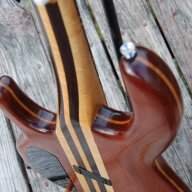
I've searched, chatted about, and just about driven my best friend/luthier and myself crazy with this, BUT I want to re-inlay an existing bass fretboard. The mark, a Spector Performer 4 string, matte black finish with what I believe is a flame top. I bought one of these and gave it to my best friend after he sold his Spector to buy food while he was in luthier school. A few months later the bass I gifted had burnt to cinders in a mutual buddie's house fire. I swore that next bass like it I found, it was mine. Four years later I walk into a local pawn shop and spotted one. No questions asked, $120 and I took it home. These basses come equipped with plastic crap-lousy fretboard dots (sorry if you like them, I don't) I would much rather they not have anything than those dots. That being said, I want to remove those dots and CAREFULLY rout my fretboard. I want those super nice Spector inlays you see on the Rebops, Euros, and USA models. Being as I don't have $2,500 to just out right buy the bass of my dreams. I figure worst case scenario is I screw up and trash the fretboard then put the body away till I either find another neck or somehow replace the fretboard I thought about green abalone but I researched it and think I would like to use abalam. Price and workability are major factors. Now, I'm fairly crafty and feel confident that with some practice I could do a pretty good job, but my luthier insists that if I pull this off, it's going to require a refret. I'm not so sure, I think with precision and attention to detail it won't need a refret. I have minor experience with wood working and wouldn't touch my fretboard without plenty of practice. I just want a few more opinions as to whether this even a remotely good idea or not and if this will need a refret. This may be a completely dumb idea to you, that's fine, what I don't need are bunch of porky mouths explaining just how dumb of an idea this is. I can take criticism fine, but I won't have my intelligence insulted. Thank you for your input fellow TB'ers!

Enjoy the benefits of a premium membership!
Upgrade Account
-
TalkBass has been independent since 1998. Add your voice.
Create a free account to reply to discussions, view embedded media, and browse with fewer display ads.
Join free Log in
Want zero display ads or expanded classifieds tools? Compare plans.
Spector crown inlays
- Thread starter Scooberto
- Start date