
Enjoy the benefits of a premium membership!
Upgrade Account
-
TalkBass has been independent since 1998. Add your voice.
Create a free account to reply to discussions, view embedded media, and browse with fewer display ads.
Join free Log in
Want zero display ads or expanded classifieds tools? Compare plans.
You are using an out of date browser. It may not display this or other websites correctly.
You should upgrade or use an alternative browser.
You should upgrade or use an alternative browser.
Squier Classic Vibe used bass, replace neck?
- Thread starter coyote1
- Start date
More options
Who Replied?


Time to point out that you cannot just simply drop a washer under the nut of a CV. There is a plug in the rod access hole that prevents the nut from being extracted. That plug needs to be removed (or drilled out) and isn’t a simple job. Sure it can be done, but it’s tricky to do and have the result look clean what with having to score into the factory finish and all.
Plan on just putting a new neck on that if you want it. Or be very skilled at woodworking.
Plan on just putting a new neck on that if you want it. Or be very skilled at woodworking.

It’s alive and it has a soul ? BUY IT !
I bought a Squier p bass body onto which I installed a Warmoth roasted maple/rosewood neck and also a Squier Affinity jazz bass with a defective neck I replaced with a Fender MIM roasted maple neck and they both sound awesome.
A bit costly but still half the price of an American Pro Fender and I now have basses that are here to stay.
I bought a Squier p bass body onto which I installed a Warmoth roasted maple/rosewood neck and also a Squier Affinity jazz bass with a defective neck I replaced with a Fender MIM roasted maple neck and they both sound awesome.
A bit costly but still half the price of an American Pro Fender and I now have basses that are here to stay.

I would like to add this to my previous remarks in this thread: if the heavens open and choirs sing when you play this bass, buy it. It's a small enough investment and there are lots of ways to deal with the neck issue, but there are not lots of basses that sound like the best bass tone you've ever heard or imagined. If you don't buy it you'll always wonder if it would have worked out. You may have regrets and your TalkBass cred will never recover. You will forever be the guy who let the greatest bass he ever heard get away. Worst case scenario? It's not repairable and it doesn't sound quite the same with a new neck. You can always sell it but you can't always buy it.
This is pure wisdom !I would like to add this to my previous remarks in this thread: if the heavens open and choirs sing when you play this bass, buy it. It's a small enough investment and there are lots of ways to deal with the neck issue, but there are not lots of basses that sound like the best bass tone you've ever heard or imagined. If you don't buy it you'll always wonder if it would have worked out. You may have regrets and your TalkBass cred will never recover. You will forever be the guy who let the greatest bass he ever heard get away. Worst case scenario? It's not repairable and it doesn't sound quite the same with a new neck. You can always sell it but you can't always buy it.
But whats the UP side? So after you replace the neck (and hopefully the new one is better than those 3). Whats so great about THIS bass? There are SO MANY nice ones out there ..... why this one? And how did you get these people to talk this long about it without a pic? Move on.... find you something nice.

Many necks come and go in the classifieds here.
If you like everything besides the neck, try a different one...
If you like everything besides the neck, try a different one...

Well… I got them to drop the price to where it was worthwhile. Brought it home, plugged it in…. yes, the heavens open and the choirs sing when I play it. It’s THE sound in my head for a bass like this.This is pure wisdom !
The ‘up’ side? Read above. Yes there are so many nice ones out there. But a) not at this price, and b) not for even a whole lot more money. The body is in near-mint condition, no dings or scratches (same with the neck btw). Ultimately music is all about SOUND. And this one has a sound that a number of MUCH more expensive basses could not match unless I went active… and one of my particulars going forward is that I’m no longer interested in active basses. My Tobias is the last of those I’ll ever have.But whats the UP side? So after you replace the neck (and hopefully the new one is better than those 3). Whats so great about THIS bass? There are SO MANY nice ones out there ..... why this one? And how did you get these people to talk this long about it without a pic? Move on.... find you something nice.
I got it on final sale. So I can experiment with putting a spacer in the neck (it’s worth removing that wood plug). And if that doesn’t work, then try a new neck.
Oh, and here’s a pic in my not to well lit basement studio
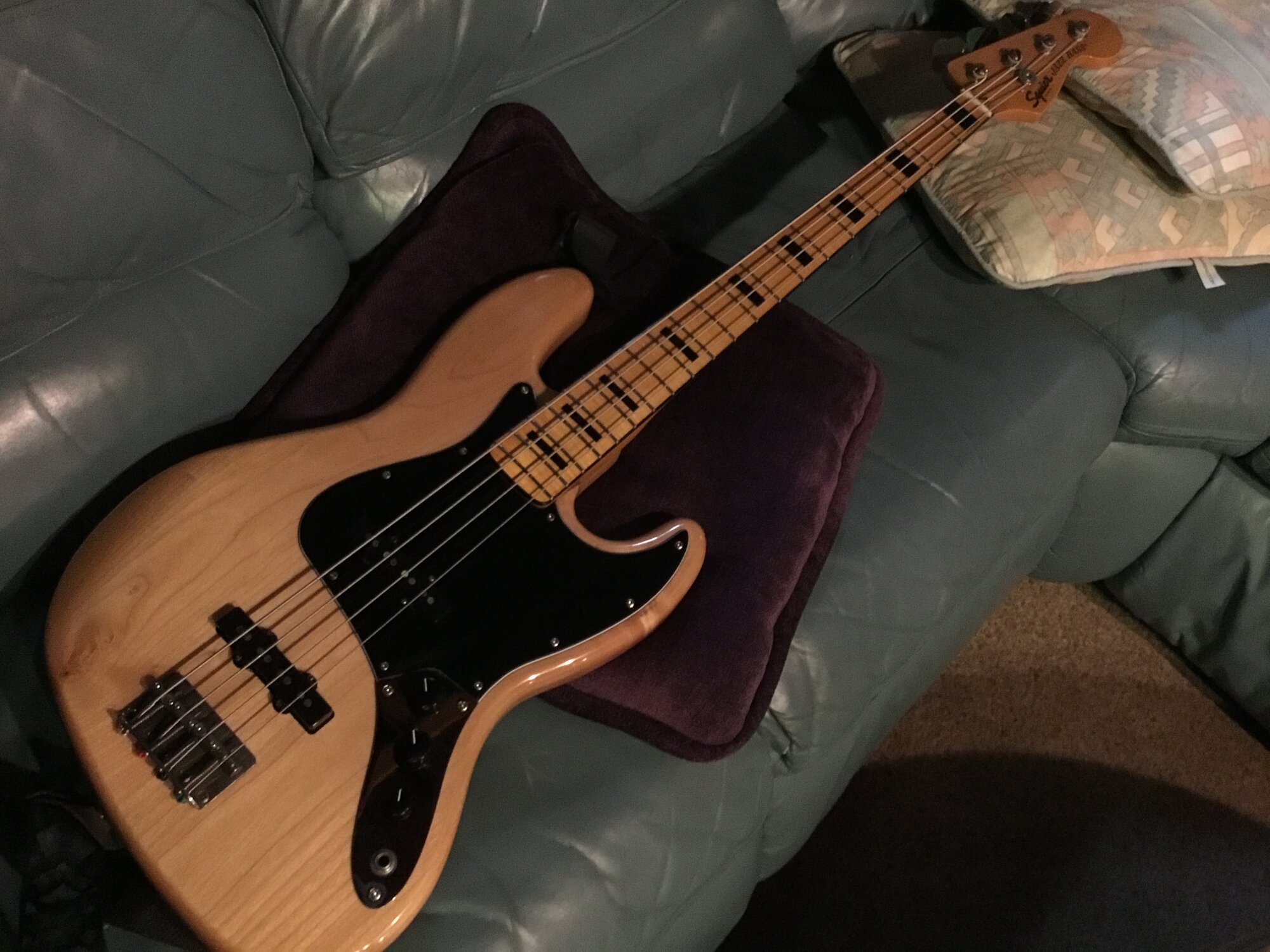

I’ve inquired with Fender about a new neck. If they can’t help, some questions for those of you who have been down this road:
1. Are the neck pockets of these Squier Classic Vibe basses identical to those of Fender instruments?
2. Same basic question, but about the tuner holes.
My concern if I were to purchase a used Jazz neck would be alignment, hole location, etc. And if I purchase a new neck, either from Fender or Allparts or Warmoth etc, I would want this to be “drop in”. I’d be willing to drill the holes for bolting it to the body.
1. Are the neck pockets of these Squier Classic Vibe basses identical to those of Fender instruments?
2. Same basic question, but about the tuner holes.
My concern if I were to purchase a used Jazz neck would be alignment, hole location, etc. And if I purchase a new neck, either from Fender or Allparts or Warmoth etc, I would want this to be “drop in”. I’d be willing to drill the holes for bolting it to the body.

Nothing is for sure…
Neck pockets are usually the same, but not always.
Tuner holes for press in bushings tend to be 18mm, and most import necks come 18mm, US made necks including Warmoth usually 17.5mm.
One thing that won’t match is tuner screw holes in the back. You’ll need to drill them on a new neck, and likely plug and drill on used.
Since you’re not looking for an adventure, follow the good advice given several times above—give this bass a pass.
Neck pockets are usually the same, but not always.
Tuner holes for press in bushings tend to be 18mm, and most import necks come 18mm, US made necks including Warmoth usually 17.5mm.
One thing that won’t match is tuner screw holes in the back. You’ll need to drill them on a new neck, and likely plug and drill on used.
Since you’re not looking for an adventure, follow the good advice given several times above—give this bass a pass.
I switched back and forth many necks from Fender, Warmoth and Bacchus to some bodies from Squier, Fender, Bacchus, Warmoth and Rosser without any issues.I’ve inquired with Fender about a new neck. If they can’t help, some questions for those of you who have been down this road:
1. Are the neck pockets of these Squier Classic Vibe basses identical to those of Fender instruments?
2. Same basic question, but about the tuner holes.
My concern if I were to purchase a used Jazz neck would be alignment, hole location, etc. And if I purchase a new neck, either from Fender or Allparts or Warmoth etc, I would want this to be “drop in”. I’d be willing to drill the holes for bolting it to the body.
Same for the tuners, as long as the bushing diameter is the same which was 17-18 mm so far for me.
Once you get THE sound, the rest is rather easy to deal with. Worst case, any good luthier can make it work.Well… I got them to drop the price to where it was worthwhile. Brought it home, plugged it in…. yes, the heavens open and the choirs sing when I play it. It’s THE sound in my head for a bass like this.
The ‘up’ side? Read above. Yes there are so many nice ones out there. But a) not at this price, and b) not for even a whole lot more money. The body is in near-mint condition, no dings or scratches (same with the neck btw). Ultimately music is all about SOUND. And this one has a sound that a number of MUCH more expensive basses could not match unless I went active… and one of my particulars going forward is that I’m no longer interested in active basses. My Tobias is the last of those I’ll ever have.
I got it on final sale. So I can experiment with putting a spacer in the neck (it’s worth removing that wood plug). And if that doesn’t work, then try a new neck.
First thing to try: spacer. Here I have an old 3/16” socket that has the same external diameter as the trussrod nut, which I removed from the headstock. The screw in the image is the same diameter and thread as the nut, and the nut fits inside the socket.
There’s 5/8” of thread in the nut. So I’m going to use a dremel to cut slightly less than 1/4” of this socket, and drop it in as a spacer. And then we’ll see what happens. If the spacer does not work, it will be nearly impossible to remove.
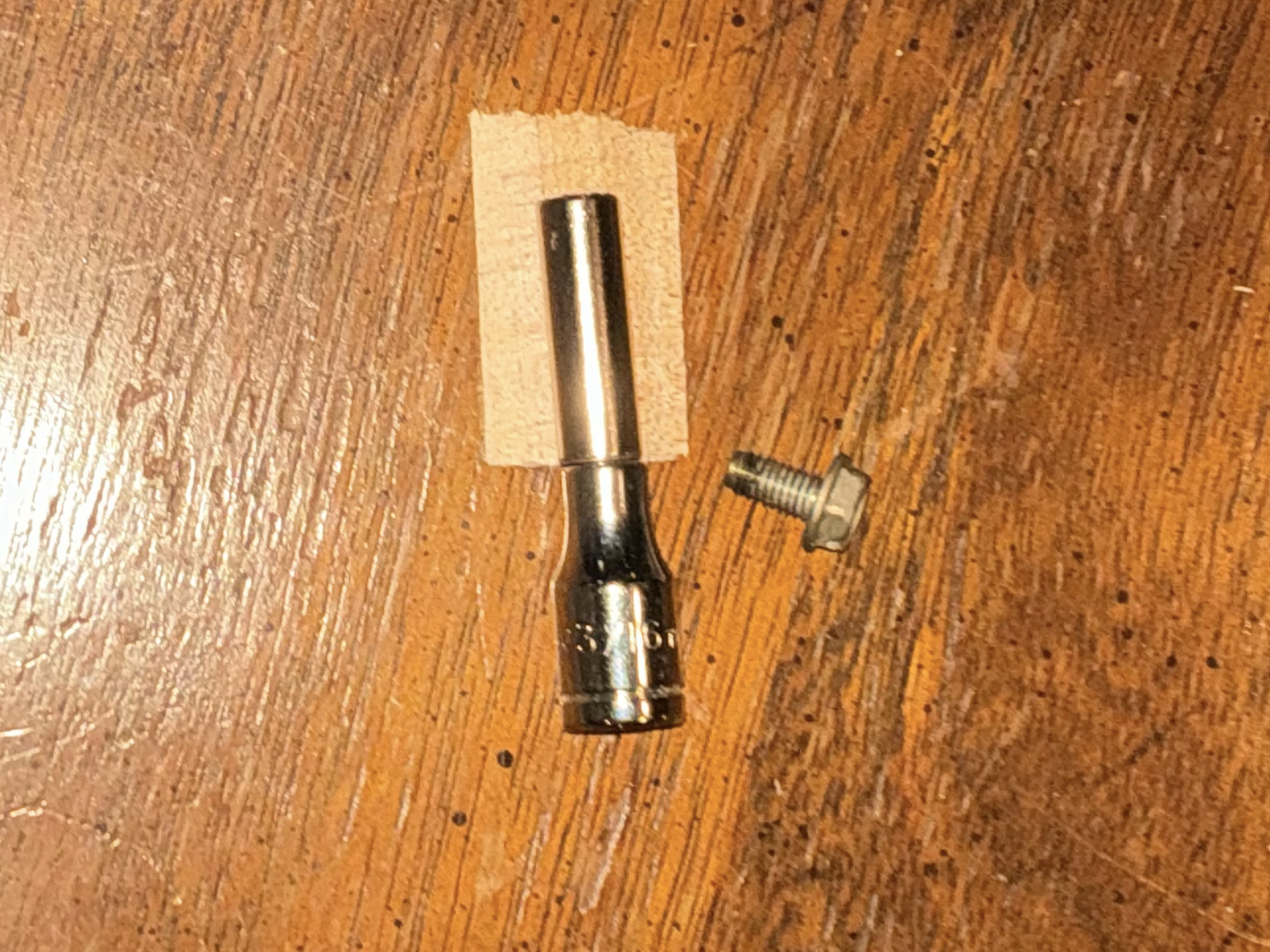
There’s 5/8” of thread in the nut. So I’m going to use a dremel to cut slightly less than 1/4” of this socket, and drop it in as a spacer. And then we’ll see what happens. If the spacer does not work, it will be nearly impossible to remove.
Last edited:
Oops.. I meant the screw fits inside the socket. Too late to edit though.
Having gotten this far, I might pause the project. I’m going away for a week… might be a good time to order new parts. A new truss rod nut with matching Allen key, and new bridge saddles again with correct Allen key. Just to do my utmost to ensure I don’t strip the truss rod.
EDIT: on further examination, that nut is hardened. If anything strips it will be the truss rod threads and not the nut.
Having gotten this far, I might pause the project. I’m going away for a week… might be a good time to order new parts. A new truss rod nut with matching Allen key, and new bridge saddles again with correct Allen key. Just to do my utmost to ensure I don’t strip the truss rod.
EDIT: on further examination, that nut is hardened. If anything strips it will be the truss rod threads and not the nut.
Last edited:
SUCCESS. Not spectacular success; with this neck it will never approach the effortless playability of my Tobias or my Grind. But success nonetheless. It’s much more playable than when I picked it up earlier today. And let’s see how the neck settles in tomorrow, and then when I’ve returned from my travels. It’s at least a playable instrument, enough so that for the moment there’s no rush to get a new neck. I can now take my time researching, and looking for deals.
I also removed the nut, and filed it on its bottom to remove some material. It was quite high. This makes the action on the first five frets a bit easier. I did not glue it, because I think I can take off another sliver of material without harming anything.
And it sounds awesome.
I also removed the nut, and filed it on its bottom to remove some material. It was quite high. This makes the action on the first five frets a bit easier. I did not glue it, because I think I can take off another sliver of material without harming anything.
And it sounds awesome.
I have her 5-string sister but she's called Vintage Modified. Like yours, it's a really nice bass for the price.Oh, and here’s a pic in my not to well lit basement studio
Instead of new bridge saddles, have a look at Wilkinson vintage bridge. I swapped for a black one (post #38), but I have the same in chrome on my LTD. The bridge fitted perfectly in the old holes. I paid $20.Oops.. I meant the screw fits inside the socket. Too late to edit though.
Having gotten this far, I might pause the project. I’m going away for a week… might be a good time to order new parts. A new truss rod nut with matching Allen key, and new bridge saddles again with correct Allen key. Just to do my utmost to ensure I don’t strip the truss rod.
EDIT: on further examination, that nut is hardened. If anything strips it will be the truss rod threads and not the nut.


