• TalkBass has been independent since 1998. Add your voice.
    Create a free account to reply to discussions, view embedded media, and browse with fewer display ads.
    Join freeLog in
    Want zero display ads or expanded classifieds tools? Compare plans.

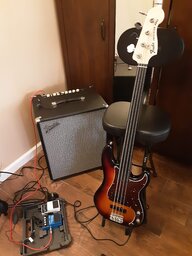
Squier fretless jazz bass..... HELP!

I just bought a squier jazz fretless bass and I like the sound. There is only one problem, when i play a note and then that note a milimeter to the left or right I get a different sound and a different note. Because of this when I play it sounds REALLY out of tune. Anyone know the problem??
thanx
here's a picture of the bass. Invalid Link Removed
 
In other words, since you don't have frets to act as the fulcrum for your strings, which are spaced and tuned to be in tune with each other, you have to be very specific about finger placement.

Fretless electric basses, like double basses and violins, are very unforgiving, and a real challenge. A lot of discipline is needed to teach your hands and fingers correct technique for them. If you're new to bass, or have poor technique, fretless bass is a hard route to take... Might be beneficial to you later to learn properly now, but that's beside the point.

If your fretless is lined, make sure you're fretting the notes directly on the fretline. Work that muscle memory, and before long it'll be second nature. I know a bassist (with decades of playing under his belt) that uses quarter tones when he plays... Very interesting.
 
The problem is that you're not quite ready for fretless.

No but you could get there. As stated, on fret-less "in tune" depends on getting the fingering in the exact position. Forturnatly for you, your new bass has the lines which is a great training aid for fret-less. Your going to need to do quite a bit of woodshedding listening very carefully to your "intonation" (the official word for playing in tune). Playing scales are helpful as it trains your ear to what note is next.

You might consider getting a teacher to help you as hand position is very helpful in playing fret-less.

Relax, enjoy your new bass. :hyper:
 
The problem is that you're not quite ready for fretless.

That's a bit harsh... I knew about intonation and difficulties of fretless before I bought one and when I did get one, I too struggled and even had moments of frustration because it sounded so bad. I knew it was my lack of technique, but I never felt I wasn't "ready," only that I needed to stick with it and find those moments when it starts to come together and have FUN with it. Before long, it started to come together and I was getting control, playing solid fretted-like lines and flowing lines with nice "mwah."

I'm by no means an expert or even great at fretless, but I now love the instrument as much, if not more, than fretted and I am good enough to play it almost exclusively at my church for the morning and evening services. What's more, the music director and members of the congregation have more than once expressed their desire to hear me on the fretless specifically. I must have learned something by sticking with it and practicing, practicing, practicing, because the audience are the first to notice and let you know if you have bad intonation! :eyebrow::lol:
 
Apart from technique, which is important, your bass could also be part of your problem.

I bought the same Squire (unofficially "Jaco") Jazz Bass. I love it but I knew even before I played it that it would need some work. A good set up can help your intonation, especially on a fretless in the price range of a Squire.

I took mine to a good luthier for the set up. I could have done it myself but I don't have the tools to do a good job on the nut, which on the Squire was way too high. It looked like it was cut for a fretted bass. The strings were so high that just pressing down on the first fret line could put it out of tune.

Another factor that affects your intonation is setting the bass's intonation (adjusting the position of the saddles). This can be a little more involved on a fretless compared to a fretted because it depends on how you "fret" or "stop" the strings with your fingers. The luthier asked me if I placed my fingers just behind the fret line, like on a fretted bass, or right on top of the line. (I play right on the line.)

After my Squire was set up I could play it in tune - even the open strings. :) It also felt much better than you'd expect for a $300 bass.

I then went a little crazy and spent almost that much again on upgrades - Hipshot Ultralite tuners, Noiseless pickups, Deluxe Bridge, etc. It was still a lot cheaper than a Fender Jaco tribute bass.
 
actually i think you're supposed to fret a TINY bit behind the fret...i'm not sure.

Generally when I play fretless I play so the rounded edge of my finger is just slightly over the fret line (I've got the same bass) and the pad/tip of my finger is actually just slightly behind it.

I've got a question to any fretless players out there if you will: did any of you start out on fretless, and if not, how long had you played fretted before you made the switch? The reason I ask is because the squier VM fretless was actually my first bass, and it's hard to like a fretted bass quite as much as that fretless sound.
 
Actually, you put your finger where the note is in tune. The big misconception is that the lines on a fretless are where your fingers go every time, and they are not on many basses. I don't like lines for that very reason. If I am looking at the fretboard when I am playing I will subconsciously move my finger there, and it is more time than not the wrong place. I play an unlined, unmarked Fender. All I have are dots on the side as position references.

As for the OP, you need to stick with it. The fact that you are noticing that you are out of tune is a good indicator that you are ready to move to the fretless. IMO that skill is actually the hardest to learn.

As for BryanM's question, I started on Trombone and piano, moved to fretted bass, and many years later move to fretless. The concept of muscle memory and listening to everything I play for intonation was not foreign to me when I picked it up.
 
I've got a question to any fretless players out there if you will: did any of you start out on fretless, and if not, how long had you played fretted before you made the switch? The reason I ask is because the squier VM fretless was actually my first bass, and it's hard to like a fretted bass quite as much as that fretless sound.

Well I've only been playing bass for about 3 years now. I started on a 6-string Ibanez BTB fretted but picked up a Dean Edge fretless 4 probably a year or so later. I always loved that "mwah" sound of players like Jaco, so I knew I wanted to have a fretless eventually. That Dean bass seemed fine at first but it wasn't long before I could tell that something wasn't sounding right. I messed with it kinda off and on, but wasn't enjoying it because I couldn't get it to sound in tune. I probably should have gotten the bass a setup, but instead, earlier last year I got GAS for a Warwick fretless, so I bought a Corvette Std. fretless and began practicing on it.

The thing is, the Warwick was a much better instrument and had a great setup, and though I sounded better on it, I still had to work on getting my technique and fingerboard memory down. But the Warwick at least made it fun. After a couple of frustrating days, it suddenly started coming together for me, so I kept at it until finally, I felt ready enough to try it at my church. Now my Corvette is not lined - just side dots, so it is good I learned to "play by ear," listening for the intonation. I was nervous my first time playing fretless in public and I made mistakes, but overall it went well and was quite addictive! I played it for a couple more weeks and then the week after, I brought my fretted Squire Jazz, just for a change. The music director said he liked how the Squire Jazz looked, but afterwards, he said he like the sound of the fretless better. A member of the choir who is a bass player himself said the same thing. It's a good feeling of confidence when two musicians compliment the sound. Then a few weeks later, I started getting compliments from several members of the congregation telling me how much they enjoy hearing the bass - all after I started using the fretless exclusively. Our church only uses piano, organ, a string synth, and my bass - no drums, nothing else. One Sunday, I had an injured finger and couldn't play. Several members told me how much they missed the bass that day. So they can hear me. Either everyone is tone deaf, or I must be doing something right on my fretless! Even when I bring my Thumb NT, I get complimented on my sound, but someone will say they really like the sound of the fretless...

It's worth having a good setup and sticking with it, no matter how frustrating at first. It really is easier than your mind thinks. I wanted to give up so many times and felt like I just wasn't capable of getting it, but those fears are gone now and it only took a few days of working at it to suddenly see a ray of hope and then more and more rays began to burst through. The reward of hearing that fretless sound coming from your own fingers and having others appreciate and enjoy it is unmeasurable. Now each day brings new discoveries on fretless instead of frustration. :)
 
This is an excellent bass (I love mine). I did have to spend some time on the set up to get things right. Take the bass to a tech that knows how to set up a fretless. Depending on how it is intonated, will indicate whether you finger on the line or behind the line and that will change slightly as you travel up and down the neck.

So your next step after a good set up is to learn the neck and how to adjust your fingering to ensure accurate intonation. Two methods to learning the neck: a) listen carefully, your ears will educate your fingers. Practice fingering a note and then slide up an octave reaching the same note in one fluid motion. b) use reference notes when you finger a note. What this means is that when you play one note find a complementary note on another string to check the first note. For example, fret a G on the 3rd fret of your E string and check it against your open G string. It doesn't have to be the same note, you can use other notes in the harmonic series like the maj/min 3, 4th, 5th, maj/min 7th of that note.

The technique that helped me most was playing along with recorded music. You will notice any wayward notes right away when you have something to compare it to. When I was good at doing those things, I started bringing the fretless to weekly rehersals. At each stage it took a bit of work to sound good. It takes time to learn, but I love the sound and the challenge. Good luck and I hope this info helps