
Enjoy the benefits of a premium membership!
Upgrade Account
-
TalkBass has been independent since 1998. Add your voice.
Create a free account to reply to discussions, view embedded media, and browse with fewer display ads.
Join free Log in
Want zero display ads or expanded classifieds tools? Compare plans.
You are using an out of date browser. It may not display this or other websites correctly.
You should upgrade or use an alternative browser.
You should upgrade or use an alternative browser.
Squire bass VI in band situation
- Thread starter ciarian
- Start date
More options
Who Replied?

John Entwistle briefly played a VI with The Who back in their mod years. Jack Bruce played one with Cream. Both used them as basses. It's a bass guitar, after all. But, you also have the ability to play them more like a guitar as well. Robert Smith of The Cure plays them as lead instruments, exploring their higher range. Peter Hook plays a Shergold Marathon VI as a melodic lead bass as well. It all depends on how you play them. You can play them as basses or get adventurous with the higher strings and take them into guitar territory.
I have a Squier VI and play a Fender Pawn Shop VI with my brother's band on occasion. I can get some impressive bottom end with a little EQ tweaking on my amp, although I mainly use it for more melodic tones rather than a standard rythm instrument. Will they replace my 4 string basses? No, but they're wonderful basses to use and explore tones not normally associated with a conventional 4 string bass.
I have a Squier VI and play a Fender Pawn Shop VI with my brother's band on occasion. I can get some impressive bottom end with a little EQ tweaking on my amp, although I mainly use it for more melodic tones rather than a standard rythm instrument. Will they replace my 4 string basses? No, but they're wonderful basses to use and explore tones not normally associated with a conventional 4 string bass.

I don't have one, so I can't say authoritatively, but what I can observe: the bass VI is a short-scale bass, with six strings and narrow spacing. So you can use it to simply play bass lines. But with the extra strings, you can play other things with it too, a lot of higher notes and easier chording than a standard four-string bass. The question is, if the bass VI player is holding down a bass line, how much room he's going to have to actually use any of that upper stuff. If you're not using it, then you may as well just play a standard bass. That's what happened with Jack Bruce; he started off playing bass VI in Cream, then went back to a regular four-string. Some TBers have found ways to apply it, though, so hopefully they'll post and share their experience.
 .
.
I did a whole practice with only my Bass VI as an experiment, although it is not as punchy as a regular bass, since I've left the stock strings on it for the moment, I could get a good bass tone out of it. The 3 pickups give it some versatility. Played it both finger style and with a pick, added some chords in when the guitarists were doing double leads. A lot of fun. It makes you shake up your playing...

A little info on Joe Perry's use of the Fender VI.
"The six-string bass guitar is a trademark of Perry's guitar sound; instead of playing it like an ordinary bass guitar, he uses it like a regular guitar, playing riffs, chords, and solos. The six-string bass helped to create the characteristic growl of Aerosmith's "Back in the Saddle", "Combination", and "Draw the Line". In the past, Perry used Fender Bass VI and Danelectro six-string basses; he also used a Gibson EB-6 for the bass solo on "King of the Kings" on the Joe Perry Project's Once a Rocker, Always a Rocker album (as indicated by the album's liner notes). Perry currently uses an Ernie Ball MusicMan six-string bass onstage."
"The six-string bass guitar is a trademark of Perry's guitar sound; instead of playing it like an ordinary bass guitar, he uses it like a regular guitar, playing riffs, chords, and solos. The six-string bass helped to create the characteristic growl of Aerosmith's "Back in the Saddle", "Combination", and "Draw the Line". In the past, Perry used Fender Bass VI and Danelectro six-string basses; he also used a Gibson EB-6 for the bass solo on "King of the Kings" on the Joe Perry Project's Once a Rocker, Always a Rocker album (as indicated by the album's liner notes). Perry currently uses an Ernie Ball MusicMan six-string bass onstage."
This may be sacrilege here on TB but you do not need a strong bass line on all songs all of the time. This is a foreign concept to many of genres that many of you play but if you play certain types of music, you as the bassist will spend a fair amount of time "playing" rests. I play in a church band and church music often has the bass sitting out the opening or dropping out for a section here or there. Some time ago someone here posted a link to a humorous video that described how to write modern praise and worship music. It went on for some length but the only part we bassists in the praise and worship music club noticed was a line thrown in almost at the end, the all too true: "Oh, yeah, and don't bring in the bass until measure 53!" Kinda how life can be for a church bassist although to be fair we are sometimes asked to play, gasp!, solos and we frequently do come in right at the beginning and play right the way through to the end.
If you have a Bass VI (and I do) and you know how to play it outside the normal bass box (I'm working on it) then you potentially have things you can do during those moments when a bass line isn't needed. For some reason my church has trouble finding lead guitarists and that is the reason I got the VI. There are times when a lead guitar is wanted but a bass is not and the VI would let me play lead. Of course, since then a couple of guitarists have shown up but you get the point. Whether your genre traditionally has the bass sit out occasionally or not, if you want to take your music and your genre in a new direction a Bass VI would let you do that while still keeping you in the game. Something to think about. At the end of the day a Bass VI is just a short scale, six string bass with unusually tight string spacing. You can tune them as low as a B if you want to run the traditional six string bass BEADGC tuning. The spacing takes some getting used to but I, who was never able to adapt to a fiver before, found that I could adapt to a Bass VI and now that I have done so, I have no trouble with fivers any more either. Go figure. You learn to play fingerstyle on a tight spacing, you learn to play with a pick, you learn to incorporate another string's range into your playing, and suddenly you are a new bassist. You may not play one all the time but a Bass VI could be the perfect spice to punch up some of what you play.
If you have a Bass VI (and I do) and you know how to play it outside the normal bass box (I'm working on it) then you potentially have things you can do during those moments when a bass line isn't needed. For some reason my church has trouble finding lead guitarists and that is the reason I got the VI. There are times when a lead guitar is wanted but a bass is not and the VI would let me play lead. Of course, since then a couple of guitarists have shown up but you get the point. Whether your genre traditionally has the bass sit out occasionally or not, if you want to take your music and your genre in a new direction a Bass VI would let you do that while still keeping you in the game. Something to think about. At the end of the day a Bass VI is just a short scale, six string bass with unusually tight string spacing. You can tune them as low as a B if you want to run the traditional six string bass BEADGC tuning. The spacing takes some getting used to but I, who was never able to adapt to a fiver before, found that I could adapt to a Bass VI and now that I have done so, I have no trouble with fivers any more either. Go figure. You learn to play fingerstyle on a tight spacing, you learn to play with a pick, you learn to incorporate another string's range into your playing, and suddenly you are a new bassist. You may not play one all the time but a Bass VI could be the perfect spice to punch up some of what you play.
- Feb 24, 2004
- 4,103
- 643
- 68
- Disclosures
- Endorsing Artist: Phantom Guitars, Eastwood Guitars
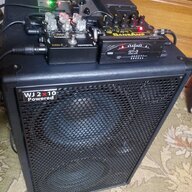
I've been on a '62 Bass VI since '75 in a number of bands and for many years in church groups. I put a Dan Armstrong hotwire in with the original pickups for MUCH more punch and bottom end, use the Staytrem bridge, have had the neck reworked several times (and re-routed once), and play through a BDDI and SWR amps (the Aural Enhancer is a real good resonant circuit and also adds beef). I keep the action a little high because picking harder gives alot of cool tones. Having said all that, IMO the Bass VI is a very fine bass.
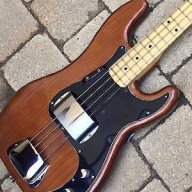
This song came to mind. Steve Kilbey of The Church used a VI throughout this album ('Priest=Aura'). The VI has a smoother & twangier sound than a standard bass; a lot less muscle & oomph, but site interestingly in the mix and some double-stop strums in certain places have a nice effect.
To hear the music a little more clearly, try this one (without band images):
To hear the music a little more clearly, try this one (without band images):
I put limits on nothing. However, there is convention, tradition, and the sonic spectrum. Unless you have a specific part designed into the song, when you're playing with two guitars it is mostly better to occupy the low end rather than crowd the mids. Or, what the hell! Crowd the mids!
mj
mj

It's very fun in a band context because it opens up tons of options for sounds. The only downside for me is I can't really dig in on it due to the string spacing.
Bumping this thread - I now do have one and would love to hear more ideas and examples of how people have used a VI in a band.

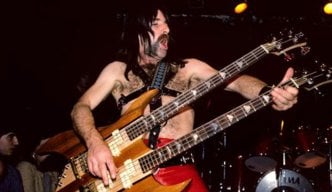
My buddy has a real pre-CBS Bass VI in near-mint (literally 9.9/10, almost looks fake condition). It's like crap-your-pants perfect (funny because most of his gear is really worn, and he's not a stickler for scratches/dings).
We'll break it out and jam as a trio sometimes with our drummer, and I find the Bass VI is the most impractical/practical instrument I've ever played.
I always just go back to playing my P bass in the band setting, though.
I kind of look at it as: I could record a whole album (guitar or bass) with this one instrument, yet I have no desire to play it live.
And to those worrying if it's "deep enough" compared to a bass - the bottom two strings might be louder than my 1962 P bass. No joke. (sorry for the crappy pic, but felt it was necessary)

We'll break it out and jam as a trio sometimes with our drummer, and I find the Bass VI is the most impractical/practical instrument I've ever played.
I always just go back to playing my P bass in the band setting, though.
I kind of look at it as: I could record a whole album (guitar or bass) with this one instrument, yet I have no desire to play it live.
And to those worrying if it's "deep enough" compared to a bass - the bottom two strings might be louder than my 1962 P bass. No joke. (sorry for the crappy pic, but felt it was necessary)
Last edited:
I have my Pawn Shop one. Next show we do it's getting stage-time next to my P. The only trick is remembering your string spacing is much narrower, and you're playing short scale.

I have a Squire VI which I am learning to play. Most of my playing is in a bass/guitar duo and there are times when the guitar is quietly finger picking that the VI seem so to offer a little bottom fingerpicking chords. I'm not that good at it, though. It does a good job on the bottom end.


