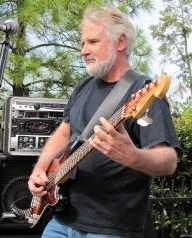
In addition to handling bass, some lead vocals, and keys (via MIDI foot pedals), I’m also the light guy for our variously 3/4/5 piece blues band. Our New Years Eve show went okay musically, except for one all-too-often repeated event. Third song in….trip a breaker. And this was with my most minimal light setup, which consisted of 8 PAR38 floods mounted on a single stand with a Chauvet foot controller. So, my New Years resolution was to make the transition to LEDs….the dives we play just can’t handle the power needs of conventional PAR cans, even smaller ones. I’ve got two banks of PAR64s that haven’t been touched in months, because almost no place that we play has a circuit that can handle their power draw.
I really wanted portability with quick setup/teardown, as well as easy control from the stage, preferably foot controller. I spent a lot of time researching the Chauvet 4BAR, and even tried ordering a factory 4BAR restock from large, unnamed online musical retailer, but despite it being “in stock” when I clicked the pay button, I got a “backorder” email within 24 hours, and a week later just canceled it.
In continuing to search for a good price on the 4BAR (which goes for $399 most places), I stumbled across a very similar item from Cheaplights.com, the StageApe FABFOUR-F. “StageApe” is somehow linked exclusively to Cheaplights, so that is the only source for this package. I read a few reviews of the FABFOUR, most of which complained about the very low height of the stand, but I was sufficiently motivated to make the 90 minute drive to Houston, home of Cheaplights.com, as I could go to their showroom and check it out for myself. The showroom itself is quite cool, and everyone there was very helpful and willing to take the time to let/help you tinker with various settings. I was satisfied with what I saw, and ordered two of the FABFOURs. I then had to pick them up at the Cheaplights warehouse (which is about 10 minutes away from the showroom), where they were again helpful, letting me turn the lights on before I left to make certain everything lit up. I did swap out one case for the unit, because the zipper on the case didn’t work, but all of the LEDS came on.
The set consists of a T-bar unit with four flat/puck-type LED cans (108 10mm LEDs each), with a 10-15 ft. power cord, case for the T-bar, a tripod stand with case, and a 4-pedal foot controller (auto/sound/freeze/blackout pedals). Construction on the units seems pretty good, mostly metal; the carrying cases are pretty flimsy but should hold up if handled carefully. I was able to fit the foot pedal inside the stand bag, so the whole assembly can easily be carried in one trip. Setup and teardown are extremely fast; I could probably set one up in a minute if I had to (and sometimes, I have to!). Linking the two units via a DMX cable is very simple; the T-bar has an LED “screen” with a simple menu, and setting one of the units to “slave” makes it mimic the other unit. Some of the reviews of the Chauvet 4BAR suggest it has linking issues, but I’ve seen none with the FABFOUR…just plug and play.
After messing around with the settings for a few hours, I noticed 3 LEDs on one of the cans didn’t light up. Tapping it made them flicker, so I took the can off and disassembled it, not wanting to make a 4 hour round trip to return the unit. The cans are quite easy to dissemble, and they really have just one part, a simple round circuit board with 108 LEDs and some resistors soldered to it. It was easy to spot the portion of the board with the 3 flickering LEDs, so I just heated up some of the joints for those LEDs and their associated resistor, and voila, everything works fine and has since.
Contrary to what I expected, this unit is not exactly the same as the 4BAR. I suspect that the lights themselves are identical—108 10mm LEDs per puck. However, there are some other differences, and after my limited experience I’d say that the FABFOUR is better, at two-thirds of the price of the 4BAR. The differences are:
- The “F” at the end of FABFOUR-F stands for “folding”—the T-bar folds in half, quite easily, meaning that stored, it takes up half the room….the carrying case for the unit is like an elongated briefcase, about 26 inches long.
- The 4BAR has a 3-pedal controller (program/sound/blackout). From reading the reviews, there is no versatility in the 4BAR’s foot control. On the FABFOUR, the “automatic” setting on the unit itself allows me to program the speed, pattern, and the fading of scene changes triggered by that pedal. The 4BAR program pedal does allow specific color selection, which the FABFOUR does not, although the 4BAR will require to you stomp through a fixed sequence of colors to get the one you want. On the FABFOUR, you can hit “freeze” when the automatic sequence hits the color you want; otherwise, you will have to select the specific color from the menu on the T-bar (which, of course, you can’t do mid-song).
- The stands for the FABFOUR that I got are much taller than those mentioned in reviews I’ve seen, extending probably close to 8 feet max. However, on the FABFOUR (unlike the 4BAR), there are threaded holes on TOP of the T-bar—meaning that you can move the LED cans to the TOP of the bar (there is easily enough slack in the preassembled cabling to do so), which gives you another foot and a half of altitude (~ 9 ft. up). However, the units won’t fit in the cases if you mount them this way, but the units can get high enough to cover most of the places we play so I would disagree with reviews I’ve seen.
- DMX control for the FABFOUR and the 4BAR seems to be 15 channel. Neither manual describes the implementation in any coherent way, but I can get rudimentary color scene control over the FABFOUR with my Elation FC-400 4-channel DMX foot controller. This is because the FABFOUR has seven different DMX “modes” that allow it to receive and use information ranging from 3 to 15 DMX channels. Looking at the 4PLAY manual, I don’t think this would be possible, as the only DMX implementation that it describes uses channels way beyond #4 for most useful settings. However, it’s hard to be certain without tinkering with the units, as both manuals are largely useless.
- The FABFOUR foot pedal is connected to the (master) T-bar via a ¼ inch jack, not DMX. However, it is clearly sending or triggering some kind of DMX information, as I have a couple of Elation dimmer packs that I’ve figured out how to program for control by passed-through DMX signal from the FABFOUR foot controller (seems like ch 1 steady on, ch 2 red, ch 3 green, ch 4 blue). So, I can now use those dimmer packs to control all my old PARs from the FABFOUR, meaning that if the venue has the power, I can control a lot of light with my feet!
So, last night was the first gig, a tiny bar and grill we’d never played before. Power for my side of the “stage” consisted of an orange extension cord that went off to places unknown….I’m sure the incandescent PARs with my 450 watt bass amp would have blown the circuit, but no hiccups with the FABFOUR. I could only use one of the two units because the stage area was so limited. Everything worked fine, but I noticed that the FABFOURs are much more focal beams (spot vs. flood) than the old par cans, and the 8 PAR 38s were clearly lighting up more of the stage than the 4 LED pucks….the former are a general wash, while the latter are more like 4 spots. With both FABFOURs going, I think the lumens will be comparable to the 8 PAR38s, but nowhere near what the PAR64s put out. Colors on the LEDs were nice and vivid; sound chase sensitivity, even on the lowest setting, was pretty high…maybe great for DJs but best used sparingly in our application. Setup and teardown were a breeze.
So, there’s my review….I give the FABFOUR-F two thumbs up. Tremendous portability. Pretty easily and flexibly controlled by the toes of the bass player. Not the brightest lights around, but two units are perfectly capable for lighting a 20-30 foot stage. Low power draw (100w per unit) that will work in the most primitive venue. It can serve to control your old PARs with a dimmer pack or two, meaning that there are lots of possibilities for expansion. And finally, it is by far the least expensive option I’ve run across if you interested in going this direction.
I really wanted portability with quick setup/teardown, as well as easy control from the stage, preferably foot controller. I spent a lot of time researching the Chauvet 4BAR, and even tried ordering a factory 4BAR restock from large, unnamed online musical retailer, but despite it being “in stock” when I clicked the pay button, I got a “backorder” email within 24 hours, and a week later just canceled it.
In continuing to search for a good price on the 4BAR (which goes for $399 most places), I stumbled across a very similar item from Cheaplights.com, the StageApe FABFOUR-F. “StageApe” is somehow linked exclusively to Cheaplights, so that is the only source for this package. I read a few reviews of the FABFOUR, most of which complained about the very low height of the stand, but I was sufficiently motivated to make the 90 minute drive to Houston, home of Cheaplights.com, as I could go to their showroom and check it out for myself. The showroom itself is quite cool, and everyone there was very helpful and willing to take the time to let/help you tinker with various settings. I was satisfied with what I saw, and ordered two of the FABFOURs. I then had to pick them up at the Cheaplights warehouse (which is about 10 minutes away from the showroom), where they were again helpful, letting me turn the lights on before I left to make certain everything lit up. I did swap out one case for the unit, because the zipper on the case didn’t work, but all of the LEDS came on.
The set consists of a T-bar unit with four flat/puck-type LED cans (108 10mm LEDs each), with a 10-15 ft. power cord, case for the T-bar, a tripod stand with case, and a 4-pedal foot controller (auto/sound/freeze/blackout pedals). Construction on the units seems pretty good, mostly metal; the carrying cases are pretty flimsy but should hold up if handled carefully. I was able to fit the foot pedal inside the stand bag, so the whole assembly can easily be carried in one trip. Setup and teardown are extremely fast; I could probably set one up in a minute if I had to (and sometimes, I have to!). Linking the two units via a DMX cable is very simple; the T-bar has an LED “screen” with a simple menu, and setting one of the units to “slave” makes it mimic the other unit. Some of the reviews of the Chauvet 4BAR suggest it has linking issues, but I’ve seen none with the FABFOUR…just plug and play.
After messing around with the settings for a few hours, I noticed 3 LEDs on one of the cans didn’t light up. Tapping it made them flicker, so I took the can off and disassembled it, not wanting to make a 4 hour round trip to return the unit. The cans are quite easy to dissemble, and they really have just one part, a simple round circuit board with 108 LEDs and some resistors soldered to it. It was easy to spot the portion of the board with the 3 flickering LEDs, so I just heated up some of the joints for those LEDs and their associated resistor, and voila, everything works fine and has since.
Contrary to what I expected, this unit is not exactly the same as the 4BAR. I suspect that the lights themselves are identical—108 10mm LEDs per puck. However, there are some other differences, and after my limited experience I’d say that the FABFOUR is better, at two-thirds of the price of the 4BAR. The differences are:
- The “F” at the end of FABFOUR-F stands for “folding”—the T-bar folds in half, quite easily, meaning that stored, it takes up half the room….the carrying case for the unit is like an elongated briefcase, about 26 inches long.
- The 4BAR has a 3-pedal controller (program/sound/blackout). From reading the reviews, there is no versatility in the 4BAR’s foot control. On the FABFOUR, the “automatic” setting on the unit itself allows me to program the speed, pattern, and the fading of scene changes triggered by that pedal. The 4BAR program pedal does allow specific color selection, which the FABFOUR does not, although the 4BAR will require to you stomp through a fixed sequence of colors to get the one you want. On the FABFOUR, you can hit “freeze” when the automatic sequence hits the color you want; otherwise, you will have to select the specific color from the menu on the T-bar (which, of course, you can’t do mid-song).
- The stands for the FABFOUR that I got are much taller than those mentioned in reviews I’ve seen, extending probably close to 8 feet max. However, on the FABFOUR (unlike the 4BAR), there are threaded holes on TOP of the T-bar—meaning that you can move the LED cans to the TOP of the bar (there is easily enough slack in the preassembled cabling to do so), which gives you another foot and a half of altitude (~ 9 ft. up). However, the units won’t fit in the cases if you mount them this way, but the units can get high enough to cover most of the places we play so I would disagree with reviews I’ve seen.
- DMX control for the FABFOUR and the 4BAR seems to be 15 channel. Neither manual describes the implementation in any coherent way, but I can get rudimentary color scene control over the FABFOUR with my Elation FC-400 4-channel DMX foot controller. This is because the FABFOUR has seven different DMX “modes” that allow it to receive and use information ranging from 3 to 15 DMX channels. Looking at the 4PLAY manual, I don’t think this would be possible, as the only DMX implementation that it describes uses channels way beyond #4 for most useful settings. However, it’s hard to be certain without tinkering with the units, as both manuals are largely useless.
- The FABFOUR foot pedal is connected to the (master) T-bar via a ¼ inch jack, not DMX. However, it is clearly sending or triggering some kind of DMX information, as I have a couple of Elation dimmer packs that I’ve figured out how to program for control by passed-through DMX signal from the FABFOUR foot controller (seems like ch 1 steady on, ch 2 red, ch 3 green, ch 4 blue). So, I can now use those dimmer packs to control all my old PARs from the FABFOUR, meaning that if the venue has the power, I can control a lot of light with my feet!
So, last night was the first gig, a tiny bar and grill we’d never played before. Power for my side of the “stage” consisted of an orange extension cord that went off to places unknown….I’m sure the incandescent PARs with my 450 watt bass amp would have blown the circuit, but no hiccups with the FABFOUR. I could only use one of the two units because the stage area was so limited. Everything worked fine, but I noticed that the FABFOURs are much more focal beams (spot vs. flood) than the old par cans, and the 8 PAR 38s were clearly lighting up more of the stage than the 4 LED pucks….the former are a general wash, while the latter are more like 4 spots. With both FABFOURs going, I think the lumens will be comparable to the 8 PAR38s, but nowhere near what the PAR64s put out. Colors on the LEDs were nice and vivid; sound chase sensitivity, even on the lowest setting, was pretty high…maybe great for DJs but best used sparingly in our application. Setup and teardown were a breeze.
So, there’s my review….I give the FABFOUR-F two thumbs up. Tremendous portability. Pretty easily and flexibly controlled by the toes of the bass player. Not the brightest lights around, but two units are perfectly capable for lighting a 20-30 foot stage. Low power draw (100w per unit) that will work in the most primitive venue. It can serve to control your old PARs with a dimmer pack or two, meaning that there are lots of possibilities for expansion. And finally, it is by far the least expensive option I’ve run across if you interested in going this direction.