• TalkBass has been independent since 1998. Add your voice.
    Create a free account to reply to discussions, view embedded media, and browse with fewer display ads.
    Join freeLog in
    Want zero display ads or expanded classifieds tools? Compare plans.

Strategies for memorizing songs

Often I just listen to this or that tune over and over and over while working, driving, whatever. And until I have it in my head, I won't even think of trying to play along with it, too easy to memorize it wrong. I'm looking to simply have the whole song (drums, background vocals, the chord changes, tempo, etc.) without a lot of theory or analyzing. I just want to get to the part where I can sing along with it with no suprises. Then I've got it.

If I got to get it down PDQ, I'll sit down and chart it, which usually works faster, as I'm listening in a more technical manner.

The weird thing, if there's something really trying in it, and I keep flubbing that spot, I walk away, come back a few days later, and I can play it backwards. I've never quite figured out how my subconscious unscrews it, but it usually does. That several bar unison riff in Stevie's 'Sir Duke' had me crazy one day, I could NOT get it under my hands. Walked away for about a week, then sat down to play along, and nailed it first time through like nobody's business. Go figure . . . .
This is my approach also. It works.
 
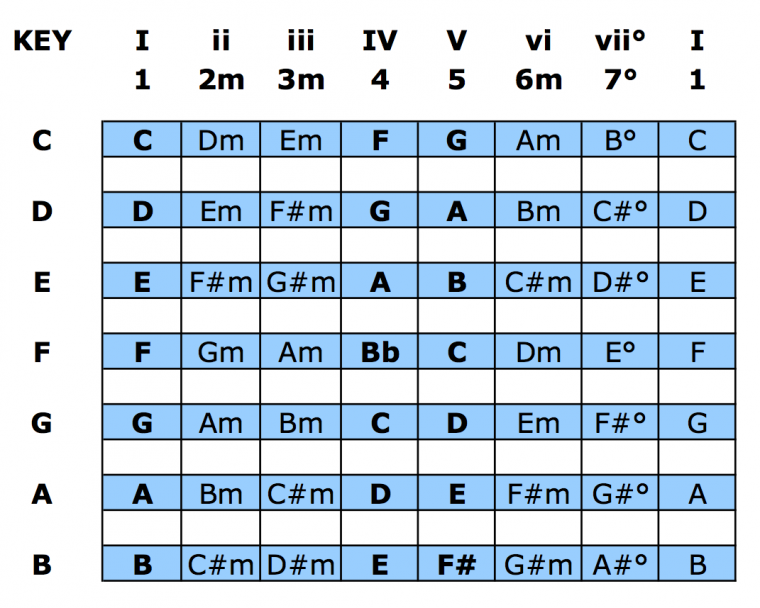
Something that might help is to think of the chord progression as numbers relative to the song key, as used in the Nashville number system mentioned above.

NNS-Chart-760x608.png


Image source: The Nashville Number System Chart For Bands. (This chart is abridged and only covers the piano's white-note keys.)

So, if the song is in E and the chord progression is E, A, C#m, they are chords I, IV and vi or 1, 4 and 6m if you find that easier. The advantage is that you begin to hear the intervals and positions relative to the key root and you can transpose instantly in the event that a guitarist throws on a capo or the singer needs to drop the key one or more semitones.

Try listening to music that you don't know and don't know the key of and call out the chord numbers in your head as it plays.
 
Ditch the sheet music. Figure it out by ear and play it by ear. Listen to the songs a lot. I used to play in a cover band with about 80 songs in 2 different styles. I never read anything except the set list. Then I did jazz school for 6 years where I was reading everything and I only retained 2 or 3 jazz standards. Reading is a crutch, and if you don't practice walking without it, you won't be able to walk without it.
 
  • Like
Reactions: ryco
I never read anything except the set list. Then I did jazz school for 6 years where I was reading everything and I only retained 2 or 3 jazz standards. Reading is a crutch,

Regardless of the usefulness of reading music - on which we fundamentally disagree - the solutions being offered involve writing. More importantly, writing for oneself. The very act of writing, and writing correctly, is the quickest way to wean oneself off the dependency on charts for performance.
 
Regardless of the usefulness of reading music - on which we fundamentally disagree - the solutions being offered involve writing. More importantly, writing for oneself. The very act of writing, and writing correctly, is the quickest way to wean oneself off the dependency on charts for performance.

We don't disagree at all. I don't see how you could get that from my post. I'm an avid reader. I just find that if I keep reading I never learn the songs well enough to remember them. Perhaps I should have emphasized that TO ME it feels like a crutch and this is my experience leading to the formation of my opinion. The solution I offer comes from many years of experience. There's no right and wrong here. Sure, writing it down helps. But then you got to put it away and play from memory.
 
Last edited:
  • Like
Reactions: SteveCS
We don't disagree at all. I don't see how you could get that from my post. I'm an avid reader. I just find that if I keep reading I never learn the songs well enough to remember them. Perhaps I should have emphasized that TO ME it feels like a crutch and this is my experience leading to the formation of my opinion.

Sorry I didn't make my point clearly enough - IME (I started reading music when I was 6 years old and now I'm heading for 10 times that!!), reading opens the door to learning correctly and actually dropping the reliance on written music. Again IME, the great thing about learning from written music is, assuming the music is written correctly in the first place, you only learn the right stuff - no guesses and no fudges. These days I use written music much more in that context than reading anything during performance, and I make sure it is right before learning from it by writing it out myself and validating it before reading back in 'learning mode'. What happens in reality is that by the time I've settled on the correctly written music I already know it well enough to just file the score away. Go figure!!

Anyway, apologies again for any misunderstandings and my part in them :)
 
  • Like
Reactions: Passinwind
Reading is a crutch, and if you don't practice walking without it, you won't be able to walk without it.
Agree with this. Once a chart is there, you have to have it. At least I do.
I think the only thing to do is put the charts up, play your stuff, and when you get hung up, then you know what you need to practice.

Like the fellas are saying,,, practice, repetition, listing to the song over and over... basically completely knowing and internalizing the song. Learn the changes and the melody - not just the bass line. That gets you closer to freedom.

---- Just to be clear, I'm not talking about reading, as in reading for a show in an orchestra pit or something. I'm talking about using cheat sheets, number charts, notes, lead sheets....
 
Sorry I didn't make my point clearly enough - IME (I started reading music when I was 6 years old and now I'm heading for 10 times that!!), reading opens the door to learning correctly and actually dropping the reliance on written music. Again IME, the great thing about learning from written music is, assuming the music is written correctly in the first place, you only learn the right stuff - no guesses and no fudges. These days I use written music much more in that context than reading anything during performance, and I make sure it is right before learning from it by writing it out myself and validating it before reading back in 'learning mode'. What happens in reality is that by the time I've settled on the correctly written music I already know it well enough to just file the score away. Go figure!!

Anyway, apologies again for any misunderstandings and my part in them :)
I understand, I'm about 10 years younger and I guess we have each found our way in that time. It's all good.
 
  • Like
Reactions: SteveCS
For me, the big reveal has been don't chart the tune

I always advocate writing your own chart as part of the learning process.
But reflecting on recent songs I have charted and memorized,
I realize that at some point I do abandon the chart
and for charts i did not abandon, indeed those are less well memorized.

I guess writing my charts is part of "figuring the song out"
which I do consider part of the memorization process
 
Writing your own charts with something as simples as the chord names can go a long way.

I also find that watching a music video of a song helps me visually remember parts.

Playing to the song and making it autopilot or just learning how to follow the BL is a strategy.

Memorizing is only good if it is played the same way every time otherwise you are always going to have to listen and improvise.
 
Memorizing is only good if it is played the same way every time otherwise you are always going to have to listen and improvise.
All due respect to you, my good man, but you make this sound like it's a "bad" thing. Even in songs learned/memorized always have listened and always have improvised a wee bit. That's the fun of playing music. Unless I misunderstand what you are saying.

To a lot of others, writing stuff out just seems to be an extra step that one is, hopefully, going to discard anyway. The OP (Lownered! lol) hasn't specified what style of music he is trying to learn. Rock/pop/R&B/country stuff is fairly easy. Jass musik I would be more understanding - but still would suggest going for memorization. But there is no right or wrong way - just different ways = whatever works for you :) I highly respect the ideas of a lot of peeps on this thread. ☮️

To the OP: Like others have said: it's repetition. Words, and music, and learning the arrangement/format of the song. Going over lines again and again paying attention and listening and making sure you are getting everything right - chord qualities, notes, rhythms. Also playing with the focus and intent of memorization.
It's hard to give advice when one doesn't know what level you are on as a player, how much experience at performance you have. If you are a n00b would advise just playing a lot and reading, and theory, and having a good teacher - all of that stuff. But like anything memorization gets easier the more you do it - just like any other musical skill [reading, scales/arpeggios, etc].
 
For me, the big reveal has been don't chart the tune. Learn the tune by ear, with the intention of ,memorizing it. That was a game changer for me.
I remember sitting in front of my turntable, bass in hand, for hours on end. Learning songs, and learning to hear song forms, intervals, and rhythmic patterns, by playing a song, and sections of each song, over and over again until I had it in hand. Nothing written down. No tabs. No cell phones, tablets, or laptops back in the sixties.

Nowadays, as I listen to songs that interest me my left hand reaches for intervals when I hear them. When I listen to a new song without an instrument, I'm visualizing the chord progressions using hand positions and Nashville numbering intervals; it doesn't matter very much what key a song is actually in to internalize the song structure.

Everyone seems to have their own way of eating new songs.
 
  • Like
Reactions: Polfuste
Spaced repetition is the key for me. I make a play list for things I'm trying to learn and listen to that any time I'm in the car or on public transport. Over the course of days and weeks it gradually sinks in.

If it's a song that I'm trying to maintain rather than learn fresh, I'll imagine myself playing along with the song. This helps me reinforce the structure and my part. I'l try to note parts I'm unsure of and check them again when I'm at my instrument. I'll also play along with a recording at home to help get it down.

I also find things stick a lot better when I work them out by ear and write them out by hand. This helps to cement the song structure. It's pretty easy to digitise hand-written charts now so I can file them away in case I need them again later. Obviously the goal is to remember them but there have been plenty of times where I haven't played a song for several years. A lot of the time it comes back automagically, but there are times when I need to refer to my charts to jog the memory.

There have been a lot of good (and pretty consistent) suggestions here. I think it comes down to finding a technique that works for you - we're all wired a bit differently and what works for me might not work as well for you. We'd all prefer a different answer but with the exception of a small number of gifted individuals, it basically comes down to putting the work in to memorise it.
 
Ditch the sheet music. Figure it out by ear and play it by ear. Listen to the songs a lot. I used to play in a cover band with about 80 songs in 2 different styles. I never read anything except the set list. Then I did jazz school for 6 years where I was reading everything and I only retained 2 or 3 jazz standards. Reading is a crutch, and if you don't practice walking without it, you won't be able to walk without it.
I agree with you about reading: in the jazz 4tet i play; our pianist and sax are formal training musicians. They are unable to play without sheets: as they never had to work on that. So they can't memorize tunes.
At the opposite, i played ear-only during 30 years, pre-internet area (so K7 and LP repeating ad lib).
3 years ago i started to compose things for this 4 tet: i 've had to learn to read and write sheets to be able to share it with them and make it happen. So i'm very happy to be able now to understand sheets, and i thank them for that cause now i can write sheets instead of tablature to make the essential transcribing work (my way to feed my playing and learn from my masters). But i still don't have any problem to memorize tunes.
 
A little more down in the weeds, here is how I spend the practice time
Make a chart, so you have the structure and the chords, and any important rhythms or riffs. One page, no matter what.
Practice any parts that are hard to play, slowly.
Play through with the chart, don’t stop for mistakes. Listen and start to get used to the little cues or expectations and where your fingers or mind goes to make them come true.
Think about the song. What is unusual about it if anything? Extra couple measures between verse 1&2 only? That kind of thing.
Play it from the beginning by memory and start over if you make a mistake
If you are fuzzy on a section, practice just that section until you have it, then go back to the beginning
Think about what you want to do in different parts, how you personally want to approach it, and some lines or class of line that you like. Assuming you are doing more than playing something exactly from memory… are you learning the song so you can play it, or someone else’s part so you can execute it. Not judging, but just 2 different activities somewhat. Taken to next level, think about a solo you would play if they suddenly called on you.
Listen to the song without your bass in hand and imagine playing it.
Do all this with a different song, then come back to the first song and see what you forgot already.
Repeat last step cycling through the set as needed
 
I'm looking for some help in the area of advice on how you memorize songs, particularly when you need to learn a song in just a few days.

You might want to take a look at this. I have Molly's book, 'Learn Faster, Perform Better' which as you might expect goes a lot further and deeper than a 20 minute video, but the video will give you a flavour: