

Enjoy the benefits of a premium membership!
Upgrade Account
-
TalkBass has been independent since 1998. Add your voice.
Create a free account to reply to discussions, view embedded media, and browse with fewer display ads.
Join free Log in
Want zero display ads or expanded classifieds tools? Compare plans.
You are using an out of date browser. It may not display this or other websites correctly.
You should upgrade or use an alternative browser.
You should upgrade or use an alternative browser.
String ID
- Thread starter TroyK
- Start date
More options
Who Replied?

I had a set of Peavey stainless steel strings that matched that description. Old Style Warwick black label might have had that too. Measuring the ball end to the taper will help us narrow it down. Also a picture of the strings.

Any pics? There are always subtle visual cues that can ID the brand the way they're designed.Brass ball ends. Black silk on both ends. Roundwound, steel maybe.
Can anyone identify these? They are squatters in my string box. No idea what they are or where they came from.
Oh, one more thing...
Would you be able to measure the length of all four strings (E-G) from the ball end to the first taper (where the silk starts at the tuner end)? The "winding length" can be another identifier of specific brands.
Would you be able to measure the length of all four strings (E-G) from the ball end to the first taper (where the silk starts at the tuner end)? The "winding length" can be another identifier of specific brands.

If they are in fact stainless steel roundwound, one possibility is the (long discontinued) La Bella Deep Talkin' Bass Roundwound (45-105). A close bassist friend of mine used to use them and he was able to confirm they did come with black silk.
Does that ring the bell for you?
Does that ring the bell for you?
It doesn't. It is possible that they came off of my last bass, when I bought it used, but I'm not sure. Said "last bass" was a Warwick and someone suggested that they could be Warwick strings. It was VERY used when I picked it up and I don't remember what strings were on it.
I did remember owning some Ken Smith strings. I was making a doublebass string trade with Ken and he threw them in to be a good guy. I don't remember exactly which model, but does that spark anything for anyone?
I did remember owning some Ken Smith strings. I was making a doublebass string trade with Ken and he threw them in to be a good guy. I don't remember exactly which model, but does that spark anything for anyone?
Ken Smith doesn't use black silk on any of their strings.I did remember owning some Ken Smith strings. I was making a doublebass string trade with Ken and he threw them in to be a good guy. I don't remember exactly which model, but does that spark anything for anyone?
Now that you mentioned Warwick, could they be Warwick Black Labels? I'm not familiar with them enough to know if they actually come (or at least used to come) with black silk.

Post #2 above (emphasis mine):Ken Smith doesn't use black silk on any of their strings.
Now that you mentioned Warwick, could they be Warwick Black Labels? I'm not familiar with them enough to know if they actually come (or at least used to come) with black silk.
I had a set of Peavey stainless steel strings that matched that description. Old Style Warwick black label might have had that too. Measuring the ball end to the taper will help us narrow it down. Also a picture of the strings.

My guess is GHS Pressurewound. I have a set on a Stingray fretless 5 right now. I'm not super happy with those particular strings on that bass. although last time I used them in a band settling they seemed just fine.
The spirals over the silk ends definitely narrow it down. I haven't seen Labella hard rocking steel or any other labella with a thick spiral. I have a feeling they could be an old set of Dean Markley Helix if they're not a set of Peavey elements. I think Warwick is another possibility however if you get a set of newer black labels you'll notice that the spirals where the silk used to be are pretty thin and look like the rest of the string. I'm not sure if they used to have a thick spiral at the end like their Red labels do. Mind you they are both different OEM suppliers using the Warwick name so who knows what changes have been made over the years. I do remember that some Ashdown branded strings had black Silk and it could be those too. The problem is that I can think of like 5 different strings that had black Silk at 1 time. It's the most common color. Red and Green are popular too.
I have owned Pressurewounds in the past and was about to buy a new set, so I would love for that to be the answer, but they felt roundwonder (mas round wound?) than that.
I'm not sure what "the taper" is exactly, but there is a diameter change 1" from the ball that maybe is what that refers to.
I'm not sure what "the taper" is exactly, but there is a diameter change 1" from the ball that maybe is what that refers to.
That really doesn't matter. When I asked for a measurement, I was talking about the length of the full winding from the ball end to the taper at the tuner end.I'm not sure what "the taper" is exactly, but there is a diameter change 1" from the ball that maybe is what that refers to.
Pre-2015 GHS Pressurewounds did come with black silk at both ends. The winding length (ball end to taper/silk) would have been 36.75" on all four.I have owned Pressurewounds in the past and was about to buy a new set, so I would love for that to be the answer, but they felt roundwonder (mas round wound?) than that.
That really doesn't matter. When I asked for a measurement, I was talking about the length of the full winding from the ball end to the taper at the tuner end.
It would be amazing if they were my old Pressure Wounds. I'll measure and give them a closer inspection tonight. They didn't strike me as being that smooth, though.

GHS I think….perhaps these are the old “Polished Rounds” which became Brite Flats…..they originally had black silk at both ends.
I’ve got some earlier GHS Pressurewounds which have black silk at the headstock end only. I haven’t seen them with black at both ends, but I don’t doubt they may have been like that originally.
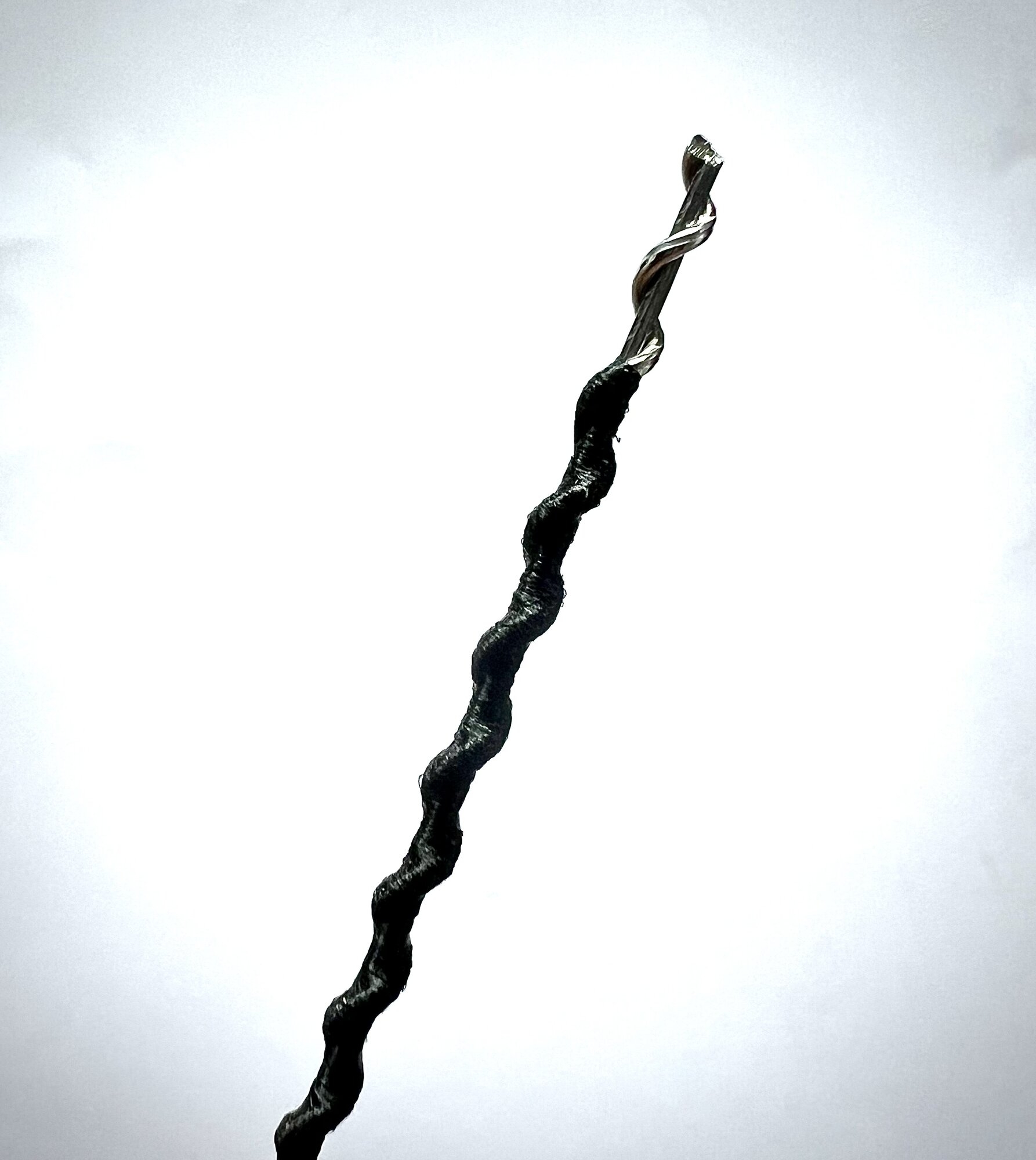
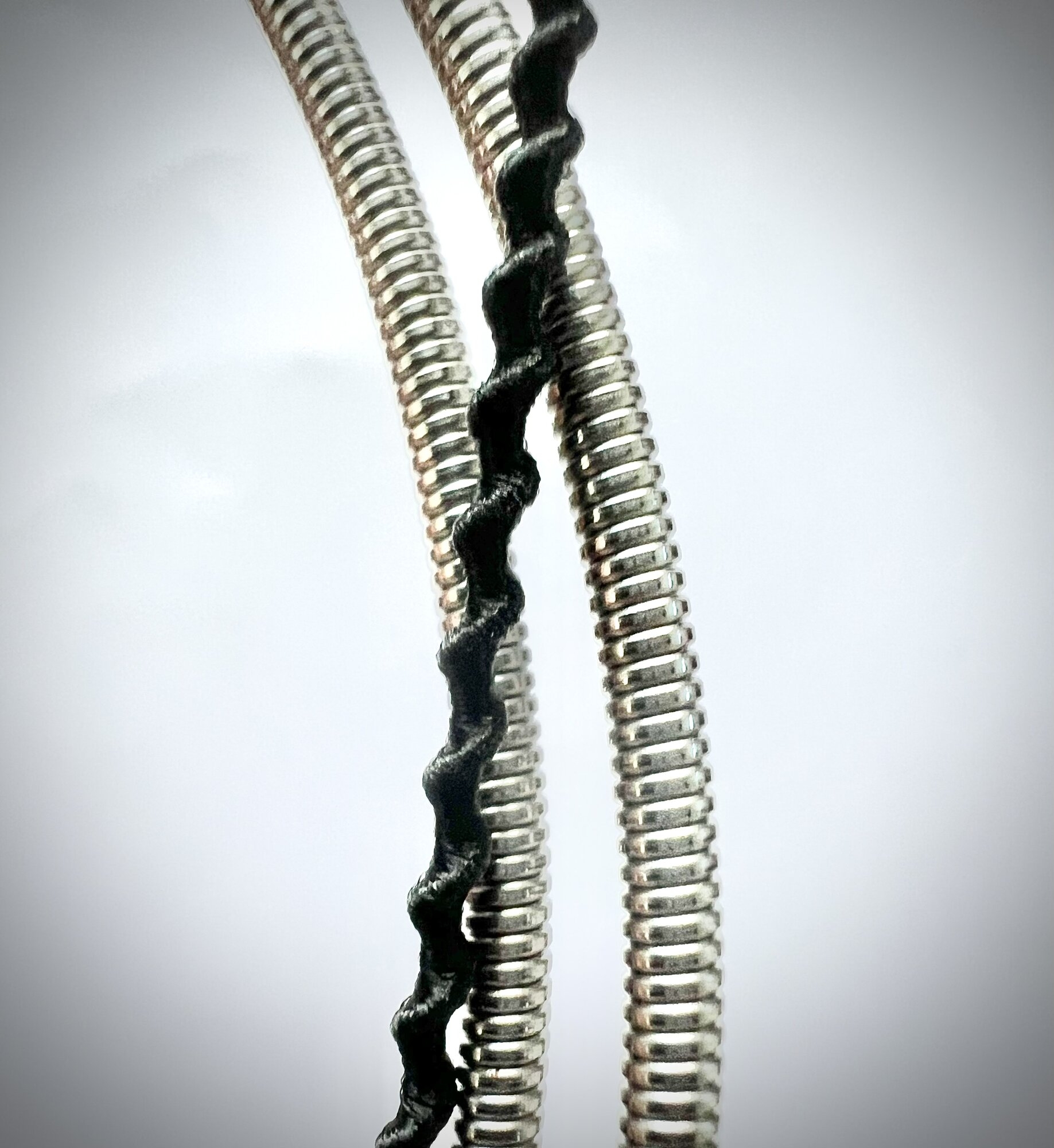
The particular pattern of spiral winding at the headstock end with the large thread “pitch” (gap between adjacent windings) extending right to the end and looking a bit like the Rod of Asclepius from Greek mythology, seems pretty characteristic for GHS strings across the range. Pressurewounds below….

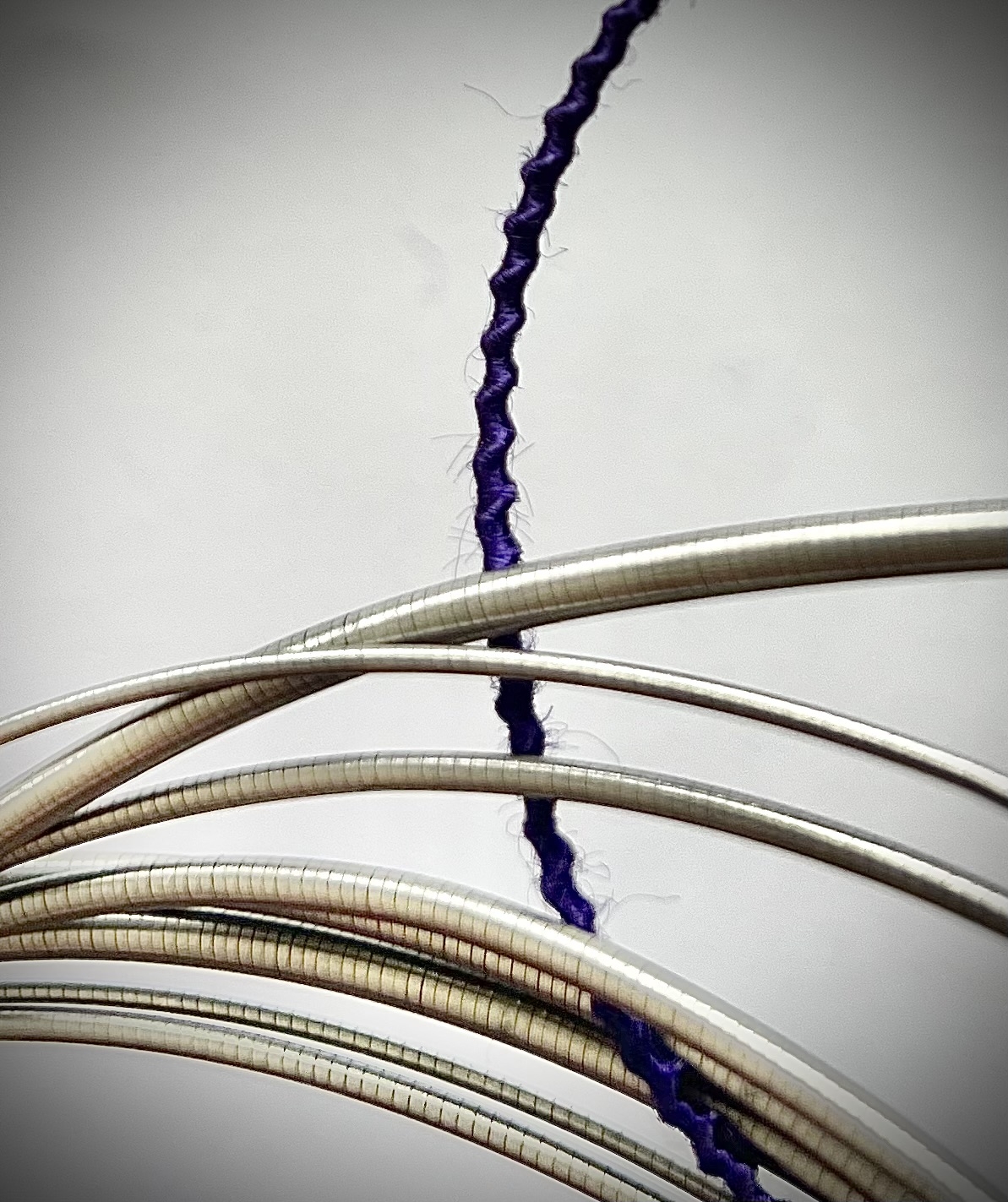
….and some GHS Precision Flats…
Early silked Dean Markleys have a similar design, although the spiral wraps are finer with narrower pitch.
Looking at your photos the surface profile seems a little flatter than the Pressurewounds I posted above, more like the old Polished Rounds. Here’s a pic of those (black silk) with current Brite Flats for comparison…the length of the silk at the ball end would seem similar to yours.
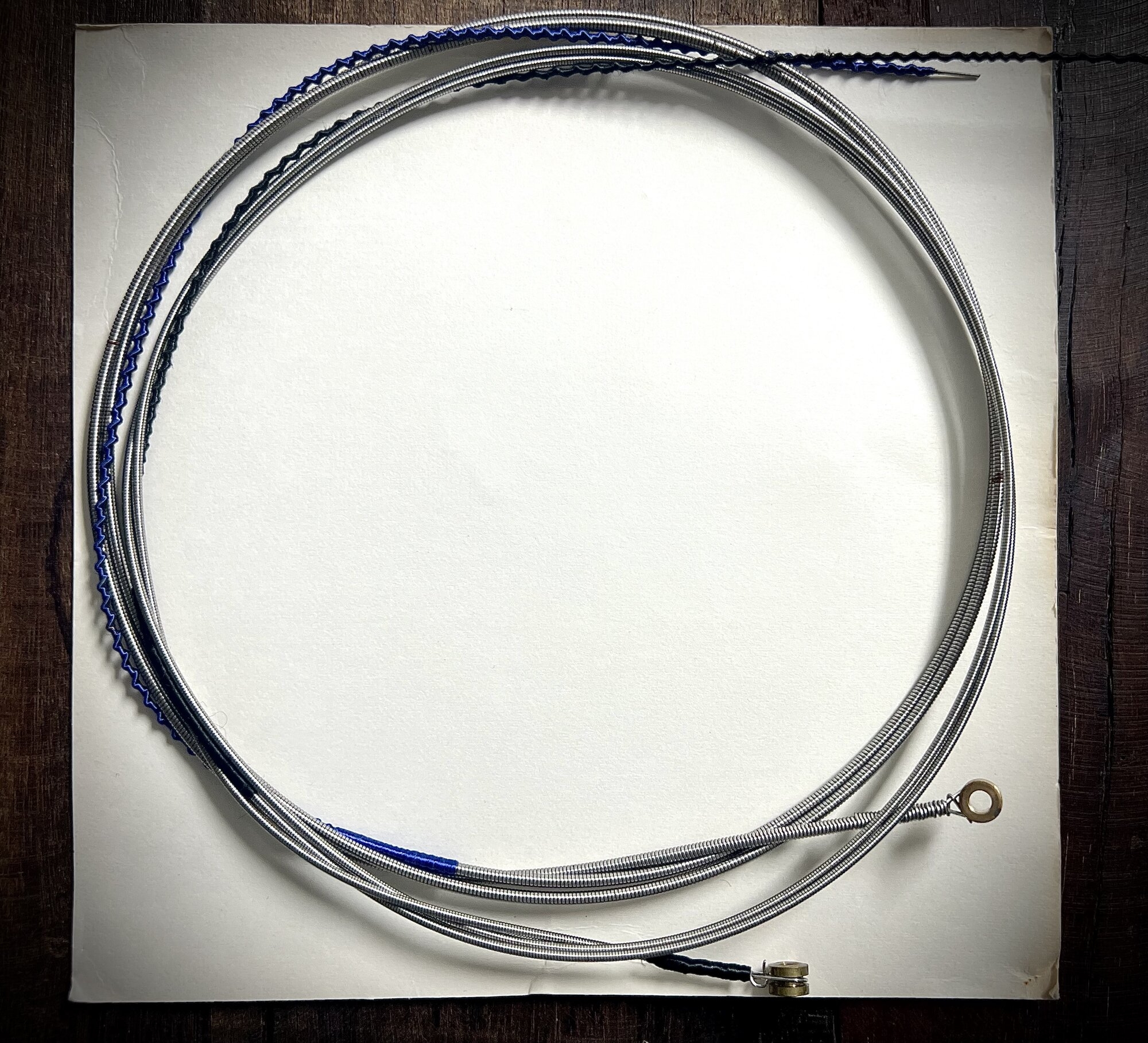
Winding length would possibly clinch it….the old polished rounds were 38 inch, while the Pressurewounds (at least the ones I have) are 37.25.
Of course, this could all be completely wide of the mark and they could be a private label produced for Warwick, as mentioned above.
I’ve got some earlier GHS Pressurewounds which have black silk at the headstock end only. I haven’t seen them with black at both ends, but I don’t doubt they may have been like that originally.
The particular pattern of spiral winding at the headstock end with the large thread “pitch” (gap between adjacent windings) extending right to the end and looking a bit like the Rod of Asclepius from Greek mythology, seems pretty characteristic for GHS strings across the range. Pressurewounds below….
….and some GHS Precision Flats…
Early silked Dean Markleys have a similar design, although the spiral wraps are finer with narrower pitch.
Looking at your photos the surface profile seems a little flatter than the Pressurewounds I posted above, more like the old Polished Rounds. Here’s a pic of those (black silk) with current Brite Flats for comparison…the length of the silk at the ball end would seem similar to yours.
Winding length would possibly clinch it….the old polished rounds were 38 inch, while the Pressurewounds (at least the ones I have) are 37.25.
Of course, this could all be completely wide of the mark and they could be a private label produced for Warwick, as mentioned above.
Last edited:
As I mentioned earlier, GHS PW did have black silk at both ends with 36.75" winding length prior to 2015. The very first set of PWs I tried back in 2015 were the older version. The ones newer than 2015 have black silk only at the tuner end with 37.25" winding length.I’ve got some earlier GHS Pressurewounds which have black silk at the headstock end only. I haven’t seen them with black at both ends, but I don’t doubt they may have been like that originally.
...while the Pressurewounds (at least the ones I have) are 37.25.
GHS I think….perhaps these are the old “Polished Rounds” which became Brite Flats…..they originally had black silk at both ends.
I’ve got some earlier GHS Pressurewounds which have black silk at the headstock end only. I haven’t seen them with black at both ends, but I don’t doubt they may have been like that originally.
The particular pattern of spiral winding at the headstock end with the large thread “pitch” (gap between adjacent windings) extending right to the end and looking a bit like the Rod of Asclepius from Greek mythology, seems pretty characteristic for GHS strings across the range. Pressurewounds below….
View attachment 7215780
View attachment 7215781
View attachment 7215784
….and some GHS Precision Flats…
View attachment 7215787
Early silked Dean Markleys have a similar design, although the spiral wraps are finer with narrower pitch.
Looking at your photos the surface profile seems a little flatter than the Pressurewounds I posted above, more like the old Polished Rounds. Here’s a pic of those (black silk) with current Brite Flats for comparison…the length of the silk at the ball end would seem similar to yours.
View attachment 7215789
I'm not familiar with this "Polished Rounds" you speak of; however, the ones in the OP's pic still look to me more like the Pressurewoud (= rollerwound) than the Brite Flats (groundwound/half-rounds).GHS I think….perhaps these are the old “Polished Rounds” which became Brite Flats…..they originally had black silk at both ends...
Here are the PW...


