• TalkBass has been independent since 1998. Add your voice.
    Create a free account to reply to discussions, view embedded media, and browse with fewer display ads.
    Join freeLog in
    Want zero display ads or expanded classifieds tools? Compare plans.

String number and their use

I get by very well on 4-strings. I GAS for a 5'er however , as I get good use of the low B in a band context with my 6-string, but find the high string of limited appeal with multiple guitars, mandolin, banjo, and bouzouki in the mix (not all at once but still...). And the 6-string neck is quite unforgiving , approach it wrong and it will hurt you - I am not sure if I could gig with it regularly without injuring myself -

so for me, at least insofar as band use, a 5'er is on my radar

as is better setup with my multi-FX to take advantage of octave down more strategically ~
 
I'll echo the comment by @nnnnnn, in that if your 5er didn't have those technical issues, then perhaps you would find it more enjoyable to work with.

But since you mentioned range, I wouldn't discount the 5er just because you don't play those low notes. IMHO, the primary advantage of a 5- (or more-) string bass is not the five extra semitones, but that you can get greater coverage across the strings without having to shift your hands up the fingerboard. On a 5er, you can go 2+ octaves across the fingerboard w/o shifting, verses the one-and-a-half octaves available with four-string basses.

I recommend learning to play with your fingers moved up on the fingerboard by five frets, effectively playing the bass as EADGC, which gives you that extra string when you need it to go higher. Then you can also dive down below the low E whenever you need to.

All of that said, if you find the extra width of the 5er's fingerboard (or the increased string density) not to your liking, then indeed, you may be more of a four-string player at heart. I'm a four-string guy myself, so I can relate.
 
Last edited:
I'll echo the comment by @nnnnnn, in that if your 5er didn't have those technical issues, then perhaps you would find it more enjoyable to work with.

But since you mentioned range, I wouldn't discount the 5er just because you don't play those low notes. IMHO, the primary advantage of a 5- (or more-) string bass is not the four extra semitones, but that you can get greater coverage across the strings without having to shift your hands up the fingerboard. On a 5er, you can go 2+ octaves across the fingerboard w/o shifting, verses the one-and-a-half octaves available with four-string basses.

I recommend learning to play with your fingers moved up on the fingerboard by five frets, effectively playing the bass as EADGC, which gives you that extra string when you need it to go higher. Then you can also dive down below the low E whenever you need to.

All of that said, if you find the extra width of the 5er's fingerboard (or the increased string density) not to your liking, then indeed, you may be more of a four-string player at heart. I'm a four-string guy myself, so I can relate.
Actually some brands do it crazily ,I mean fender 5 string neck is huge.Some brands like yamaha or Ibanez do this in a good way but some high quality ones make Big and chubby necks and they do not fit at all .
I do not know why but that is kind of shocking .
 
  • Like
Reactions: cheechi
yeah ,It has super comfortable neck .
I have narrow option for 5 string neck because most brands has crazy neck that are unplayable for me .(my label has a sadowsky and I can not even play it or same for fender basses ).
I should repair it (6th time this bass go for repair ) which is kind of weird because a lot of Yamaha bb415 owner are so happy and never face a problem but mine started with broken nut then broken toggle switch and the electronic problem and now input jack and a dead pickup .[/QUOTE]

Actually some brands do it crazily ,I mean fender 5 string neck is huge.Some brands like yamaha or Ibanez do this in a good way but some high quality ones make Big and chubby necks and they do not fit at all .
I do not know why but that is kind of shocking .
Odd, all those issues you have had with the Yamaha. I have owned a couple over the years (BX4, and BX-5, both a bit different for Yamaha, being headless basses). Their neck were, actually, too narrow, but I got used to them; the BX-5 was my first 5 string bass I ever owned, I got it in 1987, so there wasn't much available in the 5 string market at that time.

Fender, and Fender derived, 5 string basses do have huge necks, especially so as you go up the neck towards the body. I would have bought a Roscoe Beck bass, except for that.

I have both 4 and 5 string basses and comfortably switch back and forth, but, I have been doing so for over 30 years now; in the early days, it did trip me up occasionally, but that was probably due to my sticking one or the other for extended periods of time. Alternating playing them daily is what makes it easy, now.

Even though you have problems with the BB415, you can still use it to practice with and, try the idea of using the B string more as a means of greater range from the low E note and up for easier facility with string crossing to higher notes, rather than just looking at the B string for those few extra low notes. Plus, the sound of the B string, even higher up the neck, is fatter sounding, something I make use of for tonal reasons.
 
  • Like
Reactions: wishforbass
I've had nothing but good luck with Yamaha basses, but lemons happen of course.
I wanted to try fretless but by chance I bought a 5-string OLP pawnshop bargain instead.
My fangers ain't so great so the close string spacing means I must use only the index finger. Too crowded to use normal two-finger-style like I play my 4-stringers.
Fretboard is crowded but rather thin so not that big a handful. I prefer narrow Jazz/Ibby necks so the 5-string neck was good. Weight is not even excessive.
Of course I have no clue on how to use that phat B string-still trying to learn four.
And playing a crowded fretboard with just the index finger sounds silly.
Except this is an official clone of an Ernie Ball Musicman Stingray 5-string. It can't match the EBMM for tone but it does sound good.
So I got a bass with good tone and playability for $160usd. The 5th string was a (happy?) accident.
And maybe some day I'll learn to use that B string. After I learn four strings I guess, if that ever happens.
So I can't advise you, my 5-string buy was just luck. Remains to be seen if I can use that string some day.
Good luck.
 
  • Like
Reactions: wishforbass
I've had nothing but good luck with Yamaha basses, but lemons happen of course.
I wanted to try fretless but by chance I bought a 5-string OLP pawnshop bargain instead.
My fangers ain't so great so the close string spacing means I must use only the index finger. Too crowded to use normal two-finger-style like I play my 4-stringers.
Fretboard is crowded but rather thin so not that big a handful. I prefer narrow Jazz/Ibby necks so the 5-string neck was good. Weight is not even excessive.
Of course I have no clue on how to use that phat B string-still trying to learn four.
And playing a crowded fretboard with just the index finger sounds silly.
Except this is an official clone of an Ernie Ball Musicman Stingray 5-string. It can't match the EBMM for tone but it does sound good.
So I got a bass with good tone and playability for $160usd. The 5th string was a (happy?) accident.
And maybe some day I'll learn to use that B string. After I learn four strings I guess, if that ever happens.
So I can't advise you, my 5-string buy was just luck. Remains to be seen if I can use that string some day.
Good luck.

It'll be easier for you iif you learn to play with 5 string from the start.

It's not just an extra string, it requires a somewhat different approach.

Just a good piece of advice.
 
Actually some brands do it crazily ,I mean fender 5 string neck is huge. Some brands like yamaha or Ibanez do this in a good way but some high quality ones make Big and chubby necks and they do not fit at all .
I do not know why but that is kind of shocking .
It's not crazy: the reason various companies make five- and six-string basses with wide necks is because a lot of players want to have exactly the same string spacing as on a standard four-string Fender Precision or Jazz bass. I don't find that shocking.

Funny you mention Yamaha as not having this "problem", because some of their fivers do have pretty wide string spacing and thus wide necks.

It's just a matter of preference though. There are a number of brands that do narrow spacing, so stick to those. Personally I prefer a medium string spacing, but with good fretting-hand thumb position a wide five-string neck isn't uncomfortable.

(If I've misunderstood and you are talking about thickness front-to-back rather than width across the fingerboard then I'd say that I have not found five-string necks to be noticeably thicker than four-string necks regardless of brand.)
 
  • Like
Reactions: wishforbass
If I read you original post right, you have a 5 string bass which isn't functioning correctly. Parts of it are broken.

So you prefer to play a fully functioning bass rather than one that isn't. Given your situation I think we'd all be playing the 4 string.

Don't blame the instrument, get it fixed then decide if a 5 string bass is what you want to play.
 
It's not just an extra string, it requires a somewhat different approach.
Right, it can be used as a long thumb rest.................... :D

That's exactly what I told a guy I know a few years ago when he was reluctant to try one of my 5 string basses (he'd never played one, before). With that good piece of advice of mine in his head, he picked the bass up and proceeded to to it flawlessly. :thumbsup:
 
If you have a bass that's always having work done on it, has an extra string you rarely use and are wondering whether or not to replace it. I'd say replace it with a four string. The comfort of a narrow five string neck would be about the same as a wide four string neck. Depending on what your other bass is, either a P or J would do. Hope this helps.
 
  • Like
Reactions: wishforbass
Not all 5s are alike. Played a yamaha 5 string once and the "normal" 4 strings sounded awesome, but the B was just outright dull. on that particular bass it's just a thumb rest. On my Ray 35 it's awesome and sounds just as bright as the rest.

Then again, if you don't have the need for it, by all means, go for a 4. My next will be a 4 too. Been playing 5s for about 12 years, but both have advantages.
 
What do I think? Well..
If you really, honestly have no need for a 5 string bass - even one that works - and don't want to try some of the alternate tunings that others have suggested? Then, by all means; sell it and get a 4-stringer. For me, personally?
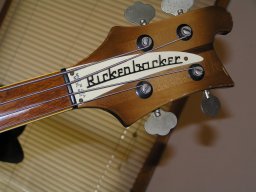
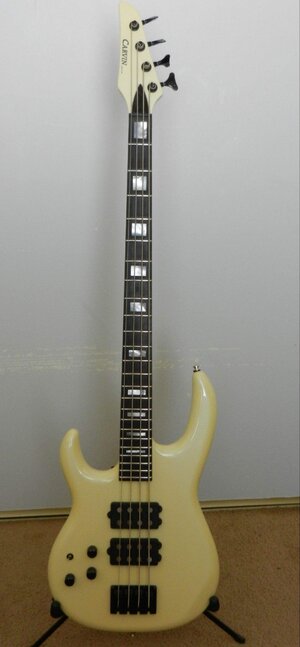
'73 Ric 4001-2.JPGCarvin LB-20 1.JPG I learned to play bass on one of these Rickenbacker 4001s way back in 1969, and I've never, ever felt that I needed a 5 string bass. No music that I've ever played - even when I was in a band - needed, or would have been easier to play, on a 5 string bass. And, neither does any of the music I like to play now. 4 strings work just fine - for Me - and always have. I have one bass (this "white" Carvin LB-20) that I strung BEAD, just as an experiment. I don't really like it; I don't play it much; and, it's probably not going to stay that way much longer... But, I fully understand - and appreciate - that 4 strings don't work so well for some other people and their music. If you are not one of those people? Then, I'd say - yes, you need a different bass. But, I wouldn't get another 5 stringer; if you don't play the one you have, I seriously doubt you'll play the new one, either. Don't buy one just because somebody tells you that "you have to have one"; even if you really don't. Yes, two basses are always nicer than one bass. But only if you like to play both of them...:cool:
 
Last edited: